


Introduction
Global grain production exceeds 2.8 billion metric tons per year, yet an estimated 10–15% is lost or downgraded due to foreign matter, diseased kernels, and discoloration. For grain and food processors, the difference between a premium shipment and a rejected lot often comes down to one stage: optical sorting.
Chute-type color sorters are the backbone of modern grain cleaning lines. Unlike gravity tables or sieves that separate by weight or size, optical sorting technology discriminates by color, shape, and surface defects at throughputs mechanical methods cannot match. The USDA Agricultural Research Service (ARS) has shown that image-based electronic color sorters process up to 2,000 lb/hr of wheat with 10–20% higher accuracy than conventional sorters when separating red and white wheat 1.
This guide explains how a chute type color sorter works—from optical detection through signal processing to pneumatic ejection—drawing on JIACUI's VALUESORT (悦选) series, serving processors in 50+ countries.
What Is a Chute-Type Color Sorter?
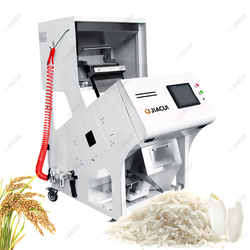
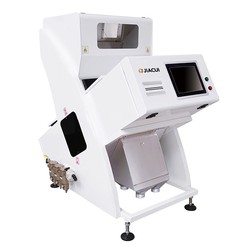
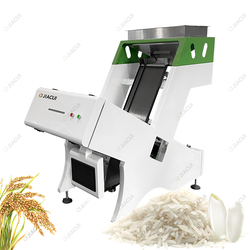
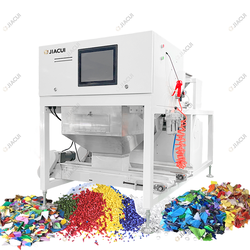
A chute-type color sorter is an automated machine that uses high-speed optical sensors to inspect individual grain or food particles as they slide down a tilted chute in free fall, then ejects defective particles using a burst of compressed air. The term "chute-type" distinguishes this from belt-type sorters where material travels on a conveyor. In a chute-type sorter, material slides along a V-shaped channel forming a single-layer curtain the camera array inspects without occlusion.
Core Components and Architecture
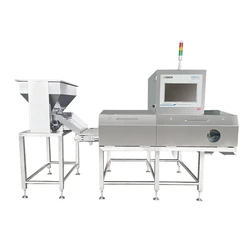
A modern grain color sorter comprises five integrated subsystems:
- Vibrating Feeder System — Dual vibrating feeders spread material evenly across multiple chutes, ensuring a uniform single-layer curtain. Uneven feeding is the leading cause of false rejects.
- Chute Assembly — A precision 304 stainless steel channel angled at 55–65 degrees. Chute width and channel count determine throughput.
- Optical Detection System — An array of line-scan CCD cameras and LED lighting modules on one or both sides of the material curtain.
- Image Processing System — A dedicated FPGA-based computing unit that acquires camera data, analyzes pixels in real time, and generates ejection commands at microsecond latency.
- Pneumatic Ejection System — High-frequency solenoid valves and precision nozzles at the chute bottom. When the FPGA detects a defective particle, the corresponding valve opens for 0.5–2 milliseconds, firing a compressed-air jet that deflects the particle into the reject stream.
The Four-Stage Sorting Process (Feeding → Optical Detection → Signal Processing → Pneumatic Ejection)
The sorting cycle repeats thousands of times per second:
- Feeding — Material enters the hopper, is regulated by the vibrating feeder, and slides down the chute as a thin, single-layer curtain.
- Optical Detection — As each particle passes the camera window, the CCD sensor captures a high-resolution line image under consistent LED illumination.
- Signal Processing — The FPGA compares each particle's optical signature against a stored reference template. If pixel data deviates beyond a user-defined threshold, the particle is classified as defective and its time-of-flight to the nozzle is calculated.
- Pneumatic Ejection — After the calculated delay, the nearest solenoid valve fires a brief air pulse. Good particles continue into the "accept" stream; defective particles are deflected into the "reject" stream.
The Optical Detection System: How CCD Cameras See Defects
Toshiba CCD Sensors: 5400×12K Resolution
JIACUI VALUESORT sorters employ Toshiba CCD line-scan cameras imported from Japan, achieving 5,400 × 12K-pixel resolution in full-color (RGB) high-speed line scanning mode. A single scan line captures 5,400 pixels across the chute width; the sensor scans up to 12,000 lines per second, producing tens of megapixels per second per camera.
This resolution directly determines the smallest detectable defect. Industry research confirms that CCD-based color sorters convert material images into electronic signals processed by dedicated image processing systems to identify and eject defective particles via high-speed pneumatic valves 2. Bühler's SORTEX line combines full-color cameras with InGaAs sensors for foreign matter detection, achieving up to 50% higher reject concentrations than monochromatic systems.
Identifying 0.03mm² Disease Spots
With 5,400-pixel line resolution across a typical chute width of 300–400mm, each pixel covers approximately 0.06–0.07mm of material width. The VALUESORT system's multi-megapixel color CCD sensor can identify disease spots as small as 0.03mm²—roughly the size of a pinhead. In high-sensitivity mode, full-color image sensors detect spots down to 0.01mm².
This capability is critical where surface defects are subtle. In rice processing, the difference between a premium head-rice kernel and a rejected one may be a single light-yellow spot from early-stage fungal infection. Traditional monochromatic sorters miss these; full-color RGB sensors detect them reliably.
Image Processing: From Light Signals to Ejection Commands
Altera FPGA Chips and Real-Time Processing
The image processing unit is the "brain" of the color sorting machine. JIACUI VALUESORT machines use Altera Cyclone IV FPGA chips (imported from the USA) for real-time image processing. FPGAs are preferred over general-purpose CPUs because they perform parallel pixel processing at deterministic, sub-microsecond latency.
The processing pipeline works as follows:
- The FPGA receives raw pixel data from the CCD sensor via a high-speed digital interface (typically LVDS or Camera Link).
- Each pixel is analyzed for RGB color values, compared against a reference template, and classified as "accept" or "reject" based on configurable thresholds for color deviation, size, and shape. The FPGA then calculates the time delay to the particle's arrival at the nozzle position.
This entire cycle—from detection to ejection command—occurs in under 1 millisecond. The FPGA processes multiple channels simultaneously, enabling machines with 8–10 channels (CS-8A, CS-10A) to achieve throughputs of 7–10 tons per hour.
JIACUI's image processing system includes an industry-unique light-color sorting mode for detecting light yellow, diseased, dark, and black rice, achieving a first carry-out ratio of ≥1:1 and a second carry-out ratio of ≥15:1. An original color + shape sorting mode enables simultaneous white rice and broken rice separation in a single pass.
AI Deep Learning and Pattern Recognition
Recent VALUESORT models incorporate AI deep learning algorithms that learn to distinguish good from defective products through training, automatically classifying particles while recording statistics. Traditional threshold-based systems require manual recalibration when switching materials (e.g., rice to coffee). An AI-trained system stores 90 groups of parameters, switchable via touchscreen or remote APP, reducing changeover from hours to minutes.
The Pneumatic Ejection System: Precision at Millisecond Speed
High-Frequency Solenoid Valves (120:1 Carry-Out Ratio)
The ejection system must open and close valves thousands of times per second. VALUESORT machines use high-frequency solenoid valves engineered for a carry-out ratio of ≥120:1 and a service life of up to 12 billion actuations.
The carry-out ratio is a critical metric: 120:1 means that for every 120 defective particles detected, no more than 1 good particle is accidentally ejected. Valve response time is 0.5–2 milliseconds. At a slide velocity of approximately 2–3 m/s, a 1ms valve opening affects only a 2–3mm segment of the material curtain—precise enough to eject a single 6mm rice grain without disturbing its neighbors.
Nozzle Array Design: From 32 to 640 Air Holes
The number of air holes (nozzles) scales with channel count and capacity. The table below shows how nozzle arrays scale across the VALUESORT range:
| Model Category | Air Holes | Channels | Typical Application | Nozzle Pitch (approx.) |
|---|---|---|---|---|
| CS-HA32 | 32 | Semi-chute | Laboratory / pilot | ~10mm |
| CS-1A64–1A80 | 64–80 | 1 | Small mill | ~5–6mm |
| CS-2A128 | 128 | 2 | Small-to-medium mill | ~5mm |
| CS-3A–4A | 192–256 | 3–4 | Medium processing line | ~5mm |
| CS-6A | 384 | 6 | Large mill | ~4–5mm |
| CS-10A | 640 | 10 | Industrial-scale plant | ~4–5mm |
More air holes allow finer spatial resolution in ejection, improving the carry-out ratio at higher throughputs. The nozzle array uses 304 stainless steel with an automatic glass cleaning system preventing dust accumulation on optical surfaces—a common cause of sensitivity drift.
JIACUI VALUESORT Chute-Type Model Lineup
The VALUESORT series spans ten models, from benchtop laboratory units to industrial-scale multi-channel machines. All models share these baseline specifications:
- Color sorting accuracy: ≥99%
- Voltage: 220V / 50Hz (configurable for export markets)
- Air source pressure: 0.6–0.8 MPa
- Standard features: Ultra-low carry-out rate, automatic dust removal, remote debugging, dual vibrating feeders
Complete Parameter Table
| Model | Channels | Cameras | Air Holes | Power (kW) | Capacity (T/H) | Weight (KG) | Dimensions (mm) | Screen | Footprint (m²) |
|---|---|---|---|---|---|---|---|---|---|
| CS-HA32 | Semi-chute | 2 | 32 | 0.7 | 0.25 | 105 | 450×1100×1500 | 12" | 0.5 |
| CS-1A64 | 1 | 2 | 64 | 1.0 | 0.8–1.5 | 157 | 800×1260×1550 | 12" | 1.0 |
| CS-1A80 | 1 (re-sort) | 2 | 80 | 1.5 | 0.8–1.5 | 189 | 820×1720×1550 | 12" | 1.4 |
| CS-2A128 | 2 | 4 | 128 | 1.8 | 1.2–2.5 | 290 | 1152×1697×1708 | 12" | 2.0 |
| CS-3A | 3 | 6 | 192 | 2.6 | 2.5–4 | 640 | 1620×1490×1690 | 15" | 2.4 |
| CS-4A | 4 | — | 256 | 3.2 | 3–5.5 | 780 | 1940×1490×1690 | 15" | 2.9 |
| CS-5A | 5 | — | 320 | 4.0 | 4–8 | 920 | 2260×1490×1690 | 15" | 3.4 |
| CS-6A | 6 | 12 | 384 | 5.6 | 5–9 | 1060 | 2580×1490×1690 | 15" | 3.8 |
| CS-8A | 8 | 16 | 512 | 5.5 | 7–10 | 1580 | 3034×1518×1650 | 15" | 4.6 |
| CS-10A | 10 | 20 | 640 | 7.0 | 7–10 | 1940 | 3634×1518×1650 | 15" | — |
Small-Scale Models (CS-HA32 to CS-2A128): For SMEs and Laboratories
The CS-HA32 is a semi-chute model for laboratory analysis and small-batch specialty grain operations. At 105 kg and 0.5 m², it processes 0.25 T/H. The CS-1A64 and CS-1A80 serve small mills at 0.8–1.5 T/H; the CS-1A80 adds a re-sort function that re-inspects the reject stream to recover good grain. The CS-2A128 introduces dual-channel operation with 4 cameras and 128 air holes, achieving 1.2–2.5 T/H for continuous production-line integration.
Mid-Range Models (CS-3A to CS-5A): For Medium Processing Lines
The CS-3A, CS-4A, and CS-5A target medium-sized rice mills handling 2.5–8 T/H. These models feature 15" touchscreens, 3–5 channels, and 192–320 air holes. The CS-3A upgrades to 6 cameras for dual-side inspection where defects appear on only one surface (e.g., beans, nuts). Footprint ranges 2.4–3.4 m², suitable for retrofits without major modifications.
High-Capacity Models (CS-6A to CS-10A): For Industrial-Scale Operations
The CS-6A through CS-10A target large-scale plants processing 5–10 T/H. The flagship CS-10A features 10 channels, 20 cameras, 640 air holes, weighing 1,940 kg at 3,634 × 1,518 × 1,650 mm. These machines are deployed in rice milling complexes, grain terminals, and contract processing facilities, operating on standard utilities (0.6–0.8 MPa air, 220V/50Hz) beyond a 7–10 m³/min compressor.
Applications Across Industries
While rice is the most common application, a chute type color sorter handles diverse materials:
- Rice: Separating discolored, diseased, dark, and black kernels from premium head rice; color + shape mode separates broken rice by length.
- Grains: Wheat, corn, barley, oats—removing foreign grains and discolored kernels.
- Beans, nuts, seeds: Kidney beans, mung beans, almonds, peanuts—removing shell fragments and discolored nuts.
- Coffee: Sorting green beans to remove black, sour, or insect-damaged beans before roasting.
- Spices, seafood, herbal medicines: Dried chili, peppercorns, dried shrimp, medicinal herbs—color uniformity indicates grade and safety.
The 90-group parameter memory allows switching between applications by selecting a stored profile.
Meeting Food Safety Standards: HACCP and Beyond
Color Sorting as a Critical Control Point
The U.S. Food and Drug Administration (FDA) defines seven HACCP principles, among which Principle 3 requires establishing critical limits at each Critical Control Point (CCP) 3. In grain processing, color sorting frequently serves as a CCP—the last opportunity to remove physical hazards (foreign matter, diseased kernels, mycotoxin-contaminated particles) before packaging.
For HACCP compliance, a color sorting machine must meet three criteria:
- Measurable critical limit: Sorting accuracy (≥99% in VALUESORT machines) is quantifiable and recordable.
- Monitoring procedure: The AI system's automatic good/defective counting provides real-time data.
- Corrective action: When accuracy drops (e.g., from dust), the automatic glass cleaning system and remote debugging enable rapid correction without stoppage.
USDA ARS Validation of Sorting Accuracy
The USDA ARS has conducted comparative studies of electronic color sorters for wheat processing, finding that image-based sorting systems achieve 10–20% higher accuracy than traditional commercial sorters when separating red and white wheat, processing up to 2,000 lb/hr 1. This validates the core premise of CCD-based optical sorting: higher sensor resolution and full-color detection yield measurable accuracy improvements over monochromatic or mechanical methods.
Why Remote Debugging Matters for Global Operations
For processors in remote regions, downtime can mean days of lost production. VALUESORT machines address this with WiFi remote control, enabling JIACUI engineers to adjust sorting thresholds, camera gain, and ejection timing without on-site visits. The system transmits operational data for remote diagnosis of sensitivity drift, valve failures, or feeding irregularities, and recalls stored profiles when materials change.
For JIACUI's 50+ country customer base, where time zones and travel logistics delay on-site support, remote debugging reduces mean time to repair (MTTR) from days to hours.
Conclusion
Chute-type color sorters represent the convergence of optics, electronics, and pneumatic engineering indispensable to modern grain processing. The technology transforms visible light reflected from each kernel into electronic signals, processes them through FPGA-based image analysis at sub-millisecond latency, and executes precisely timed pneumatic ejection to remove defective particles—all at throughputs up to 10 tons per hour.
For processors evaluating a grain color sorter, key parameters include: sensor resolution and type (CCD vs. CMOS, monochromatic vs. full-color RGB), carry-out ratio, air hole count, processing latency, and AI-based adaptive learning. JIACUI's VALUESORT series—with 21 national patents, Toshiba CCD sensors, Altera Cyclone IV FPGA processing, and 12 billion-cycle solenoid valves—meets these criteria from laboratory sampling to industrial-scale production.
To request a model recommendation, technical consultation, or quotation:
- Website: www.jcsorter.com
- Email: jiacuichen10@gmail.com
- Phone / WhatsApp: +86-13837166065
- Company: Zhengzhou Jiacui Machinery Equipment Co., Ltd.
About the Author
This technical guide is produced by the engineering team at Zhengzhou Jiacui Machinery Equipment Co., Ltd., a manufacturer with 20+ years of experience in optical sorting. JIACUI employs 30+ senior engineers, holds 21 national patents and 3 industry standards, and reinvests 12% of annual revenue into R&D. VALUESORT products carry CE and ISO certifications, deployed in 50+ countries across rice, grain, nut, coffee, and spice processing.
References
- USDA Agricultural Research Service. *Electronic Color Sorting of Wheat.* ARS Publications. https://www.ars.usda.gov/research/publications/publications.htm?SEQ_NO_115=234931
- Bühler Group. *SORTEX Optical Sorting Technology.* https://www.buhlergroup.cn
- U.S. Food and Drug Administration. *HACCP Principles & Application Guidelines.* https://www.fda.gov/food/hazard-analysis-critical-control-point-haccp/haccp-principles-application-guidelines