
- Home
-
Products Center
Products Center
-
Solutions
Solutions
- Service Support
- News Center
- About Us
- Contact Us


High-Precision AI Coffee Bean Color Sorter Machine
Intelligent optical sorting for green, parchment, and roasted coffee beans. Eliminate discolored beans, broken shells, and foreign impurities with ≥99% sorting accuracy.
- ≥99% Sorting Accuracy — 5400×12K Full-Color AI Line-Scan Camera
- Dual Applications — Tailored for both Green Beans & Fragile Roasted Beans
- High Capacity — From 20 kg/h Mini Units to 5 T/H Industrial Models
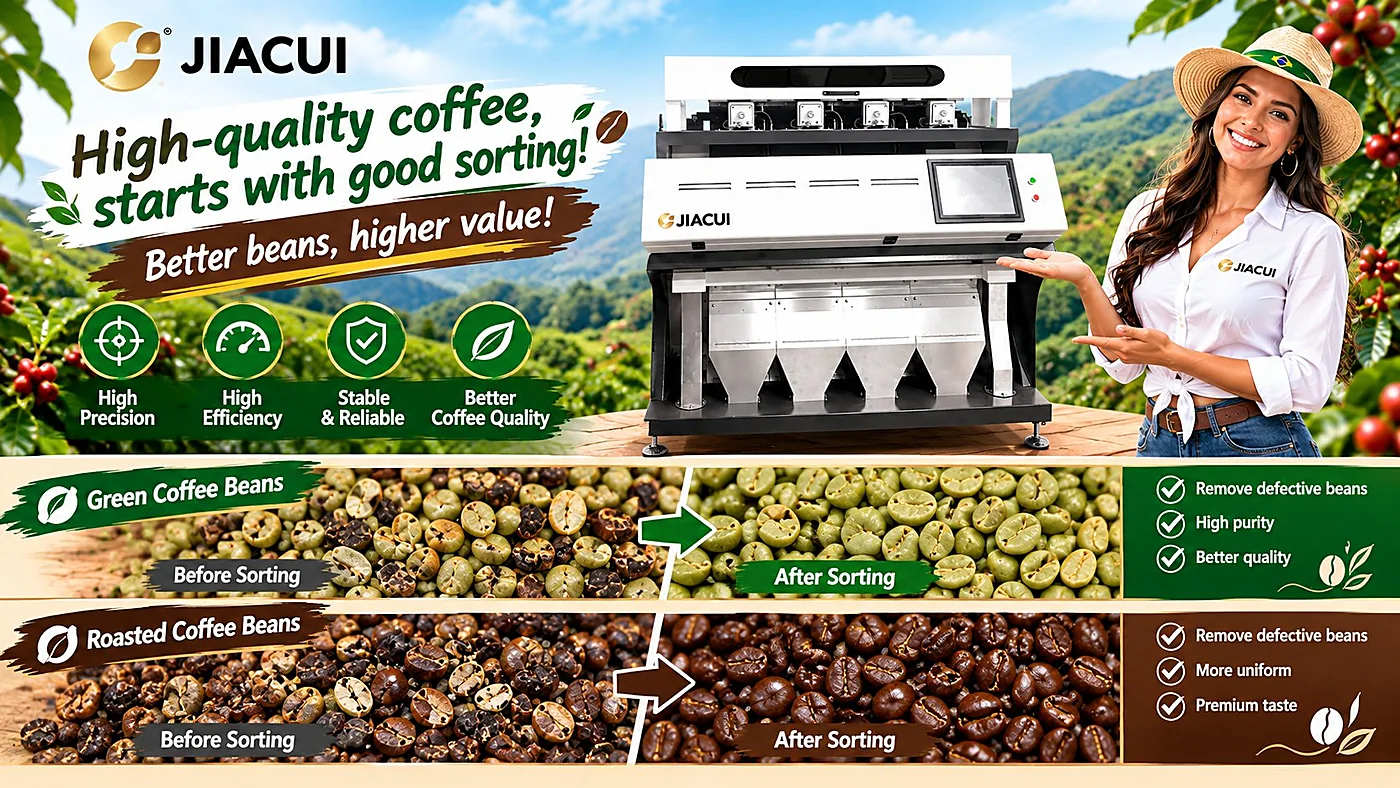
Comprehensive Defect Removal for Green & Roasted Coffee Beans
Our AI-powered optical color sorting technology detects tiny color variations, physical defects, and foreign materials that traditional graders miss.
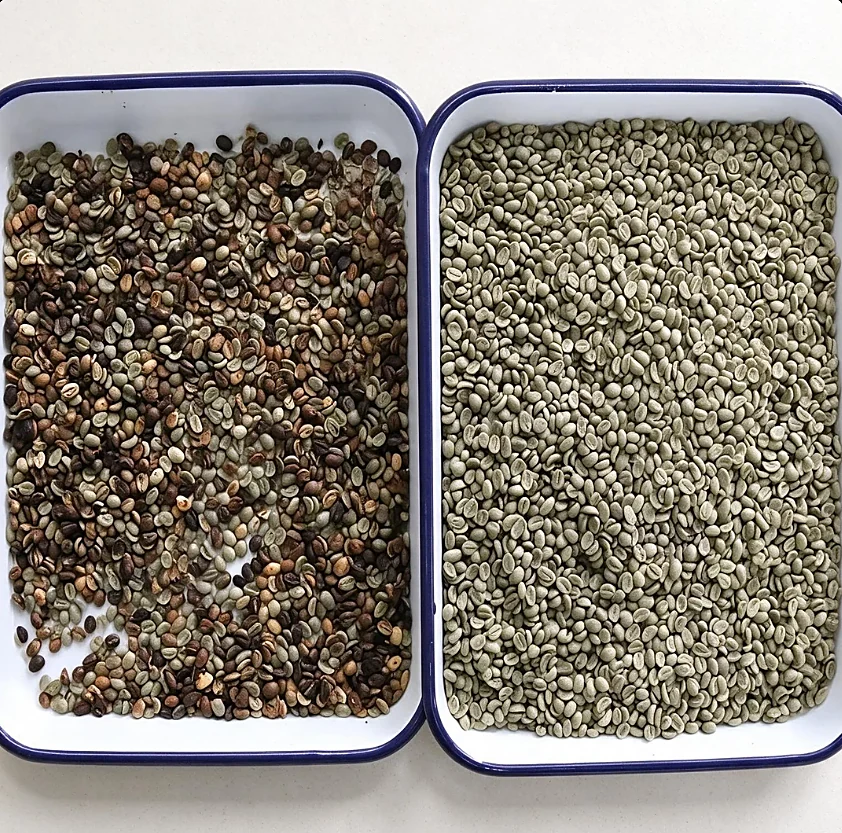
Green Coffee Bean Sorting
Primary Defects
Black beans, sour beans, moldy / fungus-damaged beans, insect-damaged (broca) beans.
Secondary Defects
Broken / chipped beans, immature / floater beans, parchment shell.
Foreign Materials
Stones, twigs, metal fragments, glass, and dust.
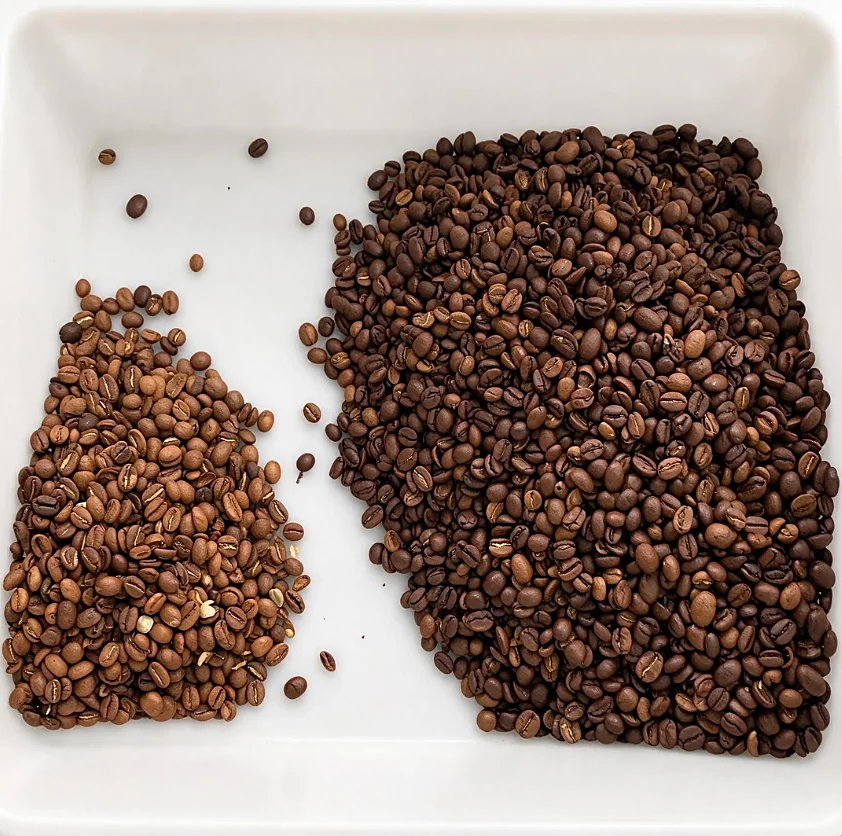
Roasted Coffee Bean Sorting
Quakers & Pale Beans
Under-roasted or immature beans that spoil espresso flavor.
Over-roasted / Burnt Beans
Charred beans affecting roast uniformity.
Physical Imperfections
Cracked beans, husk, broken shells.
Technical Specifications of JIACUI Coffee Bean Color Sorters
Typical configurations for coffee processing lines of every scale, from craft roasters to industrial export mills.
| Model | Type / Air Holes | Capacity (Tons/Hour) | Sorting Accuracy | Power (kW) | Application |
|---|---|---|---|---|---|
| CS-QB16 | Mini Chute / 16 Air Holes | 20 – 100 kg/h | ≥ 99% | 0.2 | Sample Labs, Small Roasters |
| CS-1A64 | 1 Chute / 64 Air Holes | 0.8 – 1.5 T/H | ≥ 99% | 1.0 | Coffee Farms, Craft Roasters |
| CS-2A128 | 2 Chutes / 128 Air Holes | 1.2 – 2.5 T/H | ≥ 99% | 1.8 | Commercial Processing Plants |
| CS-4A | 4 Chutes / 256 Air Holes | 3 – 5 T/H | ≥ 99% | 3.2 | Industrial Export Mills |
| CS-5A | 5 Chutes / 320 Air Holes | 4 – 8 T/H | ≥ 99% | 4.0 | Large Industrial Plants |
| CS-LA300 | Belt (Crawler) 30cm×2, Single Layer | 1.2 – 1.8 T/H | ≥ 99% | 1.75 | Fragile Roasted & Specialty Coffee |
Specifications from the official JIACUI product brochure (baseline: polished japonica rice with 2% impurities). Actual coffee performance varies with bean type and impurity content — send us a sample for a free test report. Larger chute models (CS-3A – CS-7A, up to 12 T/H) and belt models (CS-LA600 / LA1200) available on request.
Explore detailed datasheets: CS-1A64 | CS-2A128 | CS-4A (256 Channels) | CS-5A (320 Channels) | Mini CS-QB16
Chute Type vs. Belt Type: Choosing the Right Coffee Sorter
Different coffee materials call for different sorting physics. Compare the two technologies and match one to your process.
| Features / Specs | AI Chute Type Color Sorter | AI Belt Type Color Sorter |
|---|---|---|
| Best Application | High-volume green coffee beans & parchment | Fragile roasted coffee beans & premium specialty coffee |
| Key Advantage | Higher throughput, cost-effective, multi-chute scalability | Zero impact damage, stable bean orientation, ultra-gentle sorting |
| Capacity Range | 0.25 – 5.0 Tons / Hour (model dependent) | 1.2 – 3.5 Tons / Hour (CS-LA300 / CS-LA600) |
| Detection Tech | 5400×12K Full-Color Line-Scan CCD + AI Deep Learning | AI CCD Dual-Vision + Ultra-Gentle Crawler Conveying |
| Recommended Model | View Chute Series → | View Belt Series → |
Choose Chute Type if…
You operate an export mill, washing station, or dry mill processing high volumes of green coffee beans — where throughput speed and multi-pass sorting efficiency are top priorities.
Choose Belt Type if…
You operate a commercial roasting plant or handle high-value specialty roasted coffee — where avoiding bean breakage, chipping, and surface scuffing is essential.
Complete Guide to Coffee Bean Optical Sorting: Quality, Technology & ROI
The in-depth knowledge our sorting engineers compiled for coffee mills, exporters, and roasters — from defect science to return on investment.
In the competitive global coffee market, consistency, purity, and grade compliance dictate profitability. Whether processing raw parchment coffee, green coffee beans for export, or roasted specialty beans, defect control remains one of the greatest operational challenges for coffee mills and roasters. Traditional grading methods — manual hand-picking or mechanical rotary screening — are labor-intensive, costly, and incapable of detecting subtle colour micro-differences, density anomalies, or hidden internal flaws. This is where next-generation AI optical sorters come in: up to 99.9% purity while dramatically cutting carry-over loss.
What Is a Coffee Bean Color Sorter and How Does It Work?
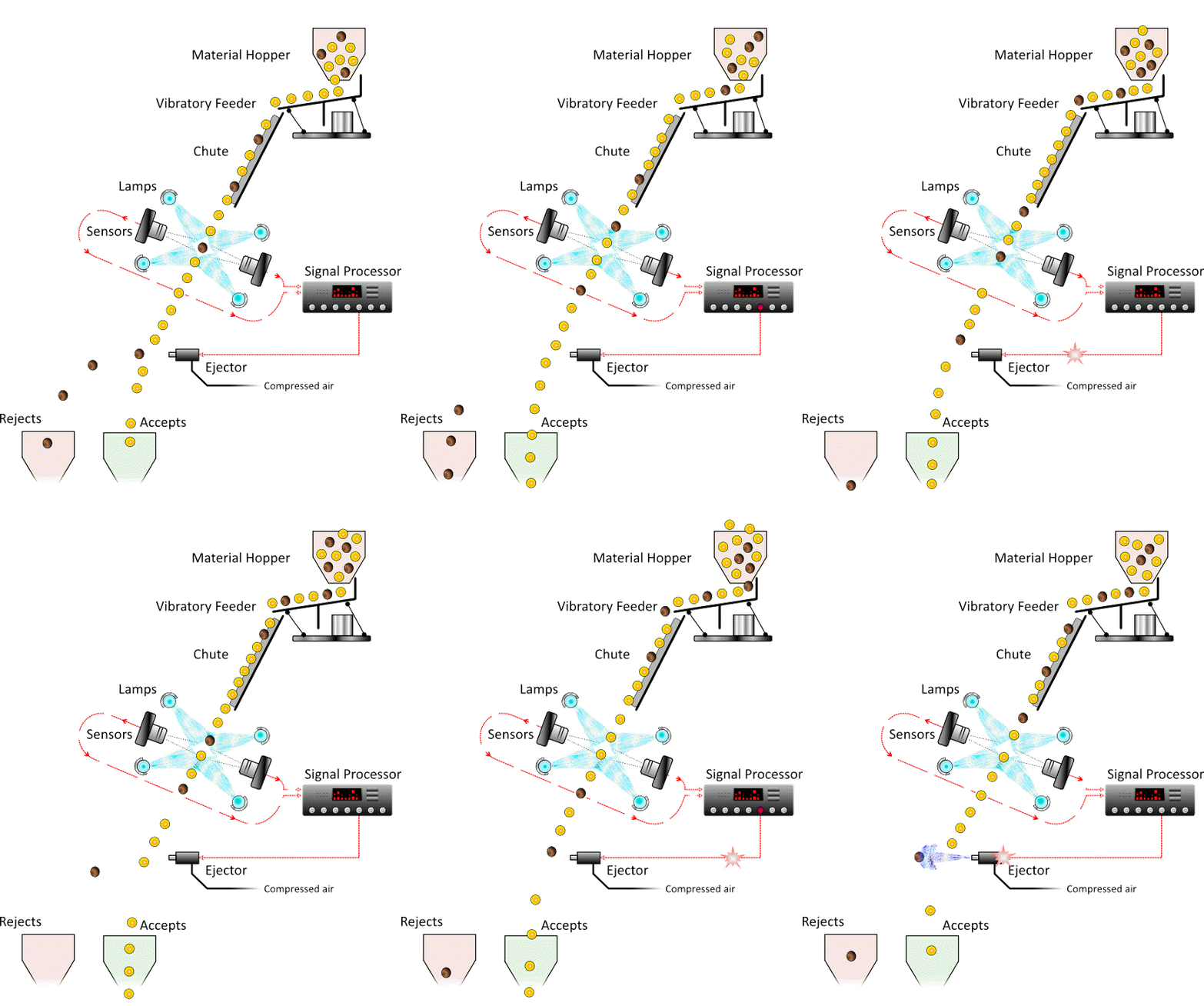
A coffee bean color sorter (also known as an optical sorter) is an automated inline inspection system that separates sound coffee beans from defective beans and foreign impurities based on visual and spectral differences. Every single bean is inspected — in four steps:
Feeding
Vibratory feeders deliver a uniform, single-layer stream of beans down the chute or conveyor belt.
Inspection
Ultra-HD full-colour line-scan cameras (with optional NIR sensing) inspect every individual bean in flight.
AI Analysis
Deep-learning algorithms analyze colour, shape, size, and texture against preset defect parameters.
Ejection
High-frequency solenoid valves fire micro-jets of compressed air to knock defective beans out of line.
Modern industrial sorters run from compact 20 kg/h benchtop units to 5+ tons per hour production lines — continuously, with far greater accuracy and speed than any manual workforce. Compare the full model range →
Green & Roasted Coffee Defect Classification Explained
Beyond the before/after comparison near the top of this page, understanding why each defect forms explains why optical sorting consistently outperforms manual grading:
- Black & sour beans (green coffee): caused by over-fermentation and poor drying; they inject sour, fermented off-notes and are a leading cause of shipment rejection at destination ports.
- Mould & Broca (insect) damage: pinholes and dark spots invisible to the human eye at grading speed — but clearly captured at 5400×12K line-scan resolution.
- Immature & floater beans: low density and pale colour; they roast unevenly and taste grassy in the cup.
- Quakers (roasted coffee): immature beans that never undergo proper caramelization / Maillard reaction — they stay pale after roasting and ruin espresso flavour.
- Over-roasted & charred beans: impart bitter, smoky off-notes and destroy crema uniformity.
- Broken beans, husk & foreign material: stones, glass, and metal fragments threaten grinding equipment and end-consumer safety.
See the tabbed green vs. roasted defect overview in the section above →
Core Optical Technologies: Ultra-HD RGB + NIR + AI Algorithms
Not all color sorters perform equally. High-performance optical sorting rests on three technological pillars:
Ultra-HD RGB Hawk-Eye Cameras
5400×12K full-colour line-scan CCD sensors capture every bean in full RGB, recognising subtle gradient shifts between sound green coffee and early-stage sour beans — down to defects as small as 0.03 mm².
Multi-Spectral / NIR Sensing
Beyond visible colour, optional near-infrared (NIR) analysis reads material density and composition, separating organic coffee material from stones, glass, and plastic — even when their colours match the bean perfectly.
Deep-Learning AI Cloud Algorithms
Self-learning neural networks replace rigid manual threshold settings, recognising compound defects (e.g. insect pinhole combined with minor discolouration) automatically — faster setup and minimal good-bean loss in the reject stream.
The ROI of Investing in an Industrial Coffee Bean Color Sorter
Optical sorting delivers measurable financial returns for processors of every scale:
- Higher price realization per ton: upgrading green coffee from Grade 2–3 to Grade 1 export standard significantly increases the market selling value of every bag.
- Reduced good grain loss: precision pneumatic ejection keeps the carry-over ratio (sound beans lost into the reject bin) to a minimum, maximizing saleable yield.
- Drastic labor cost savings: a single chute replaces 15–30 manual sorting workers, eliminating human fatigue and long-term operational overhead.
- Brand reputation protection: automated sorting guarantees zero foreign contaminants or quakers reach consumer packaging, safeguarding roaster and exporter brand equity.
Conclusion: in modern coffee processing, a coffee bean color sorter is no longer a luxury — it is an indispensable necessity for maintaining competitive quality standards. Choosing the right combination of camera technology and machine architecture (chute vs. belt) is the key to maximizing sorting performance and return on investment.
Get a free sample test & ROI estimate →See Our Coffee Bean Color Sorters in Action
Real machine tests and real processing lines — see the sorting quality before you buy.
“Live Test: Sorting Green Coffee Beans at 2.5 T/H”

Vietnam
Coffee Mill Line Upgrade Project
[Placeholder: project details & photos]
Colombia
Coffee Mill Line Upgrade Project
[Placeholder: project details & photos]
Ethiopia
Coffee Mill Line Upgrade Project
[Placeholder: project details & photos]
Brazil
Coffee Mill Line Upgrade Project
[Placeholder: project details & photos]
“JIACUI’s optical sorter increased our premium export grade yield by 18% while cutting labor costs significantly.”
Frequently Asked Questions About Coffee Bean Color Sorting
Answers from our sorting engineers. Something else on your mind? Ask us directly →
Can your color sorter process both green coffee and roasted coffee beans on the same machine?
How does the optical sorter detect insect-damaged (Broca) or sour beans?
What is the breakage rate for roasted coffee beans during sorting?
Can I test my coffee bean samples before placing an order?
Upgrade Your Coffee Processing Line Today
Contact our engineering team to get a tailored coffee bean sorting proposal, live video test, or factory-direct pricing.