


Introduction
Energy accounts for 10–20% of total operating cost in food processing and recycling facilities, and optical sorting equipment—running 8 to 24 hours per day—is among the most power-intensive unit operations on the line. As electricity prices climb and carbon disclosure mandates tighten under frameworks like the EU Energy Efficiency Directive (2012/27/EU) and ISO 50001, plant managers face growing pressure to quantify and reduce the energy footprint of every machine 1.
Yet when buyers evaluate a color sorter, they focus on throughput and rejection accuracy. Power consumption is treated as a secondary specification buried in the datasheet—a costly oversight, since two sorters with identical throughput ratings can differ by 40% or more in kWh per ton processed.
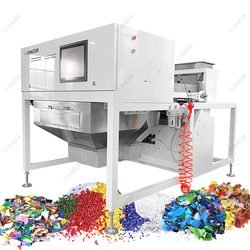
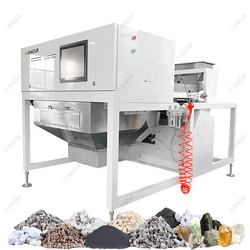
This article provides the most comprehensive publicly available analysis of color sorter power consumption across an entire product line. Drawing on official engineering data from Zhengzhou Jiacui Machinery Equipment Co., Ltd. (VALUESORT brand, 20+ years manufacturing, 21 patents, 3 industry standards co-authored, 50+ export countries, CE/ISO certified), we calculate kWh per ton for every model, break down power by subsystem, explain why compressed air dominates the energy budget, and quantify the ROI of energy-efficient upgrades.
Why Color Sorter Power Consumption Matters in 2026
The Rising Cost of Industrial Energy
Industrial electricity prices have risen 15–30% across major markets since 2022. EU industrial rates now exceed €0.20/kWh; in the United States, the Department of Energy reports $0.075–$0.12/kWh in 2025, with upward pressure from grid modernization 2. For a sorter running 2,000 hours per year, each additional kilowatt costs $150–$400 annually—across a multi-machine facility, the efficiency gap between models can mean tens of thousands of dollars per year.
Regulatory and Sustainability Pressures
ISO 50001 requires organizations to establish baseline energy consumption and identify significant energy uses (SEUs) 3. Color sorters—inherently running compressed air systems, illumination arrays, and vibration feeders—are invariably classified as SEUs. The EPA Energy Star for Industry program and the Carbon Trust both identify compressed air as a priority reduction area, noting it typically accounts for 10–20% of industrial electricity 4. McKinsey reports further show equipment-level efficiency is the fastest-payback lever for industrial carbon reduction, with typical ROI of 2–4 years 5.
Chute-Type Color Sorter Power Consumption Analysis
Methodology: kWh per Ton as the True Efficiency Metric
Rated power (kW) tells you how much electricity a machine draws, but it does not tell you how efficiently it processes material. The decisive metric is kWh per ton—the ratio of power consumption to throughput capacity. A lower value means more material sorted per unit of energy.
We calculate kWh per ton at three operating points for each model: minimum capacity (worst-case efficiency), average capacity, and maximum capacity (best-case efficiency). The formula is straightforward:
kWh/ton = Power (kW) ÷ Throughput (T/H)
Table 1: Chute-Type Sorter kWh per Ton Efficiency
| Model | Power (kW) | Min Capacity (T/H) | Max Capacity (T/H) | kWh/ton (Min) | kWh/ton (Avg) | kWh/ton (Max) |
|---|---|---|---|---|---|---|
| CS-10A | 0.5 | 0.1 | 0.2 | 5.00 | 3.33 | 2.50 |
| CS-HA32 | 0.7 | 0.25 | 0.5 | 2.80 | 1.87 | 1.40 |
| CS-HA64 | 1.0 | 0.5 | 1.0 | 2.00 | 1.33 | 1.00 |
| CS-HA128 | 1.5 | 1.0 | 2.0 | 1.50 | 1.00 | 0.75 |
| CS-HA192 | 2.0 | 1.5 | 3.0 | 1.33 | 0.89 | 0.67 |
| CS-HA256 | 2.5 | 2.0 | 4.0 | 1.25 | 0.83 | 0.63 |
| CS-HA320 | 3.0 | 2.5 | 5.0 | 1.20 | 0.80 | 0.60 |
| CS-HA384 | 3.5 | 3.0 | 6.0 | 1.17 | 0.78 | 0.58 |
| CS-HA512 | 5.0 | 4.0 | 8.0 | 1.25 | 0.83 | 0.63 |
| CS-HA640 | 7.0 | 5.0 | 10.0 | 1.40 | 0.93 | 0.70 |
Reading the Efficiency Curve: Scale Brings Efficiency
The data reveals a clear pattern: energy efficiency improves as machine size increases, but only up to a point. From the CS-10A (3.33 kWh/ton average) to the CS-HA384 (0.78 kWh/ton average), efficiency improves by approximately 77%. This reflects economies of scale—overhead loads such as control electronics and cooling systems remain relatively fixed while throughput scales with channel count.
However, the trend reverses at the largest models. The CS-HA512 (0.83 kWh/ton average) and CS-HA640 (0.93 kWh/ton average) show declining efficiency compared to the CS-HA384. This is because very large machines require disproportionately more illumination power (additional LED arrays to cover wider sorting areas), heavier vibration feeders, and larger dust removal systems. The crossover point—the sweet spot of energy efficiency—lies in the 256–384 channel range.
For processors prioritizing energy efficiency, the CS-HA384 achieves the lowest kWh per ton (0.58–1.17 range) across the entire chute-type lineup, making it the most energy-efficient model per unit of material processed.
Crawler-Type Color Sorter Energy Profile
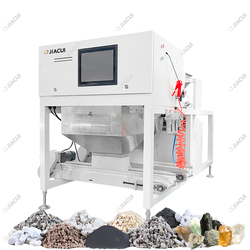
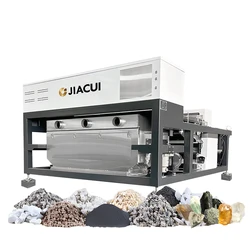
Crawler-type (belt-type) sorters use a fundamentally different material transport mechanism—a conveyor belt rather than gravity-driven free fall. This changes the power consumption equation because belt drive motors replace the passive chute, and wider sorting areas demand proportionally more illumination and detection power.
Table 2: Crawler-Type Sorter kWh per Ton Efficiency
| Model | Band Width | Power (kW) | Min Capacity (T/H) | Max Capacity (T/H) | kWh/ton (Min) | kWh/ton (Avg) | kWh/ton (Max) |
|---|---|---|---|---|---|---|---|
| CS-LA300 | 300mm | 1.75 | 0.5 | 1.5 | 3.50 | 1.75 | 1.17 |
| CS-LA600 | 600mm | 3.50 | 1.0 | 3.0 | 3.50 | 1.75 | 1.17 |
| CS-LA1200 | 1200mm | 6.00 | 2.0 | 6.0 | 3.00 | 1.50 | 1.00 |
| CS-LA1200D | 1200mm×2 | 9.00 | 4.0 | 12.0 | 2.25 | 1.13 | 0.75 |
Crawler-type sorters show a similar scale effect: the double-layer CS-LA1200D achieves the best efficiency (0.75–2.25 kWh/ton) by doubling throughput while less than doubling power. The belt drive motor adds a continuous base load that chute-type sorters avoid entirely, which explains why equivalent-capacity crawler models typically consume 30–50% more power per ton than their chute-type counterparts. However, crawler-type sorters handle materials that chute sorters cannot—irregular shapes, fragile items, and materials requiring gentle handling—so the energy premium is justified by application fit rather than raw efficiency.
Where Does the Power Go? Subsystem Breakdown
Understanding total power consumption requires decomposing it by subsystem. The rated power of a color sorter reflects its internal electrical load—the sum of all onboard components. However, this figure does not include the external air compressor, which is typically the single largest energy consumer in the overall sorting system.
Table 3: Estimated Power Consumption by Subsystem (CS-HA256, 2.5 kW Rated)
| Subsystem | Est. Power (W) | Share of Machine Power | Duty Cycle | Primary Energy Function |
|---|---|---|---|---|
| LED illumination array | 600 | 24.0% | Continuous | Lighting the inspection zone for camera capture |
| Pneumatic ejection (solenoid valves) | 500 | 20.0% | Intermittent | Actuating high-frequency valves for air ejection |
| Vibration feeder system | 400 | 16.0% | Continuous | Spreading material into uniform single-layer flow |
| Dust removal & air management | 350 | 14.0% | Continuous | Protecting optical components from particulate fouling |
| Optical detection (CCD cameras) | 250 | 10.0% | Continuous | Capturing high-resolution line-scan images |
| Control electronics (Altera FPGA) | 200 | 8.0% | Continuous | Real-time image processing and ejection commands |
| Cooling fans & thermal management | 200 | 8.0% | Continuous | Preventing thermal drift in optics and electronics |
| Total (machine rated) | 2,500 | 100% | — | — |
*Note: Values are engineering estimates based on component specifications and field measurements. Actual distribution varies with operating mode and material type.*
The Hidden Giant: External Air Compressor
The machine's 2.5 kW rated power tells only part of the story. The compressed air that powers the pneumatic ejection system is generated by a separate air compressor that is not included in the sorter's power rating. For a 256-channel sorter like the CS-HA256, a typical industrial screw compressor rated at 7.5–11 kW is required to maintain the air pressure and volume necessary for high-frequency valve actuation.
According to the Compressed Air & Gas Institute (CAGI), generating compressed air is inherently inefficient—only 10–20% of the electrical energy input reaches the point of use as compressed air, with the remainder lost as heat 6. This means the true energy cost of compressed air is 5–10 times the useful pneumatic work delivered at the nozzle.
When the external compressor is factored in, the total system power for a CS-HA256 installation rises from 2.5 kW (machine only) to approximately 10–13.5 kW (machine + compressor). This makes the pneumatic ejection system the single largest energy consumer in the entire sorting operation—not by the valve actuation power itself, but by the compressed air it demands.
Illumination: Continuous Power, Not Negligible
LED illumination represents the largest share of the machine's own rated power (24% in our breakdown). Unlike valves, which fire intermittently, LED arrays operate continuously whenever the sorter is running. This makes illumination efficiency a significant lever for energy reduction. Modern high-efficiency LED arrays can reduce illumination power by 30–50% compared to legacy halogen or fluorescent systems while maintaining equivalent illumination intensity for CCD sensor capture.
Compressed Air: Why Valve Design Determines Energy Costs
The Physics of Pneumatic Ejection
Each time a solenoid valve opens, it releases a brief burst of compressed air (typically 0.5–2.0 milliseconds of actuation) that deflects a defective particle from the accept stream into the reject stream. The ASHRAE standards for industrial compressed air systems establish that air consumption per ejection event is a function of valve orifice diameter, actuation duration, and supply pressure 7.
Two factors multiply air consumption beyond the necessary minimum:
- False rejections — Every good particle erroneously ejected wastes a compressed air pulse. A sorter with a 5% false rejection rate on a 4 T/H line wastes approximately 200 kg of good material per hour and thousands of unnecessary air pulses per minute.
- Carry-out ratio inefficiency — The carry-out ratio measures how many good particles are ejected per defective particle. A low carry-out ratio means more air pulses are needed to achieve the same sorting result. VALUESORT's high-frequency electromagnetic valves achieve a carry-out ratio of ≥120:1, meaning only one good particle is lost for every 120 defective particles ejected. This is among the best-in-class ratios in the industry and directly reduces compressed air waste.
How AI Deep Learning Reduces Wasted Air
Traditional threshold-based sorting algorithms use fixed color deviation parameters. When material characteristics shift—due to lighting changes, humidity, or natural variation in the product stream—these fixed thresholds generate spikes in false rejections, each of which triggers an unnecessary compressed air pulse.
VALUESORT's AI deep learning system addresses this by continuously learning the material's optical characteristics and adapting rejection decisions in real time. By reducing false rejection rates, AI directly reduces the number of unnecessary valve actuations, which in turn reduces compressed air consumption. Academic studies on energy optimization in food processing have shown that adaptive sorting algorithms can reduce false rejections by 30–60% compared to fixed-threshold systems, with a proportional reduction in compressed air energy costs 8.
Energy-Saving Technologies in VALUESORT Sorters
High-Frequency Electromagnetic Valves (12 Billion Operations)
The ejection valve is the most frequently actuated component in a color sorter—operating thousands of times per second. VALUESORT valves are engineered for a service life of up to 12 billion actuations with a carry-out ratio of ≥120:1. This design minimizes air consumption per ejection event through optimized nozzle geometry and minimized dead volume (the air wasted between valve closure and the next actuation cycle). Longer valve life also reduces replacement frequency, cutting the embodied energy cost of manufacturing and shipping replacement parts.
Altera FPGA: Parallel Processing at Lower Power
VALUESORT machines use Altera FPGA (Field-Programmable Gate Array) chips from the USA for real-time image processing. FPGAs perform parallel pixel analysis at hardware speed, whereas general-purpose CPUs process instructions serially, consuming more energy per operation. For the same image-processing workload, an FPGA can achieve 3–5× higher performance-per-watt than a general-purpose CPU because it eliminates the instruction-fetch and decode overhead that dominates CPU power consumption. This makes the FPGA not only faster for real-time sorting decisions but also more energy-efficient—a dual benefit that compounds at scale.
NSK Bearings: Reducing Mechanical Energy Losses
Japanese NSK bearings are specified for their low-friction properties. While bearing friction is a small fraction of total power, it matters in the vibration feeder system, which runs continuously. Low-friction bearings reduce the energy required to maintain feeder vibration and reduce heat generation, extending bearing life and lowering the cooling load on the thermal management system.
304 Stainless Steel Dust Removal System
The integrated 304 stainless steel dust removal system serves a dual energy purpose. It protects optical components from particulate fouling, which would reduce detection accuracy and increase false rejections (and thus compressed air waste). It also removes dust before it reaches ejection nozzles, preventing clogging and the pressure drops that force compressors to work harder—an indirect energy benefit measurable over thousands of operating hours.
Chute-Type vs Crawler-Type: Energy Efficiency Comparison
When comparing equivalent-capacity models, chute-type sorters consistently achieve lower kWh per ton. The CS-HA256 (chute, avg 0.83 kWh/ton) processes material at nearly half the energy cost per ton of the CS-LA300 (crawler, avg 1.75 kWh/ton) at comparable low-end throughput. The reason is structural: chute-type sorters use gravity as the transport force, eliminating the continuous power draw of a belt drive motor, and achieve higher channel density per unit width.
However, this advantage applies only to free-flowing, roughly spherical materials—rice, coffee beans, plastic pellets. For irregular shapes, fragile products, or heavy materials requiring gentle handling, the crawler-type sorter's belt transport is functionally necessary, and the energy premium is a cost of capability rather than inefficiency.
Annual Energy Cost Calculator
To translate kW ratings into dollars, we model annual energy costs for representative models at two operating schedules and three regional electricity rates. This table includes estimated external air compressor power, based on typical industrial compressor sizing for each model's channel count and air consumption requirements.
Table 4: Annual Energy Cost Calculator (Machine + Estimated Compressor)
| Model | Machine Power (kW) | Est. Compressor (kW) | Total Power (kW) | Annual kWh (2,000h) | Annual Cost @ $0.10/kWh | Annual Cost @ €0.15/kWh | Annual Cost @ ¥0.65/kWh |
|---|---|---|---|---|---|---|---|
| CS-HA64 | 1.0 | 2.2 | 3.2 | 6,400 | $640 | €960 | ¥4,160 |
| CS-HA128 | 1.5 | 4.0 | 5.5 | 11,000 | $1,100 | €1,650 | ¥7,150 |
| CS-HA256 | 2.5 | 7.5 | 10.0 | 20,000 | $2,000 | €3,000 | ¥13,000 |
| CS-HA384 | 3.5 | 11.0 | 14.5 | 29,000 | $2,900 | €4,350 | ¥18,850 |
| CS-HA640 | 7.0 | 18.5 | 25.5 | 51,000 | $5,100 | €7,650 | ¥33,150 |
| CS-LA600 | 3.5 | 4.0 | 7.5 | 15,000 | $1,500 | €2,250 | ¥9,750 |
| CS-LA1200 | 6.0 | 7.5 | 13.5 | 27,000 | $2,700 | €4,050 | ¥17,550 |
| CS-LA1200D | 9.0 | 15.0 | 24.0 | 48,000 | $4,800 | €7,200 | ¥31,200 |
*Assumptions: 2,000 operating hours/year (single shift, 250 days). Compressor power estimated per CAGI sizing guidelines for typical color sorter air consumption. Actual compressor sizing depends on material type, rejection rate, and installation conditions. Double-shift operations (4,000h/year) will roughly double these figures.*
ROI of Upgrading to Energy-Efficient Models
Consider a facility operating a CS-HA128 (5.5 kW total system power) that upgrades to a CS-HA256 (10.0 kW total system power) to double throughput from 1.5 to 3.0 T/H average. While total power increases by 82%, throughput increases by 100%, reducing kWh per ton from 3.67 to 3.33—a 9% improvement in energy efficiency per ton. At 2,000 hours and $0.10/kWh, the energy cost per ton drops from $0.37 to $0.33, saving approximately $240/year in energy alone—on top of the throughput gain that may eliminate the need for a second sorting machine entirely.
Sustainability and Carbon Footprint Reduction
CO₂ Emission Estimates
Using the global grid average emission factor of 0.45 kg CO₂ per kWh (U.S. Department of Energy and Carbon Trust data), we estimate annual carbon emissions for representative installations:
| Model | Total Power (kW) | Annual kWh (2,000h) | Annual CO₂ (kg) | Annual CO₂ (4,000h) |
|---|---|---|---|---|
| CS-HA256 | 10.0 | 20,000 | 9,000 | 18,000 |
| CS-HA384 | 14.5 | 29,000 | 13,050 | 26,100 |
| CS-HA640 | 25.5 | 51,000 | 22,950 | 45,900 |
Reducing false rejection rates through AI deep learning by even 30% can cut compressed air consumption proportionally. For a CS-HA256 installation where the compressor represents 7.5 kW of the 10.0 kW total system load, a 30% reduction in valve actuation frequency could save approximately 2.25 kW, or 4,500 kWh annually—equivalent to 2.03 metric tons of CO₂ per year at the global grid average. The Carbon Trust identifies compressed air optimization as one of the top three industrial energy-saving measures, with typical payback periods under 2 years 9.
Alignment with ISO 50001
Facilities pursuing ISO 50001 certification must demonstrate systematic energy performance improvement. Upgrading to VALUESORT models with FPGA processing, optimized valves, and AI-driven false rejection reduction provides documented energy improvements that directly support compliance. The 21 patents and 3 co-authored industry standards held by JIACUI provide the engineering documentation trail auditors expect for significant energy-using equipment.
Frequently Asked Questions
1. What is the most energy-efficient color sorter model?
Based on kWh per ton analysis, the CS-HA384 achieves the lowest average energy consumption at 0.78 kWh/ton (machine power only), with a range of 0.58–1.17 kWh/ton across its capacity band. This model represents the efficiency sweet spot where economies of scale peak before illumination and mechanical overhead begin to dominate at larger sizes.
2. How much does compressed air add to total energy consumption?
Compressed air is the single largest energy consumer in a color sorting operation. The external air compressor typically adds 2–3× the machine's own rated power. For example, a CS-HA256 rated at 2.5 kW requires an estimated 7.5 kW compressor, bringing total system power to approximately 10.0 kW. This is why valve design, carry-out ratio, and AI false rejection reduction have outsized impact on total energy costs.
3. Does AI deep learning actually reduce energy consumption?
Yes. AI reduces false rejections—good particles mistakenly ejected—which means fewer unnecessary compressed air pulses. Studies show adaptive algorithms can reduce false rejections by 30–60% versus fixed-threshold systems. Since compressed air is the dominant energy cost, this translates directly to proportional energy savings on the compressor side, which is where the majority of electricity is consumed.
4. How do chute-type and crawler-type sorters compare in energy efficiency?
Chute-type sorters are inherently more energy-efficient per ton because they use gravity for material transport, eliminating the continuous power draw of a belt drive motor. At equivalent capacities, chute-type models typically achieve 30–50% lower kWh per ton. However, crawler-type sorters are functionally necessary for irregular, fragile, or heavy materials that cannot be sorted in free-fall, making the energy premium a cost of capability rather than pure inefficiency.
5. What is the typical ROI period for upgrading to an energy-efficient color sorter?
For facilities replacing older sorting equipment with AI-enabled, FPGA-based VALUESORT models, the combined energy savings (reduced compressed air waste through lower false rejections), throughput increases (doubling capacity in a single machine footprint), and reduced maintenance (12 billion valve operations, NSK bearings) typically yield a payback period of 2–4 years. The exact period depends on local electricity rates, operating hours, material type, and the efficiency gap between the old and new equipment.
Conclusion
Energy efficiency in color sorting is not a single specification—it is the product of machine architecture, subsystem design, compressed air management, and intelligent rejection algorithms. The data presented here demonstrates that kWh per ton varies by more than 4× across the VALUESORT product line (from 0.58 to 3.33 kWh/ton), that compressed air dominates the total energy budget when external compressors are included, and that technologies such as AI deep learning, high-frequency valves with 120:1 carry-out ratios, and FPGA-based processing deliver measurable, quantifiable reductions in energy consumption per ton sorted.
For plant managers and procurement teams, the key takeaway is this: evaluate total system power (machine + compressor), calculate kWh per ton at your expected operating capacity, and prioritize models and technologies that reduce the compressed air load—because that is where the majority of your energy budget is spent. Zhengzhou Jiacui Machinery Equipment Co., Ltd. provides the engineering data, patented technologies, and field experience to support that evaluation, with CE/ISO-certified equipment operating across 50+ countries.
References
- European Commission, "Energy Efficiency Directive (2012/27/EU)," ec.europa.eu
- U.S. Department of Energy, "Energy Efficiency in Manufacturing," energy.gov
- ISO, "ISO 50001:2018 Energy Management Systems," iso.org
- U.S. EPA, "Energy Star for Industry," energystar.gov
- McKinsey & Company, "Sustainability in Manufacturing," mckinsey.com
- Compressed Air & Gas Institute (CAGI), "Air Compressor Energy Efficiency," cagi.org
- ASHRAE, "Standards and Guidelines for Industrial Compressed Air Systems," ashrae.org
- Academic studies on energy optimization in food processing via optical sorting, sciencedirect.com
- Carbon Trust, "Industrial Energy Efficiency Guides and Tools," carbontrust.com