 Quartz · SiO2
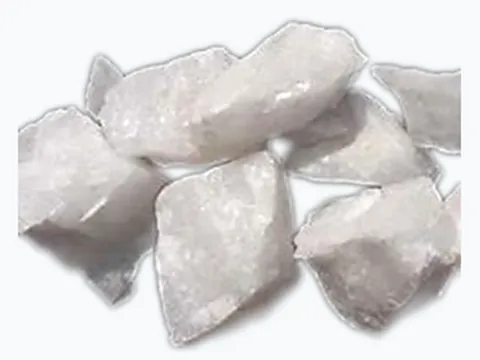
Quartz lump
Iron-stained faces, black mica and grey host rock go to reject; the accepted stream feeds glass sand, slab and engineered stone.

Quartz & mineral optical sorting
A belt-type ore optical sorter for silica sand, feldspar, calcite, baryte and fluorspar — removes iron stain, black mica and waste rock at 3–20+ T/H.
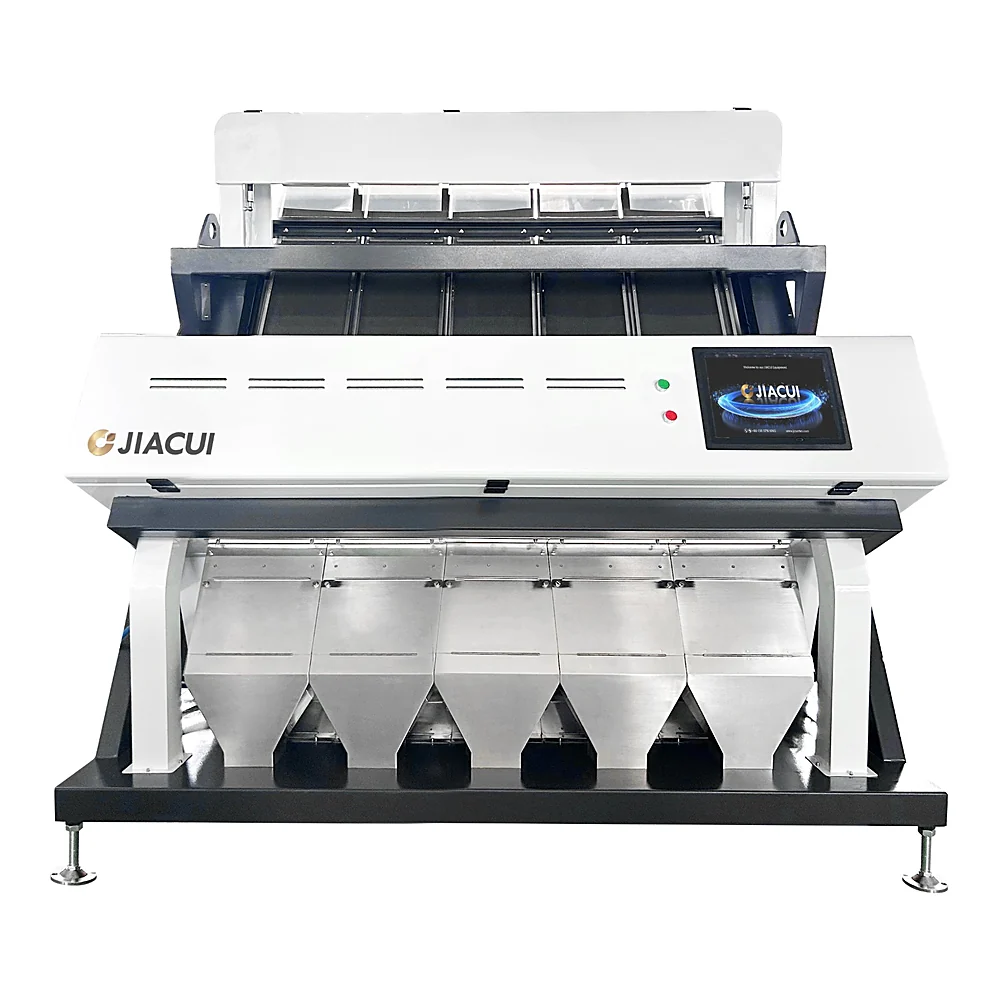
Enhance salt purity with the CS-5A color sorter, featuring 320 channels and advanced optical technology for high efficiency and precision.
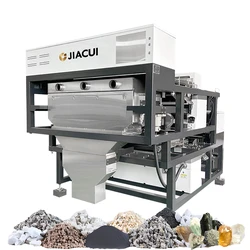
The heavy unit for lump feed: 9 kW, 2300 kg, 5–12 t/h depending on the size band, ≥99.99% accuracy and carryover better than 20:1.
View Details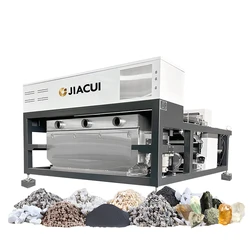
Mid-size belt sorter for 5–50 mm feed: 6 kW, 1150 kg, ≥99.99% accuracy and carryover better than 20:1.
View Details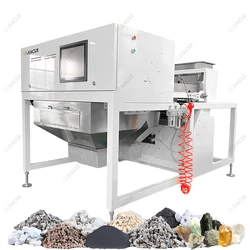
Compact belt sorter for a line that is still growing: 2.5 kW, 750 kg, 2.5–6 t/h across the size bands, ≥99.99% accuracy and carryover better than 20:1.
View Details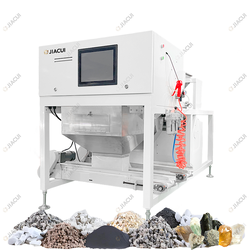
The smallest unit in the belt range: 1.8 kW, 550 kg, 1.2–3 t/h depending on the size band, ≥99.99% accuracy and carryover better than 20:1.
View DetailsQuartz & mineral color sorter
A mineral color sorter is not a grain sorter with a wider chute. Quartz, feldspar, calcite, baryte and fluorspar arrive as dense, angular rock with dust on the surface, so the machine has to hold every particle steady in front of the camera, see a color difference of a few percent, and then reject it with an air pulse strong enough to move real weight. A quartz sand sorting machine that cannot do all three is just an expensive way of moving waste from one pile to another.
JIACUI builds this ore optical sorter around the belt platform instead of a gravity chute: a heavy-duty anti-wear belt, high-resolution CCD optics with optional near-infrared channels, and a positive-pressure optical enclosure that survives quarry dust and wash-line humidity. The same industrial stone color sorting equipment handles silica sand, feldspar, calcite, baryte, talc and fluorspar, and returns a predictable, repeatable cut between product and waste — whether you are chasing SiO2 purity and whiteness for glass and engineered stone, whiteness for ceramics, or consistent grade for metallurgical and filler buyers.
Materials we sort
None of the photos below came from an image library. They are material that arrived at our test room — lump ore, sand and coal, shot on the tray it was sampled from. Under each one is what the machine rejects and what the buyer of the cleaned product is actually paying for.
Quartz · SiO2Iron-stained faces, black mica and grey host rock go to reject; the accepted stream feeds glass sand, slab and engineered stone.
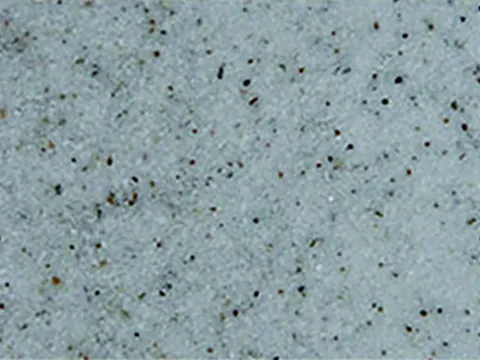 26–40 mesh
Black specks, iron grains and feldspar chips are what hold the whiteness grade down. One pass takes them out.
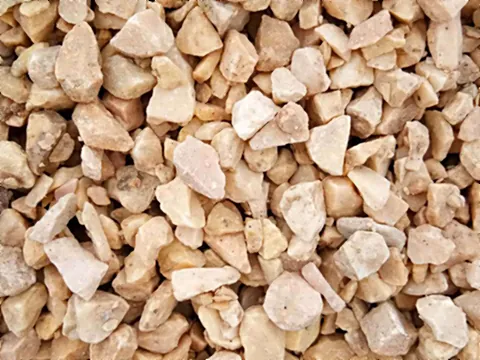 Ceramic grade
Iron spots, dark minerals and weathered lumps removed, so the fired body keeps a stable white from batch to batch.
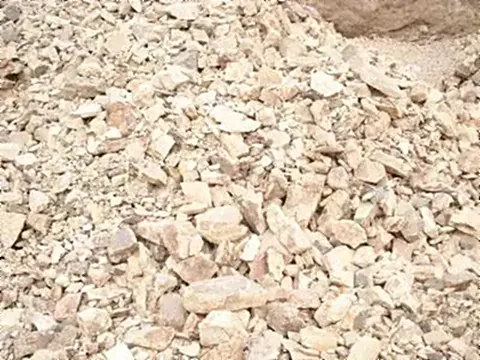 Refractory
High-silica lumps and iron-rich nodules are split off before the kiln, holding the alumina grade the buyer contracted for.
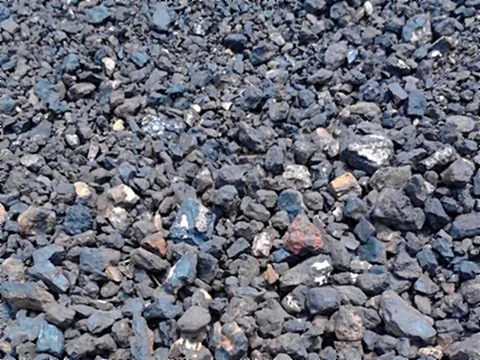 Mn ore
Barren rock, clay and low-grade nodules drop out ahead of the mill, lifting the Mn head grade and cutting grinding load.
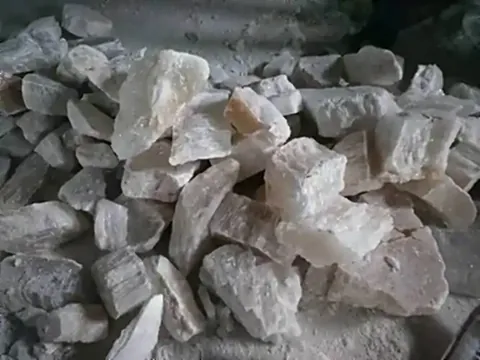 Muscovite
Dark gangue and stained flakes separated from clean muscovite for filler, insulation and cosmetics grades.
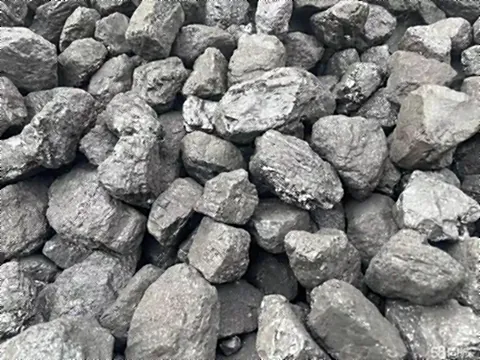 Coal prep
Shale, pyrite and stone rejected at the gate, so the washed product carries less ash and more calorific value.
Send us 5–10 kg of your feed. We run it on the test machine and send back a sorting report: photos, the reject ratio we actually measured, and the capacity that ratio implies on your tonnage.
Book a free test →Applications
Color and texture are the two signals that decide the sale price of an industrial mineral. The matrix below shows, material by material, which defects a JIACUI optical sorter rejects and what that rejection is worth at the end of the line.
| Mineral / material | Defects and waste removed | Quality and value gained |
|---|---|---|
| Quartz & silica sand | Yellow skin, iron-stained patches, black mica and foreign rock. | Raises SiO2 purity and optical whiteness for glass, slab and engineered-stone production. |
| Feldspar & calcite | Dark inclusions, iron oxide spots and discolored stones. | Meets the high-whiteness requirements of ceramics, glaze and industrial filler grades. |
| Baryte & talc | Impurity-laden gangue, mud lumps and off-color rock. | Stabilises specific gravity and gives a consistent chemical grade shipment after shipment. |
| Fluorspar & calcium carbonate | Low-grade waste stone, yellow-green impurities and silica contamination. | Lifts metallurgical and industrial grade, protecting the commercial value of the finished lot. |
| Bauxite & refractory ore | High-silica lumps, iron-rich nodules, clay and drilling fines. | Holds the alumina grade the kiln and the buyer were promised, tonne after tonne. |
| Manganese & oxide ore | Barren rock, low-grade nodules and weathered crust. | Raises Mn head grade before smelting and cuts the tonnage that reaches the mill. |
Test-room results
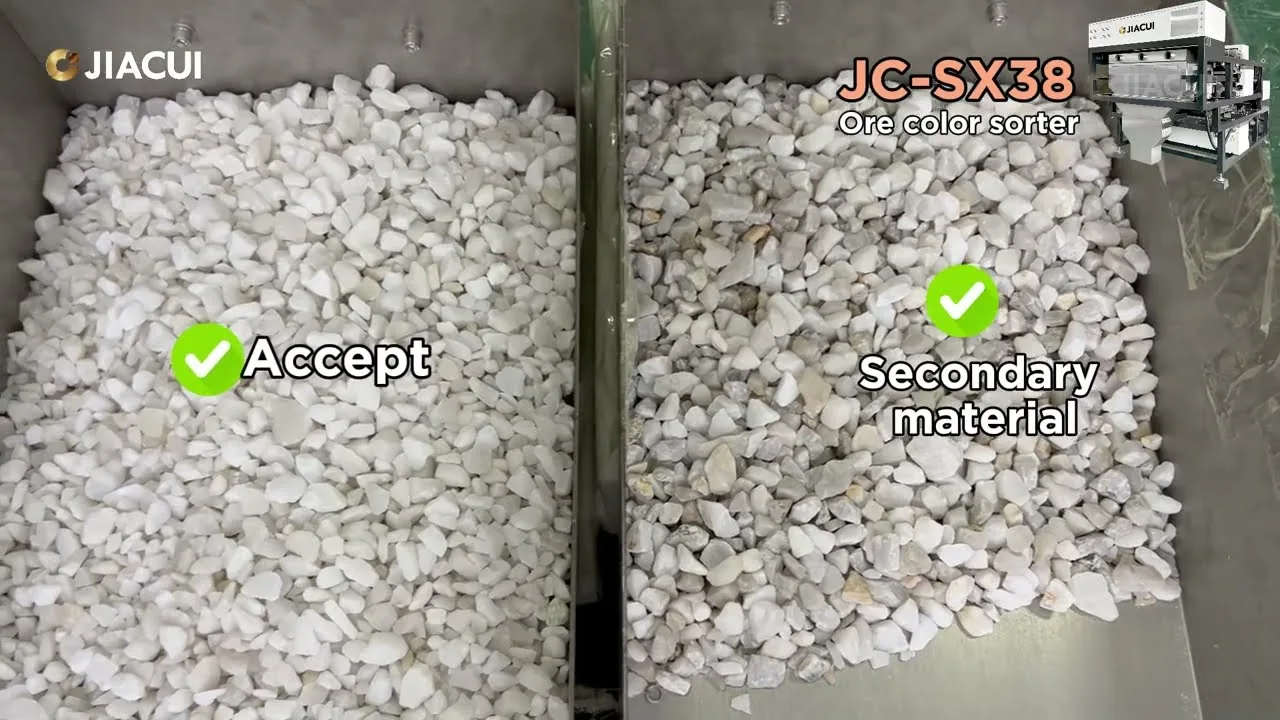
Two trays, one camera, one light. Left is the feed as it arrived, right is what the machine accepted after a single pass. Nothing is retouched and no sample is swapped between shots — the point of the pair is that you can see exactly what leaves the line.
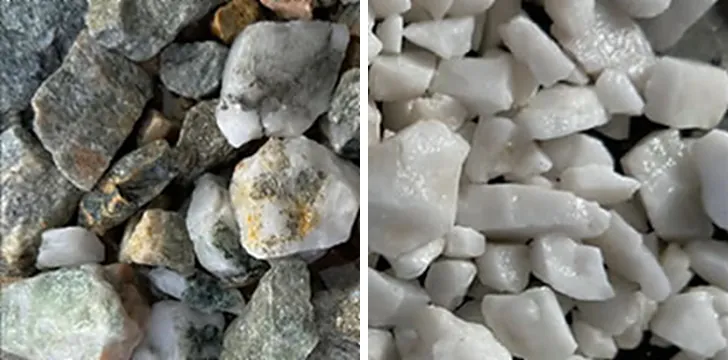
Iron-stained faces and the grey host rock are gone. What leaves the accept chute reads above 99.9% purity for glass sand and slab aggregate.

The black specks are what decide the whiteness grade. Every grain stays in focus on the belt, so the ejector does not have to over-blow to catch them.
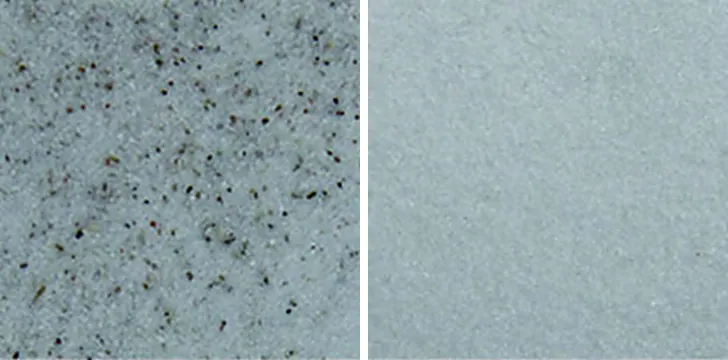
Same recipe, finer cut. Switching between the two sand grades is a recipe recall on the touch screen — no mechanical change, no second machine.
Both sand pairs were sorted on the same machine with the same recipe set. 60–120 mesh quartz sand runs on the fine-sand configuration, and we confirm capacity and purity on your own sample before quoting rather than publishing a laboratory best case.
Engineering
Four design decisions separate a machine that survives a quarry from one that survives a showroom. Each of them is visible in the numbers you get at the end of the line.
Unlike chute-type sorters, the flat belt on a belt type mineral sorter stops material from rolling and bouncing, so high-density, large-particle ore keeps a steady trajectory from 0.5 mm up to 50 mm+. That stable presentation is what makes consistent sorting of lump ore possible.
Industrial cameras resolve ultra-fine color difference — faint yellow streaks, subtle shade drift and small dark inclusions that a human picker cannot hold a standard on. Both visible-light and near-infrared channels are available for low-contrast minerals.
An enclosed optical compartment with positive-pressure air purging and IP-rated sealing, built for quarry dust, wash-line humidity and continuous 24/7 duty rather than a clean plant room.
Ultra-hard alloy nozzles resist abrasive impact and deliver short, precise air pulses, so healthy mineral is not blown out with the reject. Nozzles are user-replaceable in minutes.
Belt vs. chute
Agricultural sorting usually runs on a gravity chute. Mineral sorting mostly should not: dense, angular rock does not slide — it tumbles. Three practical consequences follow, and each one shows up directly in your yield.
Material is carried, not dropped. Every particle reaches the camera at the same angle and speed, which is the single biggest reason belt sorters beat chutes on coarse, heavy ore.
Fine silica sand, gravel-sized aggregate and crushed rock can all run on the same belt with a feed-rate adjustment — no second machine for a different cut size.
No free-falling impact against the viewing window. Abrasion is concentrated on replaceable liners and the belt itself, which keeps maintenance cost predictable in a mining duty cycle.
Selection guide
Feed size sets belt speed, camera count, ejector timing and, in the end, capacity. The bands below are the ones we quote most often, with the factory capacity of the belt platform — not a best-case figure from a laboratory run.
| Feed size | Screen / mesh | Belt model and capacity | Typical material |
|---|---|---|---|
| 30–50 mm | 1½–2 in | CS-LA1200D 8–12 t/h CS-LA300 2–3 t/h | lump quartz, bauxite, manganese ore, coal |
| 15–30 mm | ¾–1½ in | CS-LA1200D 6–10 t/h CS-LA300 1.5–2.5 t/h | feldspar, calcite, fluorspar, barite |
| 5–15 mm | 1–4 mesh | CS-LA1200D 5–7 t/h CS-LA300 1.2–1.8 t/h | quartz gravel, glass-grade chip, coal fines |
| 0.5–5 mm | 4–35 mesh | fine-material belt up to 3 t/h | silica sand, glass sand, mineral sand |
| below 0.5 mm | 35–150 mesh | quoted after a lab test on your sample | quartz powder, mineral filler |
CS-LA600 and CS-LA1200 sit between the two capacity columns above. We recommend by feed size and tonnage rather than by price list, and every belt model is specified at ≥99.99% accuracy with a carryover ratio better than 20:1 on the materials we have tested.
How it works
An optical sorter is a camera, a computer and an air valve working inside one second. Here is the order in which things happen, and where the accuracy is actually won or lost.
A vibratory feeder turns the feed into a single layer. Overlapping particles are the first cause of both misses and over-blowing, so this is where accuracy is really won.
The anti-wear belt holds every particle at the same speed and the same angle under the cameras. Angular rock tumbling down a chute arrives at a different angle every time.
High-resolution CCD cameras take two or three views of each particle, plus an optional near-infrared channel when the difference is not a color difference at all.
An FPGA pipeline and a deep-learning model compare every particle with the recipe. Shade drift, texture and shape all count — not average color alone.
A 0.2 ms air pulse from alloy nozzles moves the reject out of the stream. Pulse length is set per material: too long and good product leaves with the waste.
Accept, middling and reject leave through separate chutes. The middling can be re-run in a second pass, which is how carryover stays below 1:20 on coarse ore.
Filtered, dried air feeds the ejectors, and the optical compartment runs at positive pressure — quarry dust never reaches a lens.
Choosing the technology
Three ways to take waste out of a mineral stream. They are less competitors than different questions, and picking the wrong one is the most expensive mistake in pre-concentration.
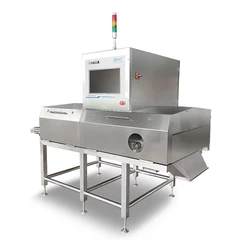
In practice most mineral plants start with color, because surface staining and waste rock are what the market grades on. Where the contamination is internal — or color-identical — an X-ray transmission sorter does the job color cannot. We quote both, and we will tell you when color alone is enough.
Economics
A sorter does not make product. It removes cost: whatever you reject before the mill is never crushed, ground, pumped, dried or hauled.
Reject a tonne ahead of the mill and you also reject the energy, the liners, the water and the reagent that tonne would have consumed.
Every tonne of host rock rejected at the sorter is a tonne that never rides a truck to the plant or to the tailings dam.
Less fine waste means less thickening, less pumping and a smaller impoundment — often the part of a permit that is hardest to expand.
We will not quote a payback figure off a brochure. Send 20–50 kg, we measure the reject ratio on your ore, and you put your own power and haulage cost against it — the number is then yours, not ours.
FAQ
Yes. We supply water-resistant, wet-sorting belt configurations with high-efficiency water drainage and anti-fogging optical lenses, so washed quartz lines can be sorted straight after dewatering without drying the material first.
Capacity runs from about 3 tonnes per hour to over 20 tonnes per hour per machine, depending on particle size distribution, belt width and how evenly the feeder spreads the material. We confirm the exact figure on your own sample before quoting.
Key contact areas are lined with replaceable high-chrome anti-abrasion steel plate and polyurethane buffers, and the conveyor belt is reinforced. Ejector nozzles use ultra-hard alloy, so abrasive ore wears consumables instead of the frame or the optics.
Yes. Color models are stored as recipes, so switching between white quartz and yellow quartz is a recipe recall on the touch screen, not a hardware change. The demo video on this page shows that switch being made on one machine.
0.5 mm — about 35 mesh — on the standard belt platform, and finer material up to 120 mesh on the fine-sand configuration. Below that, throughput drops quickly, so we test your sample before quoting instead of promising a number that will not hold.
Iron-stained grains, black specks and dark mineral particles are exactly what color sorting is for, and the sand pairs above come from that job. Metallic iron, or contamination locked inside a grain, is a different problem: that is where magnetic separation or X-ray transmission earns its place — and we will say so rather than sell you the wrong machine.
Every unit is assembled and then run on your own sample in our test room. The recipe that produced the purity you signed off on is saved into the machine, and the test report with before / after photos travels in the crate. A spare-nozzle and filter kit ships with the unit, and wear parts stay in stock for repeat orders.
Send us a sample of your raw quartz, feldspar or ore. If you are sizing a quartz color sorter or a complete mineral sorting line, our lab runs a full sorting test, measures the post-sorting purity and whiteness, and returns a tailored technical proposal with a factory-direct price — free of charge, no obligation.



 WhatsApp