



AI Color Sorter · Deep-Learning Optical Sorting
Every JIACUI color sorter we ship can run the AI classification engine: it is a software and imaging upgrade on the same chassis, not a separate product line. That is why this page covers the whole range — 15 chute-type models from a 0.02 T/H bench unit to a 12 T/H eight-chute machine, plus four belt-type models for fragile and heavy material. On the machine side, a 5400 × 12K full-colour line-scan CCD captures the surface; on the software side, a trained network judges shape, size, colour shade and texture together instead of comparing every pixel against a fixed threshold. The practical difference is what happens on material that a threshold sorter cannot resolve: overlapping grains, shadowed flakes, mould colonies that have not yet changed colour, and product that a badly set machine throws away as if it were waste.
How an AI Color Sorter Differs From a Threshold Optical Sorter
A conventional optical sorter does one thing well: it compares every pixel against a colour band that an operator set by hand. That works on material with a stable colour baseline and clean, high-contrast defects, which describes a well-prepared lot of white rice. It stops working the moment the defect and the good product share a colour — a dark good kernel beside a dark defect, a shadowed flake in a crowded stream, a mould colony that has not discoloured the surface yet. The operator then has two bad options: loosen the threshold and let defects through, or tighten it and throw away good product.
An AI sorter moves the decision from a threshold to a classifier. The same camera data is scored on several features at once — hue, shade, length, width, aspect ratio, edge curvature, surface uniformity — and the combination decides, not any single channel. That is the whole difference, and it is why the two columns below diverge so far on hard material while looking identical on easy material.
Swipe the table sideways to see both columns.
| Point of comparison | Threshold optical sorter | JIACUI AI color sorter |
|---|---|---|
| What the machine measures | Pixel brightness and colour against a fixed tolerance band you set by hand. | Shape, size, colour shade and surface texture scored together by a trained network. |
| Defects it can resolve | Clean, high-contrast defects on material with a stable colour baseline. | Low-contrast and overlapping defects: shadowed flakes, broken kernels in a crowd, mould colonies before they visibly discolour. |
| Who sets it up | An operator with experience on that material, trial and error on every new lot. | The machine scans the incoming material and proposes a preset; the operator confirms it. |
| When the raw material changes | Re-tune thresholds, usually after a shift of running to sample. | Recall a stored recipe, or let the model adapt from a short calibration run. |
| Good product lost in the reject stream | High, because a fixed threshold cannot tell a dark defect from a dark good kernel. | Lower, because classification is multi-feature and ejection timing is computed per particle. |
| Data you can act on | Counters and run hours. | Per-class rejection counts, so you can see which defect is costing you yield. |
Neither column is a claim about accuracy percentages. They describe what the machine is capable of deciding, which is the part that shows up on a hard lot and disappears on an easy one.
AI Sorting Across Every Material We Build For
The same classification engine runs on every platform we make, but the recipe, the optics and the conveying method change with the material. Nine starting points below — each one leads to the page that covers that material in detail, with the models, the achievable grade and the honest limits.
Not on the list? Send 20–30 kg of it. We run every new inquiry on a lab machine before quoting, and we report what is achievable rather than what you hoped to hear.
The Technology Stack Inside Our AI Sorters
Four subsystems do the work. Only one of them is the algorithm, and the algorithm is worthless without the other three.
1. 5400 × 12K full-colour line-scan imaging
A Toshiba CCD line-scan sensor captures the full width of the chute or belt in colour at production speed, resolving spots down to roughly 0.01 mm². Colour fidelity at that resolution is what makes shape scoring possible in the first place — a network cannot judge curvature from a blurred edge.
2. Deep-learning shape and colour scoring
Instead of one threshold per channel, the network scores several features at once: hue and shade, length and width, aspect ratio, edge curvature and surface uniformity. That combination is how a machine separates a dark-good kernel from a dark-defect kernel, which is the case a threshold sorter gets wrong in both directions.
3. Automatic calibration and stored recipes
The controller scans a sample of incoming material, proposes a sensitivity and ejection setting, and the operator confirms or trims it. Recipes are stored per product and per supplier, so a mill switching between parboiled and basmati is a menu change, not a tuning session.
4. Predicted ejection timing
Once a particle is classified, the controller computes which nozzles will be beside it at the ejection point and when. Valves complete a full open-close cycle in under 1 ms and run to 300 Hz nominal, beyond 1,200 cycles per second on grain duty; the delay between scan and eject is typically 5–30 ms and is set from belt or chute speed rather than guessed.
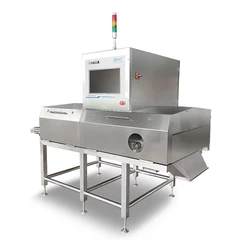
Two things are worth being precise about, because the market is not. First, near-infrared, ultraviolet and X-ray are optional detection channels, quoted per project when the defect has no visible signature — internal rot, moisture differences, transparent contaminants, density differences. They are not fitted to every machine, and a supplier who lists InGaAs spectral fusion as standard equipment on an entry-level sorter is describing someone else's machine. Second, the accuracy figure on our specification tables is ejection accuracy measured on a prepared sample; what your line achieves depends on defect type, contamination load and feed rate, which is exactly why we ask for your material before quoting a number.
Adding AI to a Color Sorter You Already Own
Most buyers do not need a new machine to get AI classification. If the chassis, chutes and ejectors are sound, the imaging head, controller and driver board are what change — which is a one-day job rather than a capital project. This is the part of the range that never appears on a specification table, so it is worth stating plainly: every model we currently build can run the AI engine, and upgrading an installed machine is a normal order, not a special favour.
If the machine is from another manufacturer, we ask for photographs of the plate, the camera head and the valve block first. Some chassis accept the swap cleanly, some do not, and the difference is mechanical rather than commercial.
Chute or Belt: Choosing the Right AI Platform
This decision is made by the material, not by the budget, and it is rarely close. Free-flowing material goes down a chute because nothing else gives the same capacity per square metre. Anything that bruises, will not slide, or is flat goes on a belt.
Chute type — free fall
Material slides down an inclined chute past the camera and is ejected in free fall. Highest capacity per square metre of floor, gentlest on nothing, and the right answer for anything that flows: rice, wheat, sesame, small seeds, plastic granule. 15 models, 0.02–12 T/H.
Belt type — carried
Material rides a flat belt at controlled speed and is inspected from above and below. Slower per metre of width, but it does not bruise product and it handles flat, heavy or irregular pieces that will not slide: soybeans, cashew, large nuts, plastic flake, mineral lumps. 4 models, 1.5–12 T/H depending on material and belt width.
Swipe the table sideways for the full mapping.
| Material | Platform | Why |
|---|---|---|
| Rice, wheat, sesame, small seed | Chute | Flows freely; capacity per m² is the deciding factor. |
| Plastic granule, pellet | Chute | Uniform, free-flowing; no breakage risk to protect. |
| Soybean, chickpea, kidney bean | Belt | Seed coat and hilum survive; chute drop causes splits. |
| Cashew, walnut, almond, pistachio | Belt | Large irregular pieces will not slide evenly. |
| Plastic flake & regrind | Belt | Flat light flakes tumble on a chute and miss the scan line. |
| Mineral lump, ore preconcentration | Belt | Heavy and irregular; needs a carried layer. |
| Defect invisible in visible light | Either + X-ray / NIR | Density or spectral channel quoted per project. |
The full engineering comparison — scan geometry, air consumption, floor space per tonne — is in chute type vs belt type.
Chute-Type AI Color Sorters: 15 Models From 0.02 to 12 T/H
Fifteen production models, all running the AI classification engine. The smallest is a bench unit for sample and lab work; the largest is an eight-chute line machine. Capacity is quoted on standard white rice, so parboiled, high-defect or unusually shaped lots will run below the figure on the plate — plan the model one step above your calculated hourly rate.
Swipe the table sideways for power, weight and dimensions.
| Model | Capacity (T/H) | Accuracy | Carryover | Power | Weight | L×W×H (mm) |
|---|---|---|---|---|---|---|
| CS-QB16 | 0.02 – 0.1 | ≥99.99 | >30:1 | 0.2 | 66 | 330×700×1000 |
| CS-CH32 | 0.25 | ≥99.99 | >120:1 | 0.7 | 105 | 450×1100×1500 |
| CS-1C64 | 0.5 – 1.0 | ≥99.99 | >10:1 | 1.2 | 350 | 955×1630×1550 |
| CS-1A64 | 0.8 – 1.5 | ≥99.99 | >30:1 | 1.0 | 157 | 800×1260×1550 |
| CS-1A80 | 0.8 – 1.5 | ≥99.99 | >30:1 | 1.5 | 189 | 820×1720×1550 |
| CS-1C96 | 1.0 – 1.5 | ≥99.99 | >10:1 | 1.8 | 500 | 1045×1630×1550 |
| CS-1C80 | 1.2 – 2.5 | ≥99.99 | >120:1 | 1.8 | 290 | 1152×1697×1708 |
| CS-2C160 | 1.5 – 2.0 | ≥99.99 | >10:1 | <2.2 | 600 | 1330×1630×1550 |
| CS-3A | 3.5 – 4.0 | ≥99.99 | >120:1 | 2.6 | 640 | 1620×1490×1690 |
| CS-6C | 4.0 – 6.0 | ≥99.99 | >10:1 | 4.8 | 1350 | 2528×1595×2040 |
| CS-7C | 4.0 – 7.0 | ≥99.99 | >10:1 | 4.8 | 1650 | 2765×1570×1850 |
| CS-6A | 5.0 – 10.0 | ≥99.99 | >10:1 | 4.8 | 1060 | 2580×1490×1690 |
| CS-8C | 5.0 – 8.0 | ≥99.99 | >10:1 | 4.6 | 1800 | 3152×1595×2040 |
| CS-10C | 7.0 – 10.0 | ≥99.99 | >10:1 | 5.5 | 2200 | 3910×1595×2040 |
| CS-12C | 8.0 – 12.0 | ≥99.99 | >120:1 | <7.5 | 2600 | 4668×1595×2040 |
Accuracy is the ejection accuracy published for each model on a prepared sample. Every model accepts the AI upgrade, including units already in service.
Belt-Type AI Color Sorters: 4 Models for Fragile and Heavy Material
The belt series carries the product instead of dropping it, which is slower per metre of width and the only correct answer for anything that breaks, will not slide, or lies flat. Single-belt units cover most jobs; the double-deck CS-LA1200D runs two layers through one frame when floor space is the constraint.
Swipe the table sideways for nozzle count and weight.
| Model | Belt width | Capacity (T/H) | Nozzles | Power | Weight |
|---|---|---|---|---|---|
| CS-LA300 | 300 mm | 0.5–1.5 | 64 | 1.75 kW | 320 kg |
| CS-LA600 | 600 mm | 2.5–6 | 128 | 6 kW | 750 kg |
| CS-LA1200 | 1,200 mm | 2.5–6 | 256 | 6 kW | 1,150 kg |
| CS-LA1200D | 1,200 × 2 mm | 5–12 | 512 | 9 kW | 2,300 kg |
Capacity on the belt series is quoted for plastic flake in three size bands and is the figure we publish elsewhere on this site; on soybeans, cashew or mineral lumps the same belt runs at a different rate because layer thickness and belt speed are set per material. The number to plan with is the one we confirm on your sample, not the one on the plate.
What an AI Color Sorter Costs, and What Moves the Number
We do not publish list prices, because two machines with the same model number and different imaging and ejector configurations are not the same machine. What we can do is tell you exactly which lines in a quotation carry the money, so you can compare suppliers line by line instead of by headline figure.
- Capacity and platform. A 0.5 T/H single-chute unit and a 12 T/H eight-chute machine share software, not hardware. Belt platforms cost more per tonne of throughput than chutes because they are slower per metre of width — that is the price of not breaking the product.
- Imaging head. Full-colour 5400 × 12K line-scan CCD is the baseline for AI classification. Where a project needs an added NIR, UV or X-ray channel, that is a separate line in the quotation and it is the only way to sort some defects at all.
- Ejector count and valve grade. More nozzles mean finer ejection and a lower carryover ratio, plus a larger compressor requirement. This is where a cheap quotation quietly cuts corners.
- Ancillaries. Compressor and dryer, dust collector, spare valve kit, elevator and conveyor. We quote the utility sheet so you can source the air system locally instead of paying freight on air tanks.
- Freight, installation and duty. Machine volume, destination port and whether our engineer attends commissioning. Ask for CIF and FOB side by side before comparing suppliers.
To get a number that means something, send four things:
- The material and its current defect rate — a photo of a bad lot is worth a page of text.
- What must come out, and what must not be lost.
- Real throughput in tonnes per hour, and how many hours a day the line runs.
- Whether this is a new line or an upgrade to a machine you already own.
AI Color Sorter FAQ
What actually makes a color sorter an AI color sorter?
The classifier. A threshold sorter compares each pixel against a colour band you set by hand. An AI sorter runs a trained network over the same pixels and scores shape, size, shade and texture together, so it can separate defects that look identical to a threshold on colour alone. The camera matters too — 5400 × 12K full-colour line-scan data is what gives the network something to work with — but the decision layer is the difference.
Can you upgrade the sorter I already own, including another brand?
On JIACUI machines, yes, across the whole range in current production. On other brands it depends on the chassis and the ejector driver: we need a photo of the machine plate, the camera head and the valve block before we can answer honestly. Send them with a material sample and we will confirm feasibility rather than promise it.
Do all 19 models really run AI?
Yes. The classification engine is not reserved for the large machines. What changes across the range is camera count, chute width, nozzle count and installed power — the software and the reasoning are the same, and a 0.5 T/H lab unit produces the same report as a 12 T/H line machine.
Is deep learning hard for my operators to use?
The interface is a material menu, not a parameter matrix. The machine scans incoming material, proposes a preset and the operator confirms it; stored recipes are recalled by name. Where a lot behaves differently from the sample, the operator trims sensitivity and ejection intensity and saves it as a new recipe. No coding, no threshold tables.
Can I test my material before buying?
Yes, and it is free. Send 20–30 kg with a note on the defects you want removed. We run it on a lab machine, send back a sorting report with the settings used and before-and-after video, and quote the model that achieved it. If your material cannot be sorted to the grade you need in visible light, the report will say so.
Where does NIR or X-ray fit in?
When the defect has no visible signature. Internal rot, moisture differences, transparent contaminant inside transparent product and density differences need a different channel: NIR for composition and moisture, X-ray transmission for density. These are quoted per project, not fitted as standard, and we will tell you when they are the only honest route to your spec.
What is the difference between AI sorting and just a better camera?
A better camera gives you more pixels of the same decision. AI changes the decision. That is why two machines can quote the same 99.99% ejection accuracy and behave completely differently on a hard lot: the number describes the ejection, not the classification. Ask any supplier to run your material; the report is the only comparison that means anything.
Further Reading on AI Sorting
Get a Tailored AI Sorting Proposal
Tell us the material, the defect and your hourly capacity. Our engineers will confirm which platform fits, whether an AI retrofit is possible on the machine you already run, and what grade is realistically achievable on your sample — usually within one working day.