



Tea Color Sorter · AI Shape + Color Sorting
A green stem and a green leaf are the same color, which is why a color sorter alone never solved tea. JIACUI builds optical sorters that read shape and color together — length, width, curvature and surface texture on one pass — so stems, stalks, yellow leaf and hair leave the line while whole leaf, tips and buds stay in the accepted stream. The same platform sorts 20 kg/h of specialty leaf and 3 t/h of CTC black tea, because the chassis changes and the algorithm does not.
What a Tea Color Sorter Removes From Your Leaf
Hand picking is slow, inconsistent and increasingly hard to staff, and it grades by eye at the speed of the picker. An optical sorter does the same four jobs on every kilogram, at a rate you set. These are the four that decide the price of a tea lot.
Stems, stalks and leaf stalk
The highest-value removal of the four, and the one a color-only machine cannot do. On green tea and oolong the stem is the same green as the leaf, so the head has to judge width, straightness and edge sharpness instead of shade. Curved, rigid, narrow objects leave; broad, soft, irregular leaf stays. On orthodox leaf the same rule takes the stalk that carries two and three leaves.
Yellow leaf, red leaf and oxidized flake
Yellow leaf in oolong, red leaf in black tea, oxidized edges in green tea: these are the faults a taster finds first because they change both the look of the leaf and the taste of the liquor. Full-color RGB capture at 5400 pixels per line separates a faint warm cast from sound leaf that a monochrome or low-resolution head averages into the accepted stream.
Hair, fiber, plastic thread and insects
The rejects that turn into a customer claim rather than a discount. Hair, woven-bag fiber, plastic thread and insect fragments are non-tea bodies and are flagged on shape and color together, at the point in the line where they are still easy to catch. This is the foreign-body control an FSSC 22000, BRC or buyer audit asks you to evidence, not just to promise.
Dust, broken grades and oversize flake
A shape-capable sorter is also a grader. Whole leaf, broken leaf, fannings and dust are separated on geometry rather than screen size, which means a factory can hold a grade specification lot after lot instead of re-screening. Grade consistency is what a repeat order is actually bought on.
Removal rates depend on the fault, the grade and the feed rate. The trial report states what your leaf actually achieves — including the cases where a shape call is marginal and a second pass is the honest answer.
Sorted by Tea Type, Not by One Setting
Every tea below runs on the same platform and none of them share a recipe. What changes is chassis, chute angle, air pressure and the shape threshold — because a CTC granule and a Longjing flat leaf have almost nothing in common except that both are tea.
Running several teas on one machine? Recipes are stored in the controller and a changeover is a menu selection. See the tea sorting solutions overview for line layouts by factory size.
How the Machine Reads a Tea Leaf
Six parts of the machine decide whether a stem leaves and a tip stays. None of them is the part suppliers usually talk about.
- 5400-pixel full-color capture
Every leaf is imaged in RGB at 5400 pixels per line with more than 16 million color combinations. Wide dynamic range matters here: a shaded edge and a genuinely yellowed edge look similar to a cheap head and completely different to a good one.
- Geometry as a sorting criterion
The network evaluates length, width, area, perimeter and curvature, not just a color value. That is what separates a 3 mm stem from a 3 mm strip of leaf — the one call tea grading depends on and the one color sorting cannot make.
- One-touch teach per lot
Feed a handful of good leaf and a handful of the fault you want gone, and the controller builds the recipe. Recipes are stored per tea and per season, so next year's first flush starts from last year's settings instead of from an engineer's visit.
- Sub-2 ms ejectors, 1 billion cycles
High-frequency solenoid valves with a response under two milliseconds and a one-billion-cycle rating. Short, precise pulses mean the nozzle takes the stem it aimed at and leaves the leaf beside it — carryover is decided here, not in the brochure.
- Gentle presentation, not a free fall
Leaf tea is light and fragile. Low-angle chutes with deceleration, or a horizontal belt that carries rather than drops, keep the whole-leaf percentage that the grade is priced on. Belt feeding is the right answer for anything that must arrive unbroken.
- Light and glass that stay clean
Shadowless LED lighting removes the blind spot where two leaves overlap, and the viewing glass is wiped automatically. On a line running three shifts in a dusty factory, dirty optics — not the algorithm — is what makes accuracy drift by mid-shift.
Chute or Belt: Choose the Chassis First
The single decision that cannot be changed later. Both chassis use the same cameras and the same software; they differ in how the leaf reaches the camera, and that decides what the leaf looks like when it arrives.
Swipe the table sideways to compare all six criteria.
| Criterion | Chute-type tea sorter | Belt-type tea sorter |
|---|---|---|
| Best fit | Granular CTC, fannings, dust, small broken grades | Whole leaf, flat leaf, bud-set, ball-rolled oolong, white tea |
| How the leaf travels | Gravity: the leaf slides down a chute past the camera | A horizontal belt carries the leaf past the camera — no drop, no impact |
| Leaf damage | Very low on granular grades; strip leaf can abrade on a steep chute | No drop height and no sliding contact, so breakage is the lowest of any chassis |
| Throughput | Highest per metre of chute width, which is why CTC lines use it | Lower per metre of width, because the belt runs one leaf deep |
| Floor space & air | Compact footprint, more nozzles per metre and therefore more compressed air | Longer footprint, fewer nozzles per tonne and lower air consumption |
| Typical choice | CTC black tea, large-volume fannings and dust lines | Specialty green, white, orthodox black, oolong and any premium loose-leaf grade |
Rule of thumb: if whole-leaf percentage appears in your selling price, the answer is belt. If your product is granular and the line runs on throughput, the answer is chute. The full chassis comparison covers material behaviour in more detail.
Tea Color Sorter Models and Specifications
Seven chute models cover a small factory through a CTC export line. Every one is the same CCD and software platform; chute count, valve grade and footprint are what change. Click a model for its page, photographs and full parameter sheet.
Swipe the table sideways for power, weight and dimensions.
| Model | Capacity (T/H, rice rating) | Carryover | Power (kW) | Weight (kg) | L×W×H (mm) |
|---|---|---|---|---|---|
| CS-1C64 | 0.5 – 1.0 | >10:1 | 1.2 | 350 | 955×1630×1550 |
| CS-1C96 | 1.0 – 1.5 | >10:1 | 1.8 | 500 | 1045×1630×1550 |
| CS-1C80 | 1.2 – 2.5 | >120:1 | 1.8 | 290 | 1152×1697×1708 |
| CS-2C160 | 1.5 – 2.0 | >10:1 | <2.2 | 600 | 1330×1630×1550 |
| CS-3A | 3.5 – 4.0 | >120:1 | 2.6 | 640 | 1620×1490×1690 |
| CS-6C | 4.0 – 6.0 | >10:1 | 4.8 | 1350 | 2528×1595×2040 |
| CS-12C | 8.0 – 12.0 | >120:1 | <7.5 | 2600 | 4668×1595×2040 |
Belt models for whole-leaf and flat tea
| Model | Belt width | Nozzles | Power | Weight |
|---|---|---|---|---|
| CS-LA300 | 300 mm | 64 | 1.75 kW | 320 kg |
| CS-LA600 | 600 mm | 128 | 6 kW | 750 kg |
| CS-LA1200 | 1,200 mm | 256 | 6 kW | 1,150 kg |
Capacity in the first table is rated on rice at normal impurity levels — it is not a tea figure. Leaf tea is far lighter per unit volume, so plan on the indicative tea range in the sizing table below and confirm it on a trial. Accuracy is ≥99.99% on every model; air supply 0.6–0.8 MPa; power supply configured to your local voltage.
How to Size a Tea Sorter for Your Factory
Most wrong purchases are wrong by one size, and almost always because the quotation was built on a rice capacity instead of a tea one. Three questions settle it.
Start from kilograms per hour, not tonnes
Tea is bought and quoted in kg/h, and a tea sorter is nothing like as fast on leaf as it is on rice — the nameplate is a rice rating. Work out the leaf you actually pass in a 20-hour day, add the peak you see at first flush, and size to that number. A factory that runs 600 kg/h of made tea should be looking at a 700–900 kg/h machine, not at a 4 t/h plate.
One pass, or a pass on the rejects?
Premium leaf usually justifies re-sorting the reject stream to recover good leaf that left with a stem. Whether that is worth it depends on your carryover ratio: at >120:1 very little sound leaf leaves, so a second pass mostly re-runs the same leaf. Ask for the ratio before you buy the second machine.
Grade, not just defect count
Two factories can both remove 95% of stems and sell at different prices, because one also holds whole-leaf percentage and grade consistency. Set the machine for the grade you sell, then measure both numbers — that is what the trial report is for.
| Your line | Indicative tea throughput* | Models to start from | Chassis |
|---|---|---|---|
| Sample room, specialty or single-origin lots | 10 – 40 kg/h | CS-QB16 (mini) | Chute |
| Small factory, single line | 100 – 300 kg/h | CS-1C64, CS-1C96 | Chute |
| Mid-size factory, two grades | 300 – 700 kg/h | CS-1C80, CS-2C160 | Chute |
| Mid-large factory, one grade | 800 – 1,500 kg/h | CS-3A | Chute |
| Large CTC or export line | 1,500 – 2,500 kg/h | CS-6C | Chute |
| 2,500 kg/h and above | 2,500 – 3,500 kg/h | CS-12C | Chute |
| Delicate, flat or ball-rolled leaf | 100 – 600 kg/h | CS-LA600, CS-LA1200 | Belt |
*Indicative for made tea at normal fault levels, for the leaf grade named. Small-particle, high-fault or very light leaf runs lower; the trial report gives the figure for your tea. Capacity and payback planning explains how to turn kg/h into a cost per kilogram sorted.
Grade, Foreign Matter and Export Requirements
Sorting is not only about looking better. On export tea it is the difference between a lot that clears inspection and a lot that is held, and it is the part of quality control a buyer can audit.
What a buyer counts in 100 g
A tea taster works from a small sample and counts: stems, yellow leaf, foreign matter, and how much of the leaf is still whole. All four are visible to an optical sorter, and all four are what the price is negotiated on. Sorting to a number you can state is worth more than sorting "better".
Foreign matter is a claim, not a discount
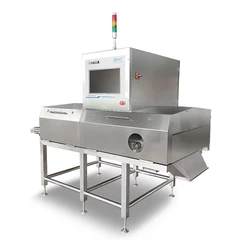
A stone in a retail pack is a broken tooth; hair or plastic is a recall. Optical sorting is one control in that chain, and buyers increasingly ask for evidence of it. Where metal or glass is a known risk in your building, pair it with an X-ray inspection unit at the end of the line — optical sorting cannot see inside a sealed pouch.
Consistency between lots
The complaint that costs a repeat order is rarely "dirty", it is "different from last time". Recipes stored per tea, per flush and per grade mean a change of lot is a menu selection rather than a re-tune by trial and error.
What Sets the Price of a Tea Color Sorter
Two quotations for "a 600 kg/h tea sorter" can differ by a factor of three, and it is rarely the margin. These five lines account for the gap — ask every supplier to break them out.
Throughput and chute width
A 64-channel single-chute unit and a twelve-chute line share software, not hardware. Capacity is the single largest line in any tea sorter quotation.
Chassis: chute or belt
A belt machine carries the leaf instead of dropping it, which costs more per kg/h and is the only correct answer for premium whole-leaf grades.
Camera, lighting and spectral options
Full-color CCD with shadowless LED is the baseline. Near-infrared (InGaAs) is an option for specific foreign-body problems, not standard equipment — treat any quotation that lists it as standard on an entry model with suspicion.
Ejector count and valve grade
More nozzles mean finer ejection and a higher carryover ratio, and a bigger compressor. This is where a cheap quotation quietly cuts corners.
Ancillaries, freight and commissioning
Compressor and dryer, dust collection, elevator or belt feed, spare valve kit. Ask for the utility sheet so you can price the ancillaries locally, and for FOB and CIF side by side before you compare suppliers.
What to send us for an accurate quotation
- The tea type and grade: CTC, orthodox strip, flat green, ball-rolled oolong, white, Pu'er or a blend.
- What must come out: stems, yellow leaf, red leaf, hair and fiber, dust, or a size split.
- Your real throughput in kg/h, and how many hours a day the line runs.
- Whether whole-leaf percentage is part of your selling price — that decides belt or chute.
- Local voltage and frequency, and the air supply you already have on site.
Five answers give a firm budget figure; a sample turns it into a guaranteed one.
Tea Color Sorter FAQ
Can an optical sorter remove tea stems that are the same color as the leaf?
Yes, and this is the specific job the machine was configured for. A color-only sorter cannot do it, because a green stem and a green leaf occupy the same part of the color space. Our head also measures length, width, edge sharpness and curvature, so a narrow, straight, rigid object is rejected while a broad, soft leaf passes — even when both are exactly the same green.
Will the air ejectors break fragile tea leaves?
The ejector is not the main risk; the drop is. Belt-fed and low-angle-chute machines keep the leaf from falling and from sliding at speed, and air pressure is set low for light material. What we will not do is quote a breakage percentage we have not measured: send 2–5 kg of your leaf and the trial report states the whole-leaf percentage before and after sorting, on your material.
How hard is it to set up a new tea season or a new lot?
Feed a small batch of good leaf and a small batch of the fault, and the controller builds the recipe. Recipes are saved per tea and per flush, so next season starts from a saved profile. Operators do this on the touchscreen; no engineer visit and no laptop.
How many kilograms per hour can one machine sort?
It depends on the tea, not just on the model. The nameplate capacity published for each model is a rice rating, and leaf tea runs well below it because the material is far lighter per unit volume. Indicative tea throughput by model is in the sizing table above; the figure for your leaf is confirmed on a trial, and we would rather give you a lower honest number than a higher one you cannot run at.
Chute type or belt type for green tea?
Belt for premium whole-leaf and flat green tea, because the leaf never falls and is never dragged across a surface. Chute for granular CTC, fannings and dust, where throughput matters more than the last percent of whole leaf. Many factories run a chute machine on the bulk grades and a belt machine on the top grade.
Does it work on CTC granular black tea at volume?
Yes — CTC is the easiest tea to sort optically, because granular flow is uniform and the contrast between fermented leaf and green unfermented particle is strong. A multi-chute sorter is the normal choice, and capacity is close to the published rating when the feed is graded first.
What about dust, lint and oil film on the viewing glass?
Tea dust settles on optics faster than almost any other product. The machines use automatic glass wiping, a dust-proof enclosure and an air purge on the camera window so accuracy holds across a three-shift week. Cleaning the glass is still on the daily checklist — see the maintenance checklist.
What do you need from me to quote accurately?
The tea type and grade, the fault you must remove, your kg/h and shift pattern, whether whole-leaf percentage affects your price, and your local power and air supply. Those five answers give a firm budget figure; a 2–5 kg sample turns it into a guaranteed one.
Further Reading on Optical Tea Sorting
Send 3 kg of your tea. We will send back the sorted result.
Our lab runs your leaf through the model we recommend, photographs the accepted and rejected streams and reports the removal rate and the whole-leaf loss you can expect — before you commit to a purchase order. Trial reports are free; you cover the courier.