


Detection gets the attention in every sales conversation. Cameras, sensors and AI algorithms are what suppliers present, and they are what buyers compare. But the component that decides how much good product you keep is the one nobody photographs: the ejection system.
A sorter that identifies every defect perfectly and then removes them sloppily will destroy more value than a sorter that misses a few. This is the part of the machine that physically converts a decision into yield, and it is where accuracy and carry-over are finally set.
Understanding the ejection chain also tells you something practical before you buy: which questions to ask, what compressor to budget for, and why two machines with identical cameras can produce very different results on the same product.
What happens in the milliseconds after a decision
Once the processor marks a particle for rejection, the physical sequence is fixed and fast.
The system already knows the particle's position, velocity and predicted trajectory, because the feeding stage launched every piece at a known speed from a known point. It computes which nozzles will be adjacent to that particle when it reaches the ejection point, and at what instant. A precisely timed delay then elapses — typically 5 to 30 milliseconds depending on belt or chute speed — and the selected valves open.
Each valve stays open for roughly 5 to 20 milliseconds, releasing a compressed-air pulse at working pressure that strikes the particle and deflects it off its natural path into the reject chute. Good product, hit by nothing, continues undisturbed into the accept stream.
Two things follow from that sequence. The entire process is a timing problem, not a force problem. And every millisecond of error translates directly into either a missed defect or a lost good particle.
Solenoid valves: the response-time budget
The valve is the fastest-moving mechanical component in the machine, and its specification is the one that matters most.
Industrial sorting valves are rated by opening and closing time. Published configurations for optical food sorters put this at under 1 ms for a full open-close cycle, with the fastest dedicated ejector valves achieving roughly 0.5–0.6 ms. In frequency terms this supports up to 300 Hz operation, and demanding grain applications push valves beyond 1,200 cycles per second.
Getting a valve open that fast is not trivial engineering, and the standard solution is instructive. These valves use a dual-voltage drive: a high voltage is applied for a fraction of a millisecond to snap the valve open, then immediately dropped to a low hold voltage that merely keeps it open. Without that second stage, the coil would overheat catastrophically at sorting frequencies; with it, power draw and heat generation stay manageable over continuous duty.
Service life is the other spec worth checking. Market-standard ejector valves are typically rated for 100 to 500 million actuations, with the spread depending heavily on operating conditions and — critically — on air quality.
Nozzle pitch: matching hardware to particle size
Nozzle spacing is the most under-specified parameter in the industry, and it should be chosen from particle size, not from price.
Published food-sorter configurations use ejector valve pitch of 4–8 mm, giving 128 to 512 valves across the working width. Belt-based machines typically run wider spacing in the 6–12 mm range; a two-metre-wide sorter therefore carries somewhere between 170 and 330 individual valves, each capable of firing 200 to 400 times per second.
The selection logic is straightforward:
- Dense pitch for small particles. Rice, sesame and fine tea need a nozzle close enough to the target that the air jet has not dispersed before it arrives. Space them too widely and small particles drift out of the effective jet.
- Wider pitch for large particles. Whole nuts, coffee beans and ore fragments are heavy enough that wide spacing is sufficient, and fewer valves mean lower air consumption and far less maintenance.
A practical consequence: a machine optimised for rice will be over-built and over-maintained on nuts, and a machine optimised for nuts will under-perform on sesame. This is exactly why material must be specified before configuration.
Air supply: pressure, volume and quality
Compressed air is the largest controllable operating cost in a sorting plant, and it is the most common cause of sorting faults that get misdiagnosed as electronic problems.
Pressure. Ejection systems work in the 2–6 bar range, with some configurations running to 7 bar. Large chute machines may consume up to 6.5 m³/min at 0.5–0.8 MPa.
Volume. A useful planning figure: a two-metre sorter at 80% loading consumes roughly 3,000–6,000 normal cubic metres per hour at 6 bar, which translates to 20–40 kW of continuous compressor electrical load. Smaller optical food sorters are specified at 300–1,200 Nl/min at full reject. On the compressor itself, grain-handling practice scales from about 15 HP for small machines to 40 HP for large multi-chute units.
That compressor load belongs in your operating budget and your electrical design, not in an afterthought.
Quality. This is where most field problems originate. The air supply must be oil-free, dry and filtered. Moisture or oil contamination clogs solenoid orifices and causes valves to stick or under-fire; in humid coastal plants, an air dryer on the ejector supply line is not optional. Recommended architecture is an oil-free screw compressor with dryer and filtration, feeding an accumulator tank that holds reserve volume for peak demand, with a pressure regulator holding every burst at identical pressure regardless of plant fluctuations.
Matching valve flow rate to material
Valve sizing is expressed as flow rate, and the matching table is one of the most directly useful pieces of selection guidance available:
| Material class | Examples | Typical valve flow |
|---|---|---|
| Small and light | Sesame, quinoa, fine tea leaf | 40–300 L/min |
| Medium | Rice, wheat, beans, small pellets | 400–1000 L/min |
| Large and heavy | Whole nuts, coffee, ore, large plastic flake | 2000–4000 L/min |
The reasoning is momentum. A sesame seed and a cashew kernel differ in mass by orders of magnitude, and the air pulse must be sized to move the target far enough to clear the splitter without being so energetic that it catches neighbouring product.
Where ejection faults actually come from
When sorting quality degrades, the ejection system is the first place to look, and the causes are usually mundane:
- Worn or slow valves. As coils and springs age, response time lengthens. The valve still fires, but late — so the pulse arrives behind the target. This shows up as falling rejection efficiency rather than as an obvious fault.
- Compressed-air leaks. A leaking manifold starves the valves, and they under-fire. Purity drops, and the symptom looks like a detection problem.
- Contaminated air. Oil or moisture in the supply fouls orifices progressively.
- Nozzle blockage. Dust-laden or sticky product accumulates at the nozzle tip, particularly in mineral and recycling applications.
- Incorrect pulse duration. Too short and targets survive; too long and you blow away good neighbours.
- Timing-window miscalibration. The scan-to-eject delay must track actual product speed. If feed rate changes and the timing model does not, targets are missed entirely.
Tuning the trade-off: rejection against carry-over
The single adjustment with the most economic consequence is valve-open duration, and it is a direct trade.
Short pulses conserve air and spare neighbouring product, but light or marginal targets may not be deflected far enough and fall into the good stream. Longer pulses guarantee removal of everything targeted, but the blast is wider than the target and carries good product with it.
That trade is the mechanical origin of carry-over — the ratio of good product to genuine defect in the reject stream. It is why a machine tuned to "remove absolutely everything" can be the most expensive machine you own, and why the correct target is an economic optimum rather than maximum rejection. We cover the diagnostic side in detail in Why your sorter rejects good product.
Specifying an ejection system: the checklist
Before you sign, these are the questions worth asking, because they separate a configured machine from an assembled one:
- Valve response time — under 1 ms, with the frequency rating stated?
- Nozzle pitch — matched to my smallest particle, or to the supplier's default?
- Valve count — adequate across the full working width?
- Flow rate class — matched to my material's mass?
- Air consumption — stated in Nl/min or m³/min at a named pressure, so I can size a compressor?
- Air quality requirement — what filtration and drying is specified, and is it included?
- Reserve and regulation — accumulator tank and pressure regulator present?
- Spares policy — valves are consumable at some horizon. What is the lead time and price?
What this means on JIACUI machines
Ejection is configured per machine on the same logic as the rest of the build: nozzle pitch and valve flow class selected for the target material, not averaged across the range.
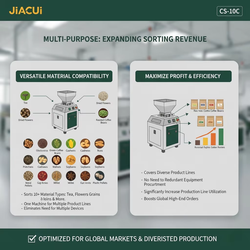
The chute range runs from the compact CS-QB16 at 20–100 kg/h through CS-HA32, CS-4A and CS-5A to the CS-7A at 6–12 T/H, with belt machines — CS-LA300, CS-LA600, CS-LA1200 and the double-deck CS-LA1200D — for products that must travel flat. The double-deck configuration is worth noting here: it permits a second sorting pass on the rejected stream, which is the mechanical way to recover good product carried over in the first pass.
Across the range the published baseline is sorting accuracy ≥99%, measured on polished japonica-type rice at roughly 2% foreign content. We state the condition because an accuracy figure without one is not a specification you can compare.
FAQ
Why does my sorter get worse during the afternoon?
Usually heat and dust, in that order. Ambient temperature shifts affect air density and lamp output, and dust on the viewing window attenuates illumination progressively through a shift. If the drop is sudden rather than gradual, suspect the compressed-air supply first.
How do I know a valve is failing?
A healthy valve fires crisply; a failing one becomes sluggish and its response time lengthens, so it ejects late. The practical test is to measure carry-over and rejection efficiency together over time — a valve problem moves both, in opposite directions.
Can I just increase air pressure to improve sorting?
Only to the pressure the system was designed for. Above specification you increase air consumption, accelerate valve wear and widen the effective blast, which raises carry-over. The gain in rejection is usually paid for several times over in lost good product.
Is a bigger compressor better?
Not necessarily — an oversized compressor that short-cycles wastes power and delivers less stable pressure. Size it to the stated consumption plus a sensible margin, and prioritise dryness and filtration over raw capacity.
Do belt and chute machines need different ejection setups?
Yes, because the product trajectory differs. A belt machine launches product on a fixed parabolic path from a known point; a free-fall chute machine has product accelerating under gravity. The scan-to-eject timing model and the nozzle geometry are set accordingly.
How much should I budget for compressed air?
Use the sorter's stated consumption at working pressure, add your rejection rate as a duty factor, and convert to compressor kW — for a mid-size machine that is typically a 20–40 kW continuous electrical load, which is a real line item in the operating budget. Full cost modelling is covered in Color sorter ROI and capacity planning.