


Every coffee lot that leaves a mill carries two numbers that determine its price: the grade, decided by how few defective beans remain, and the yield, decided by how much saleable product survives the cleaning process. Traditional graders, densimetric tables and hand-picking crews can improve one of those numbers, but usually at the expense of the other.
Optical sorting is the only technology that improves both at the same time. This guide explains what a modern coffee bean color sorter actually detects, how to match a machine to your throughput, and where the real money is made or lost — written for millers, exporters and roasters who are specifying equipment rather than just researching it.
If you want the short version first: sorting green coffee is a defect-removal problem, sorting roasted coffee is a product-protection problem, and the machine that excels at one is rarely the best choice for the other. Everything below builds from that distinction.
Why color sorting decides your final grade
Most exporting countries grade coffee under variants of the SCA (Specialty Coffee Association) or national standards. Regardless of the specific scheme, the counting logic is similar: a sample of 300–350 grams is inspected and classified by defect count.
| Grade band | Typical requirement | Commercial impact |
|---|---|---|
| Specialty / Grade 1 | 0 primary defects, ≤5 full defects | Direct trade pricing, cupping score premium |
| Premium / Grade 2 | ≤6 full defects, no primary | Standard export contract |
| Commercial grade | Higher tolerance | Commodity pricing, blended into lots |
The rules are unforgiving in one specific way: a single primary defect (usually a black bean or a sour bean) can disqualify a sample from specialty grade entirely. Inspection is statistical, which means a lot that averages well can still fail because one handful contained an insect-damaged bean.
This is why displacement-by-density and manual sorting struggle. Both remove the *average* problem. Neither reliably removes the rare, catastrophic bean hidden in a flow of several hundred kilograms per hour. Optical inspection sees 100% of the stream, bean by bean, thousands of times per second.
What a coffee bean color sorter actually detects
A coffee color sorter combines four subsystems that each need to be specified correctly. Most disappointing installations are the result of someone optimizing one subsystem and neglecting the others.
- Feeding — beans must be presented as a stable, single-layer curtain. Vibration feeders and chute channels stabilize the flow; poor feeding causes overlapping beans, which to the camera look like one large defect.
- Illumination — LED arrays with controlled spectrum and intensity. Coffee is a low-contrast material: a quaker (under-developed bean) differs from a good bean by a small shift in luminance, not by an obvious color change.
- Optical acquisition — high-resolution line-scan cameras capture RGB data at line rates fast enough that a bean travelling several metres per second is sampled dozens of times.
- Ejection — pneumatic valves fire a precisely timed air pulse to deflect rejected particles into the reject chute. Valve response time, not camera resolution, is often the limiting factor on small-bean applications.
The interesting part is where AI and traditional threshold sorting diverge. A threshold algorithm asks "is this pixel outside my tolerance band?" — which works well for a black bean in a flow of green beans. It fails badly with acceptable natural variation: a japonica-type bean ranges from translucent to creamy depending on cultivar and processing, and a threshold tight enough to catch subtle defects will also reject that legitimate variation. For coffee specifically, this is the difference between recovering 98% of your saleable beans and losing a meaningful percentage of them into the reject bin.
You can read the deeper technical comparison in our article on AI deep learning in color sorting.
The coffee defect catalogue
Knowing which defects your machine must catch is the starting point for machine specification. They divide into three groups with very different removal difficulty.
Primary defects — the automatic grade-killers. Black beans (often from over-fermentation or dead cherries), sour beans (under-fermentation), mouldy or fungus-damaged beans, and insect-damaged beans. These usually show strong color contrast and are removed with high reliability by any decent RGB system.
Secondary defects — quality reducers rather than Grade killers. Broken and chipped beans, immature or "floater" beans, parchment fragments, and partial black beans. These need finer color discrimination and often a second sorting pass.
Foreign material — stones, twigs, metal fragments, glass, husk fragments and dust. Most of these are best handled upstream by destoning and aspiration; asking the color sorter to do this job exclusively will cost you capacity. Note that dense foreign material and X-detectable contaminants are better addressed by X-ray sorting systems.
| Defect class | Detection difficulty | Recommended approach |
|---|---|---|
| Black / sour beans | Low | Single RGB pass, high sensitivity |
| Mould, insect damage | Medium | RGB + trained defect model |
| Broken / chipped | Medium | Size + shape discrimination |
| Parchment, husk | Medium–high | Second pass or aspiration pre-clean |
| Stones, glass | High by color alone | Pre-clean destoner or X-ray stage |
Green versus roasted: two different problems
Green bean sorting happens before export, at moisture contents around 10–12%. The material is hard, flows predictably, and tolerates free-fall. Throughput and defect sensitivity are the priorities, because the mill has thousands of bags to process and every hour of line time is money.
Roasted bean sorting happens after roasting, at the roastery. Here the priorities invert completely:
- The beans are brittle. Free-fall onto steel chutes creates breakage, and broken roasted beans are either downgraded or sold as a lower-value product.
- The material has been through a 200°C process. Downstream packaging wants whole beans, especially for whole-bean retail SKUs.
- Oil migration can create surface sheen that confuses simple color algorithms.
- Batch sizes are smaller but product value per kilogram is far higher, so over-rejection of good roasted beans is expensive.
The practical consequence: green coffee is usually sorted on a high-capacity chute-type machine, while roasted coffee is usually sorted on a belt-type (crawler) machine that conveys beans gently at controlled speed. We cover the platform trade-off in detail in the chute versus crawler comparison, and the specific parameter differences in our follow-up guide on green versus roasted coffee sorting.
Throughput planning: matching machine to your line
The most common specification mistake is buying to peak capacity rather than to the average. A sorter rated for 6–12 T/H does not need to run at 12 T/H; running a machine continuously at 100% of its rated maximum leaves no margin for feed variation and typically increases the carry-over of good product into reject.
| Production scale | Suggested configuration | Typical machine class |
|---|---|---|
| Sample / micro-lot, lab | Bench unit, 20–100 kg/h | CS-QB16 class tabletop sorter |
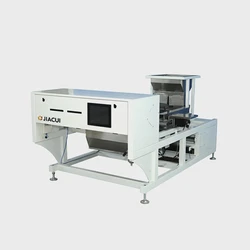
| Small mill, 1–3 lines | Compact chute machine | CS-4A class vertical chute sorter |
| Mid-size exporter | Multi-channel chute sorter | CS-5A class chute sorter |
| Large exporter / roaster supply | High-capacity multi-channel | CS-7A class chute sorter, 6–12 T/H |
| Roasted beans and fragile kernels | Belt / crawler platform | CS-LA1200D class double-deck crawler |
Sizing rule of thumb used by most mills: size the sorter so that normal operation sits at 60–75% of rated maximum capacity. This preserves defect sensitivity (beans stay in a stable single layer rather than stacking) and leaves headroom for seasonal peaks.
If you are building a new line, note the Brazilian and Colombian installations we documented for the CS-LA1200D double-deck crawler, which were sized precisely on that principle.
What ≥99% sorting accuracy really means
Suppliers quote accuracy generously and define it inconsistently. The honest definition used in our own documentation is:
Sorting accuracy ≥99%, measured at a defined baseline condition of polished japonica-type rice with approximately 2% foreign content.
Two things follow from that sentence, and both matter commercially:
- The number is condition-dependent. Cleaner input gives better apparent results; dirtier input gives worse. Any supplier quoting accuracy without stating the test condition is not giving you a comparable number.
- Accuracy alone does not describe yield. A machine can hit 99% accuracy while rejecting a painful amount of good product alongside the bad. What you actually want to know is the carry-over ratio (good product lost into the reject stream). There is a full explanation in our article on what color sorter accuracy really means.
For coffee specifically, ask for a factory acceptance test on your own product. Ten kilograms of your green beans run through the machine before shipment will tell you more than any datasheet.
Integrating into an existing line
A sorter is rarely installed alone. Typical placement in a green coffee line is after destoning and aspiration, before grading and bagging, so that the optical stage handles what mechanical cleaning cannot. For roasted lines it usually sits between the roaster's cooling tray and the packaging machine, often with a metal detector upstream.
The three integration questions that most affect performance are simple but frequently skipped:
- Is there a surge hopper upstream? Feed starvation causes the machine to process in bursts and reduces consistency.
- Is compressed air available at the required volume and dryness? Ejector valves are the single largest consumer of air in the plant, and wet air fouls them.
- Is there a re-inspection path? Most facilities either re-run reject once or route it to a second, higher-sensitivity pass.
Remote diagnostic capability is worth specifying if you operate multiple shifts or multiple sites; it is covered in our article on remote debugging and IoT for color sorters.
FAQ
Can one machine handle both green and roasted coffee?
Technically yes if it is a belt-type platform, and many roasters do run both. But throughput differs enormously — a mill pushing several tons per hour of green and a roaster pushing a few hundred kilograms per hour of roasted do not want the same machine. If you do both in volume, two machines sized to each stage will outperform one compromise machine.
How much product loss should I expect?
That depends entirely on input quality, which is why it must be measured rather than promised. On well-pre-cleaned green coffee, total loss including defects is typically low single digits. On dirty input with high stone or husk content, expect substantially more — and address the pre-cleaning rather than tightening sorter sensitivity, which trades away good beans.
Does the sorter need different settings for different origins?
Yes. A natural-process Ethiopian lot behaves differently from a washed Central American one, and both differ from a monsoon-processed Indian lot. Modern machines store recipes so operators can switch configurations per lot; if you process many origins, recipe management matters more than raw sensitivity.
Will it remove mycotoxin / ochratoxin contamination?
A color sorter cannot measure toxin content. What it does remove is the visible mould damage that is strongly correlated with toxin risk, which is why sorters are used as a control point inside a broader food safety programme rather than as a substitute for testing. See our guide to food safety compliance including HACCP, FDA and EU requirements.
What about power consumption?
Sorting is not especially power-hungry, but compressed air is expensive and often overlooked. On large installations air consumption dominates running cost. Our energy efficiency analysis breaks down typical figures by machine class.
How often does maintenance interrupt production?
Daily cleaning of the optical window and weekly filter checks are operator-level tasks of a few minutes. Anything beyond that depends heavily on how well the pre-cleaning and air supply are managed. The full schedule is in the color sorter maintenance checklist.
Where to start
If you are specifying equipment today, the most useful next step is not reading more datasheets — it is sending us a sample. Run ten kilograms of your own coffee through the machine before you commit, evaluate the accept and reject streams side by side, and judge the result on your own two numbers: grade achieved and yield retained.
Browse the coffee bean color sorter range, review the wider product catalogue, or contact our engineering team to arrange material testing.