


Nuts present the sorting engineer with an awkward combination: the product is high value, physically fragile, and its defects are frequently low contrast. Get any one of those three wrong and you either destroy premium product, ship visible defects, or both.
This guide covers the three largest commercial nut categories — almonds, walnuts and peanuts — explaining what each needs removed, why they break, and how to configure both machine and line to keep whole kernels intact.
Why nuts are harder than grains
Grains arrive hard, dry and predictable. Nuts do not:
| Property | Consequence for sorting |
|---|---|
| High oil content | Surface sheen confuses simple color algorithms |
| Brittleness after processing | Mechanical handling creates the defects you are trying to avoid |
| Irregular 3D shape | Free-fall presentation is unstable, hurting detection consistency |
| High value per kilogram | Over-rejection is expensive in absolute terms |
| Skin / testa variation | Legitimate variation resembles defect to naive thresholds |
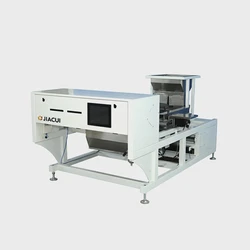
The practical result is that chute-type free-fall handling, standard for rice and many grains, is often inappropriate for premium nuts. Gentle belt conveying costs more and runs slower, and is usually still the correct choice because the alternative converts whole kernels into lower-value pieces.
Almonds: the shell-fragment problem
Almond processing produces a mix of challenges that differ from most tree nuts because significant sorting happens after blanching.
What must be removed: shell fragments (hard, sharply contrasting, unfortunately often similar in size to kernels), doubles and rejects embedded material, insect damage, rancid or discoloured kernels, and brown-spotted kernels indicating prior mould risk.
The shell-fragment problem deserves specific attention. Shell material is light-coloured and similar in apparent brightness to almonds in some lighting conditions, but its structure differs. Simple color thresholds misclassify both directions — missing fragments and rejecting kernels. This is a case where trained recognition handling texture, not just hue, performs materially better; see AI deep learning in color sorting.
Almonds are relatively robust for a nut, which means chute handling can be acceptable for lower-value streams, while premium whole-kernel lines usually justify belt platforms. Note also that almond lots often contain hidden insect damage best caught before storage.
Walnuts: irregular shape and fragile halves
Walnut halves are the most geometry-challenging material in nut sorting. They are irregular, curved, often presenting no flat surface toward the camera, and they fracture extremely easily.
Key challenges:
- Shell fragments embedded or loose in kernel lots — the primary removal target.
- Discoloured and mouldy kernels — including internal mould that is not surface-visible, which is why walnut lines frequently supplement optical sorting with other detection.
- Breakage prevention. Walnut halves lose most of their value once quartered. Minimizing drop height is not optional, it is the whole design brief.
For walnuts, belt-type platforms with minimized transfer points are almost always correct. If a specification proposes free-fall at multiple stages, question it directly.
Peanuts: volume, aflatoxin pressure and redskin variation
Peanuts sit at the opposite end: high volumes, lower per-kilogram value than tree nuts, but severe food-safety pressure, particularly regarding aflatoxin.
Target defects include damaged and shrivelled kernels, visible mould, darker seed coats, germinated kernels, aflatoxin-suspect kernels (visible correlation only), plus stones and clods.
Two important points specific to peanuts:
- Redskin peanuts show legitimate wide natural color variation between kernels. Detecting subtle damage inside that variation is exactly the low-contrast problem described for other materials, and aggressive settings will cost significant kilogram yield.
- The aflatoxin correlation is real but limited. Optical sorting removes kernels with visible mould damage, and this statistically reduces toxin load, but it does not measure toxin. Any claim that a sorter "removes aflatoxin" should be treated as imprecise; the honest framing is risk reduction within a broader control programme. See food safety compliance including HACCP, FDA and EU requirements.
Because volumes are high and margins thinner than tree nuts, peanut lines often use chute-type units at higher throughput, reserving gentler platforms for premium blanched or whole-kernel products.
Comparison: configuration by nut type
| Nut | Main removal targets | Typical platform | Dominant risk |
|---|---|---|---|
| Almond (shelled) | Shell fragments, discolouration, insect damage | Chute for volume; belt for premium | Missing embedded fragments |
| Almond (blanched/premium) | Skin remnants, blemish | Belt-type | Physical damage during handling |
| Walnut halves | Shell fragments, mould | Belt-type essential | Breakage destroying value |
| Peanut (raw) | Mould, damaged, stones | Chute-type, high volume | Missed contamination |
| Peanut (blanched premium) | Skin fragments, discolouration | Belt-type | Over-rejection at volume |
Breakage: most of it is created before the sorter decides anything
As with cashew, most broken kernels in a nut line are created by handling rather than sorting decisions. The checklist that matters:
- Reduce drop height. Every vertical transfer is a breakage opportunity. This is the highest-impact change available.
- Use impact-absorbing surfaces at unavoidable transitions, in food-grade materials.
- Eliminate sharp transitions in conveying — elbows and sudden direction changes cause kernel-to-kernel collisions.
- Tune ejector pressure downward. Excessively strong air pulses damage neighbouring kernels, not just the target. Set the minimum that reliably deflects.
- Do not overfeed. Beyond reducing detection quality, excess feed creates tumbling and impacts.
Measure rather than assume: run a known mass through with ejection disabled, quantify breakage, then compare with ejection active. The difference is your machine-induced loss. On premium tree nuts anything above roughly one percent deserves investigation.
A full platform trade-off analysis is in chute-type versus crawler-type sorters.
Managing low contrast: lighting and models
Improving detection on difficult nut defects comes from three levers, in rough order of impact:
- Illumination design. Spectrally controlled LED lighting with consistent geometry reveals defects that ordinary lighting flattens away. This is usually the cheapest meaningful upgrade.
- Trained recognition models. Learning defective appearance from thousands of real examples tolerates natural variation in a way single-threshold systems cannot. Background in AI deep learning for sorting.
- Camera configuration. Higher resolution helps on small defects but delivers little if lighting and models are wrong — often mis-sold as the primary lever.
Equally important is consistency. A machine performs to specification only while optics stay clean and calibrated; nut oils and dust are aggressive on optical surfaces, so cleaning frequency must be higher than on grain lines. See the maintenance checklist.
FAQ
Can one machine handle several nut types?
Usually yes with stored recipes, though settings differ substantially between almonds, walnuts and peanuts. If you process multiple types commercially, prioritize recipe management and quick-change cleaning over raw throughput.
Why do I lose so many good kernels into reject?
Most often either sensitivity set too aggressively for your material variation, or unstable feed causing overlapping particles. Address presentation first — it frequently resolves the issue without touching sensitivity. Detailed diagnostics are in our article on over-rejection.
Is belt-type always better for nuts?
Not always. For high-volume peanuts or lower-value streams where the product tolerates handling, chute machines are more economical and perfectly appropriate. Reserve belt platforms for premium whole-kernel products where breakage cost exceeds the extra capital.
How do we handle internal mould that is not visible?
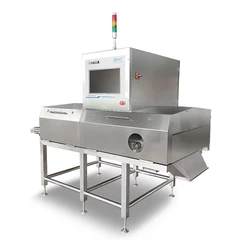
Optical sorting cannot see inside kernels. Internal defects require different technology — this is one application where X-ray sorting systems genuinely add capability rather than duplicating it.
Do you need different settings per variety?
Yes. Almond varieties differ significantly in skin color and size, and peanut classes differ markedly. Expect to develop and store a recipe per variety, and revalidate seasonally as new-crop characteristics shift.
What maintenance matters most for nut lines?
Oil and dust accumulation on optics, more than anything else. Establish daily cleaning of optical surfaces and regular inspection of feed contact parts. Nut operations that adopt grain-line cleaning schedules routinely under-perform within weeks.
Practical next steps
Decide first whether your priority is defect removal (typical for peanuts and lower-value streams) or yield protection (typical for premium tree nuts). That single decision dictates platform, feed rate, sensitivity philosophy and ejector tuning.
Review appropriate machine classes in the nut color sorter range, and note the overlap with cashew handling, which shares the same delicacy constraints. The most reliable evaluation is empirical — send us a sample of your kernels and assess accept and reject streams against your own grade specifications.