


Rice is the most unforgiving optical sorting application in the food industry, and for one reason: the buyer sees every defect. A sack of rice is poured out and visually assessed in seconds. Chalky kernels, yellow grains, broken tips and the occasional stone are all immediately visible, and they are the difference between a contract renewed and a container rejected.
Unlike materials where sorting protects high-value units, rice sorting is about purity at scale. Volumes are enormous, margins per kilogram are thin, and the standard applied is directly visible to the customer. This guide covers what actually needs removing, where accuracy claims come from, and how to configure a rice line properly.
What "export grade" actually requires
Export specifications vary by destination and buyer, but they converge on the same parameters. Understanding them tells you exactly what your sorter must do.
| Parameter | Typical specification | Sorting relevance |
|---|---|---|
| Broken content | Often ≤5%, sometimes ≤2% for premium | Size/shape discrimination, plus gentle handling |
| Chalky / immature kernels | Low single digits | Subtle white-on-white contrast — the hard part |
| Yellow / damaged kernels | Very low tolerance | Discolouration detection |
| Paddy (unmilled) | Should be near zero | Prior to destoning stages usually |
| Foreign material | essentially nil | Stones, glass, metal — most needing more than color |
Notice the pattern: the visible defects are precisely those with poor contrast. A black stone against white rice is trivial. A chalky kernel against white rice differs only in opacity and subtle yellowing — this is where good and poor sorting installations separate.
The technical baseline: where "≥99%" comes from
Accuracy figures are quoted loosely across the industry, so it helps to know the origin of the number. Our own stated figure is deliberately specific:
Sorting accuracy ≥99%, measured at a defined baseline: polished japonica-type rice with approximately 2% foreign content.
There are three important implications for anyone specifying equipment:
- The condition is part of the number. Cleaner input appears to improve performance; dirtier input degrades it. A supplier quoting 99% without stating the test condition is not offering you anything comparable.
- Accuracy describes rejects, not yield. A machine can achieve 99% accuracy while discarding a great deal of acceptable rice alongside defects. The number you actually need is the carry-over ratio — good product lost into reject. Our article on what color sorter accuracy really means explains the distinction fully.
- Rice is the reference material because it is the standard test. If your material is not rice, expect different behaviour and test accordingly.
Where mechanical cleaning ends and optical begins
A frequent design error is asking the sorter to do work that cheaper equipment handles better. Rice mills should arrange stages so each device does what it does best:
- Destoning first. Stones are dense and mostly removed by gravity separation far more economically. Asking a color sorter to catch stones means it will also mis-reject discoloured rice.
- Aspiration for light material. Husk, dust and chaff are cheaply removed by air before the optical stage. Removing them improves optical consistency materially.
- Optical last. The sorter handles what mechanical stages cannot: subtle discoloration, chalky kernels, partial damage, and the residual foreign material that escaped upstream.
Arranging it this way is cheaper, faster, and results in better sorting, because the sorter sees a cleaner, more uniform stream.
Platform choice for rice: chute versus belt
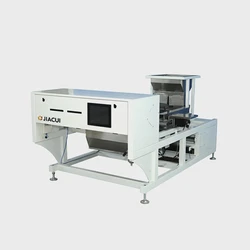
Polished white rice is relatively hard and free-flowing, so chute-type machines typically suit rice better than belt platforms. They deliver higher throughput at lower capital cost, which matters because rice lines run continuously at volume.
Belt platforms remain appropriate for specific cases: brown rice, parboiled rice with more fragile surfaces, or specialty and organic lots where higher per-kilogram value justifies gentler handling and lower throughput. The full platform comparison, including capacity ranges and breakage data, is in our dedicated article on chute-type versus crawler-type sorters.
| Rice type | Recommended platform | Reason |
|---|---|---|
| Polished white rice | Chute-type | Hard, free-flowing, high volume |
| Brown rice | Chute or belt | Slightly more fragile bran layer |
| Parboiled rice | Belt-type often preferred | Denser but more brittle surface |
| Specialty / organic | Belt-type | Higher value justifies gentler handling |
| Broken recovery grading | Either, with shape discrimination | Size-based separation task |
Capacity planning for a rice mill
Rice lines are typically continuous, multi-shift operations, so capacity planning has more in common with process engineering than purchasing. Key considerations:
- Size to 60–75% of rated maximum for routine production. This keeps kernels presenting in a stable single layer, which directly improves detection and reduces false rejects.
- Plan the re-sort loop. Even well-configured sorters send some good rice to reject. Either route reject back through a second pass or use a smaller dedicated unit for recovery. On thin rice margins, this recovery pays for itself.
- Account for compressed air. Ejector valves dominate running cost on high-tonnage rice lines. Undersized air supply causes inconsistent ejection and therefore both missed defects and wasted product. See our energy consumption analysis.
- Plan for multiple grades. Mills running several rice varieties need recipe storage and quick switching; nutrition-grade lots and premium export lots do not want the same sensitivity.
Getting chalky-kernel removal right
This is the single hardest rice application, and worth its own note because it is where most mills are disappointed.
Chalky kernels are white against white. Their difference lies in opacity and internal structure, not surface color. RGB threshold systems handle them poorly. Improvements come from three directions, roughly in order of effectiveness:
- Better illumination geometry. Controlled lighting reveals internal structure differences that flat frontal lighting hides.
- Trained recognition models. Models learn chalky texture from examples rather than relying on a single threshold — covered in depth in AI deep learning for color sorting.
- Conservative feed rate. Chalky detection is degraded by overlapping kernels. Slowing slightly improves both detection and yield.
Mills that cannot achieve chalky removal to spec usually have problems in all three areas rather than needing a fundamentally different machine.
Quality systems integration
Rice exporting almost always requires documented food safety controls, and the sorter is a legitimate control point within that system — but with clearly understood limits.
A sorter cannot measure pesticide residues, heavy metals or microbial contamination. What it does remove is foreign material and visibly damaged kernels, which are themselves compliance parameters and often contractual. Document it as a control measure within your HACCP plan, maintain calibration and cleaning records, and never treat it as a substitute for laboratory testing. Full coverage in our guide to HACCP, FDA and EU compliance.
FAQ
Why does my sorter miss some yellow kernels?
Usually either feed presentation — kernels overlapping so the camera sees an averaged surface — or lighting calibration drift. Check cleanliness of optical windows and feed uniformity before increasing sensitivity, because raising sensitivity on a rice line typically costs more good rice than it recovers in defects.
How often do optics need cleaning?
Rice dust is abrasive and oily. Daily operator-level cleaning of windows and feed surfaces is normal; anything less will show up as declining detection within a shift. Full schedule in the maintenance checklist.
Can the same sorter handle rice and other grains?
Generally yes, but sensitivity and feed settings differ substantially between rice, wheat, maize and pulses. Recipe storage is essential if you process multiple grains, and expect some yield compromise when switching compared to a dedicated line.
Should I re-sort the reject stream?
On rice, usually yes. Reject contains defects plus acceptable kernels carried over by the ejection process. A second pass or small recovery unit is standard in well-run mills.
Does broken rice get sorted out or sorted separately?
Both are possible. Many mills deliberately sort to *separate* brokens for sale rather than merely discard them, since brokens have their own market. This needs size and shape discrimination — confirm capability when specifying.
Is X-ray needed for rice?
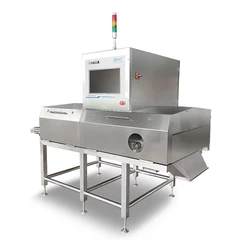
For most foreign-material cases no — destoning and optical sorting cover it. But dense or embedded contaminants and certain stone types are better caught by X-ray sorting systems, particularly for premium infant-food or baby-rice lines where tolerance approaches zero.
Where to begin
Rice sorting succeeds on configuration, not just hardware. Define your target against an actual buyer specification, arrange mechanical cleaning correctly upstream, size the machine below its maximum, and plan reject recovery. Those four decisions determine results more than the brand on the machine.
Review machine classes in the grain color sorter range, read the broader methodology in how to choose the right color sorter, and then do the decisive thing: send us 10 kg of your rice and evaluate the accept and reject streams yourself.