


Pulses — lentils, chickpeas, beans, peas and cowpeas — are among the highest-volume optical sorting applications in food processing, and among the most economically sensitive. Margins per kilogram are thin, volumes are enormous, and buyers apply visual standards that leave little room for error.
The defining characteristic of pulse sorting is a contrast problem: defects frequently differ from acceptable product in subtle ways, while the occasional high-contrast foreign item (a stone) demands immediate removal. Handling both in one pass is what separates good installations from frustrated ones.
This guide covers what needs removing in pulses, why stones specifically complicate the picture, and how to configure a line to hit specification without sacrificing yield.
What actually needs removing
Pulse defect categories divide cleanly by detection difficulty, which determines how your machine should be configured.
| Defect class | Examples | Detection difficulty | Notes |
|---|---|---|---|
| Discolouration | Darkened lentils, chalky chickpeas, aged appearance | Medium–high | Often subtle; the largest group by volume |
| Insect damage | Bore holes, weevil damage, frass | Medium | Pattern recognition outperforms color alone |
| Physical damage | Split, broken, shrivelled | Medium | Size and shape discrimination |
| Foreign material | Stones, clods, glass, metal | Variable | See dedicated discussion below |
| Adhering material | Pod fragments, stalks, dust | Low–medium | Mostly handled upstream |
A crucial commercial note: pulses often have both an export grade and domestic price, and the difference can be substantial. Sorting to export specification is therefore a direct revenue decision, calculated rather than merely technical. The sizing methodology in our ROI and capacity planning guide applies directly.
The stone problem
Ask any pulse processor about their most expensive sorting failure and it will almost certainly involve stones, not color.
The issue is physical: stones and mineral clods frequently approximate the size and often the color of the pulses themselves. A grey limestone fragment among grey lentils presents almost no color contrast. But unlike discolouration, where a missed unit costs quality points, a missed stone risks:
- Damage to downstream processing equipment,
- A customer complaint or worse, product recall,
- Loss of a contract worth vastly more than the machine.
The correct answer is do not ask the color sorter to do this alone. Proper configuration:
- Destone first, mechanically and economically, reducing stone load dramatically before the optical stage.
- Use the sorter as confirmation, catching residual material that escaped destoning.
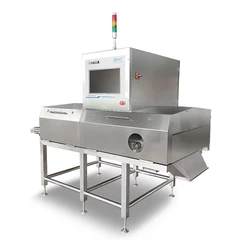
- Add X-ray where tolerance is genuinely near zero or where purchased grades demand it — the technology class is described in our X-ray sorting overview.
Processors frequently try to solve stones by increasing color sensitivity. This is counterproductive: it discards acceptable pulses without reliably catching low-contrast stones, worsening yield while failing to solve the real problem.
Why discolouration is harder than it looks
Lentils and beans show legitimate variation within a single lot. Different varieties, and even different maturity or storage conditions within one variety, produce a spread of natural hues. Then genuine defects sit inside that spread.
This creates exactly a situation where single-threshold RGB analysis fails: tighten enough to catch all defects and you reject legitimate variation; loosen enough to preserve yield and you ship defects.
The fixes, in order of cost-effectiveness:
- Consistent illumination. Properly specified LED lighting reveals distinctions that flat lighting collapses. This is usually the cheapest upgrade with the largest effect.
- Trained recognition models. Classifying on multiple learned features rather than one threshold tolerates natural variation while still flagging genuine defects. Full technical background in AI deep learning for color sorting.
- Stable feed presentation. Overlapping units cause the camera to read averaged surfaces, hiding small defects and creating phantom ones. This is the most commonly overlooked factor and one of the cheapest to correct.
Platform choice for pulses
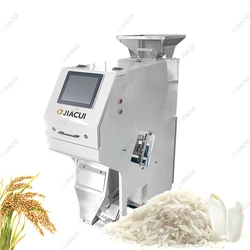
Most pulses are reasonably hard and free-flowing once cleaned, so chute-type machines are the standard choice for volume pulse sorting. They deliver the required throughput economically, and properly configured will meet export specification on most lots.
Belt platforms become appropriate in specific circumstances:
| Situation | Better platform | Reason |
|---|---|---|
| Standard dry pulses at volume | Chute-type | Hardy, predictable, economical |
| Very high value premium pulses | Belt-type | Yield protection outweighs capital cost |
| Brittle processed pulses (split dhal) | Belt-type | Already fragile — protect further |
| Low throughput specialty packs | Either compact class | Match to line rather than maximum capacity |
Note the special case of split pulses (dhal, dal). These are already halved and are notably more fragile than whole pulses — drop heights and ejector pressures must be reduced accordingly, and by this point there is no value recovery option if they break further.
Throughput and the reject recovery loop
Pulse lines run at scale, so configuration details carry large absolute consequences. Three points dominate:
- Size to 60–75% of rated maximum. Overfeeding is the single most common cause of disappointing pulse sorting results, hurting detection and creating false rejects simultaneously.
- Always plan reject re-inspection. Even well-tuned machines carry acceptable pulses into reject. Either recirculate through a second pass or install a small dedicated recovery unit. At thin pulse margins this recovery typically pays back quickly.
- Budget compressed air properly. Ejectors dominate running cost on high-tonnage pulse lines, and inadequate supply causes both missed defects and wasted product. See our energy consumption analysis.
Cleaning, hygiene and downstream integration
Pulse processing generates dust that is both aggressive on optics and relevant to food safety. Two practices matter disproportionately:
- Daily optical cleaning. Dust films on windows degrade performance measurably within a single shift on high-dust pulses. Non-negotiable, and the full schedule is in our maintenance checklist.
- Correct stage ordering. Aspiration and destoning upstream, optical sorting after mechanical cleaning and before grading or packing, metal detection before packing.
Regarding compliance: the sorter functions as a documented control point within your HACCP plan, removing foreign material and visibly damaged units. It does not measure pesticide residues or microbial contamination, and should never substitute for laboratory testing. See food safety compliance for HACCP, FDA and EU.
FAQ
My sorter misses darkened lentils but rejects plenty of good ones — what is wrong?
Almost certainly feed presentation or lighting rather than sensitivity. Check first whether units are presenting singly, then verify optical window cleanliness, then lighting calibration. Increasing sensitivity first usually makes the problem worse by pushing more good product into reject.
Can the machine separate stones by size alone?
Generally not reliably. Stones frequently match pulse size. Density separation (destoning) handles them far better, and X-ray handles residual cases where needed. Do not expect size-based optical separation to solve stones.
How much good product should end up in reject?
It varies with input quality, which is exactly why it must be measured rather than assumed. If carry-over is material — and on pulses even one percent of high-tonnage throughput is significant — re-inspection is worth installing. Our accuracy explainer covers how to measure it properly.
Should I sort before or after splitting?
Whole pulses are sorted before splitting in most configurations, because splitting creates substantial new breakage that would otherwise be judged. some processors add a light post-split pass for specific defect removal. Test both arrangements against your actual output.
Do different pulse varieties need different settings?
Yes, significantly. Red lentils, green lentils, chickpeas and black-eyed beans each need their own recipe. Insist on adequate recipe storage capacity if you process multiple types, and revalidate seasonally.
Is X-ray worth adding for pulses?
For most general applications, destoning plus optical sorting is sufficient. Add X-ray where the buyer's specification demands near-zero foreign material, where stone contamination persists despite destoning, or where you have had equipment damage or complaints — those costs typically dwarf the additional capital.
Deciding what "good enough" means
Pulse sorting is fundamentally an economic decision rather than a purely technical one. Define target specification against an actual buyer contract, quantify the value of achieving export grade versus domestic pricing, and size the installation accordingly. Machines that slightly overshoot required capacity and run at moderate feed rates routinely outperform larger machines run at their limit.
Review appropriate machine classes in the bean color sorter range, read the general methodology in how to choose the right color sorter, and do the decisive test: send us 10 kg of your pulses and evaluate accept and reject streams against the standard you actually have to meet.