



Rice Color Sorter Machine · Chute-Type CCD Sorting
A rice color sorter decides whether a lot ships as Grade A or gets discounted at the port. JIACUI builds chute-type CCD machines that take out yellow tips, chalky kernels, black-spot damage, paddy and glass at up to 99.99% accuracy — with a carryover ratio you specify instead of hope for. Fifteen models from 0.5 to 12 T/H cover a village mill, a 60 tonne-a-day plant and a two-shift export line.

Mini Rice Color Sorter CS-QB16
MODEL:JIACUI CS-QB16 is the ultimate mini rice color sorting machine for laboratories & small mills. Features 0.02-0.1 T/H capacity & ultra-low power.
View Details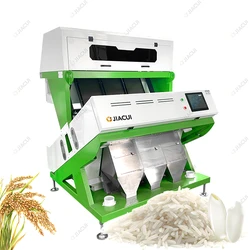
Rice Color Sorter (192channels)
MODEL: CS-3ABoost milling yield with Jiacui's CS-3A Rice Color Sorter (192 channels). Features 3.5-4 T/H large capacity, ≥99.99% accuracy, and an optimized >120:1 carryover ratio.
View Details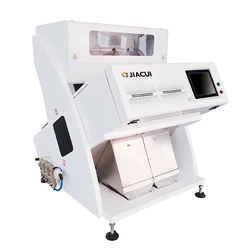
Rice Color Sorter (160channels)
MODEL: CS-2C160Upgrade your mill with Jiacui's CS-2C160 Rice Color Sorter (160 channels). Features 1.5-2 T/H high capacity, Cloud Control Technology, and ≥99.99% sorting accuracy.
View Details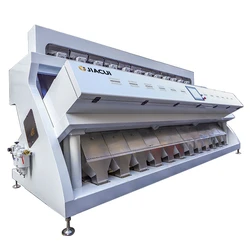
Rice Color Sorter CS-12C (768channels)
MODEL: CS-12CThe CS-12C is JIACUI's flagship 768-channel rice color sorter delivering 8–12 T/H throughput. AI deep learning, 5400-pixel CCD cameras. Ideal for large rice mills.
View Details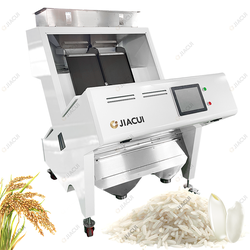
Rice Color Sorter (128channels)
MODEL: CS-2A128Optimize grain purity with Jiacui's CS-2A128 Rice Color Sorter, which features 128 channels. This high-efficiency, smart optical sorting solution is designed for premium rice processing plants.
View Details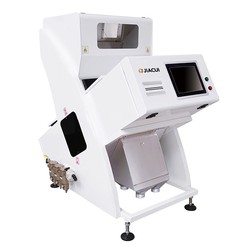
Small Color Sorter For Rice (96channels)
MODEL: CS-1C96The CS-1C96 Small Rice Color Sorter (96 channels) offers high-precision optical sorting (≥99.99%) with a 1.0-1.5 T/H capacity for professional grain milling.
View Details
Small Color Sorter For Rice (80channels)
MODEL: CS-1C80Model Power(Kw) Power Supply Dimension L*W*H (mm) Weight (Kg) Capacity (T/H) Accuracy (%) Carryover Ratio CS-1C80 1.5 customizable 1045X1630X1550 400 0.7-1.2 ≥99.99 >10
View Details
Small Color Sorter For Rice (64channels)
MODEL: CS-1C64The CS-1C64 Small Rice Color Sorter (64 channels) delivers high-precision optical sorting (≥99.99%) for grain processing. Compact design with 0.5-1.0 T/H capacity.
View Details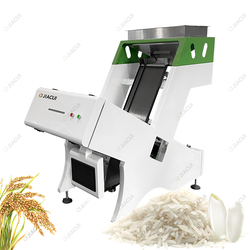
Small Rice Color Sorter (80channels)
MODEL: CS-1A80Discover the Small Rice Color Sorter by Jiacui Machinery, featuring advanced technology for precise rice sorting with high output and quality.
View Details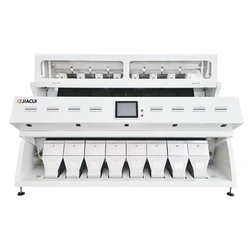
CS-10C Rice Color Sorter 640 Channels | 7–10 T/H Mid-Large Scale
MODEL:JIACUI CS-10C: 640-channel rice color sorter with 6–10 T/H throughput. RGB spectrum + AI algorithm. Best choice for mid-to-large rice mills upgrading capacity.
View Details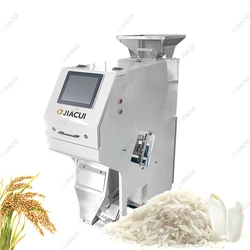
Small Color Sorter For Rice CS-CH32
MODEL:Innovative quality sorting products focusing on the entire rice processing
View Details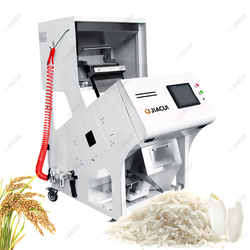
Small Rice Color Sorter (64channel)
MODEL:Model Power(Kw) Power Supply Dimension L*W*H (mm) Weight (Kg) Capacity (T/H) Accuracy (%) Carryover Ratio CS-1A64 1 customizable 800*1260*1550 157 0.8-1.5 ≥99.99 >30
View DetailsWhat a Rice Color Sorter Removes From a Paddy Lot
A mill buys paddy by weight and sells head rice by grade, and the gap between the two is almost always the same four defect groups. One pass of a chute-type sorter handles all of them, at the throughput your line already runs.
Yellow tips, chalky belly & immature kernels
A yellowed tip or a chalky belly-white grain is the difference between Grade A and a discounted lot. The head reads colour at 5400 pixels per line with more than 16 million colour combinations, so a faint shade shift at the tip of one grain is separated from sound white rice instead of being averaged away with its neighbours.
Black-spot, insect & heat-damaged grains
Mould spots, borer damage and grains scorched in the dryer are caught on colour and shape together. Sorting on average brightness alone lets a dark speck pass in an otherwise white stream — and that is precisely what a buyer's lab finds after the container is opened.
Paddy, red rice & off-variety grains
Unhusked paddy, red kernels and stray grains of another variety break the uniformity a buyer checks first. They leave the machine before the bag is sewn, not at the port — which is why a mill that sorts properly can sell the same paddy for a better grade.
Stones, glass & plastic
Dense foreign matter that survives destoning is flagged optically and ejected. Clear glass and clear plastic remain the hardest call for any optical sorter because they take the colour of whatever is behind them: send a contaminated sample and we will tell you honestly what a CCD head achieves on your material, including when the answer is "not reliably".
Rice Color Sorter Models and Specifications
Fifteen production models, from a 0.02 T/H bench unit for sample work to the 12 T/H CS-12C. Every one is a chute-type optical sorter on the same camera and software platform — what changes is chute count, valve grade and footprint. Click a model for its full page, photographs and parameter sheet.
Swipe the table sideways for power, weight and dimensions.
| Model | Capacity (T/H) | Carryover | Power (kW) | Weight (kg) | L×W×H (mm) |
|---|---|---|---|---|---|
| CS-QB16 | 0.02 – 0.1 | >30:1 | 0.2 | 66 | 330×700×1000 |
| CS-CH32 | 0.25 | >120:1 | 0.7 | 105 | 450×1100×1500 |
| CS-1C64 | 0.5 – 1.0 | >10:1 | 1.2 | 350 | 955×1630×1550 |
| CS-1A64 | 0.8 – 1.5 | >30:1 | 1.0 | 157 | 800×1260×1550 |
| CS-1A80 | 0.8 – 1.5 | >30:1 | 1.5 | 189 | 820×1720×1550 |
| CS-1C96 | 1.0 – 1.5 | >10:1 | 1.8 | 500 | 1045×1630×1550 |
| CS-1C80 | 1.2 – 2.5 | >120:1 | 1.8 | 290 | 1152×1697×1708 |
| CS-2C160 | 1.5 – 2.0 | >10:1 | <2.2 | 600 | 1330×1630×1550 |
| CS-3A | 3.5 – 4.0 | >120:1 | 2.6 | 640 | 1620×1490×1690 |
| CS-6C | 4.0 – 6.0 | >10:1 | 4.8 | 1350 | 2528×1595×2040 |
| CS-7C | 4.0 – 7.0 | >10:1 | 4.8 | 1650 | 2765×1570×1850 |
| CS-6A | 5.0 – 10.0 | >10:1 | 4.8 | 1060 | 2580×1490×1690 |
| CS-8C | 5.0 – 8.0 | >10:1 | 4.6 | 1800 | 3152×1595×2040 |
| CS-10C | 7.0 – 10.0 | >10:1 | 5.5 | 2200 | 3910×1595×2040 |
| CS-12C | 8.0 – 12.0 | >120:1 | <7.5 | 2600 | 4668×1595×2040 |
Accuracy is ≥99.99% on every model in the table. Capacity is rated on standard white rice at normal impurity levels; long grain, parboiled and high-defect lots run lower. Air supply 0.6–0.8 MPa, power supply configurable to your local voltage.
How to Size a Rice Color Sorter for Your Mill
Most wrong purchases are wrong by one size, and almost always because the quotation was built on a peak figure instead of a shift average. Three questions settle it.
Start from tonnes per hour, not channel count
Add up the paddy you actually run in a 20-hour day and divide. A 60 t/day mill needs 3 T/H of sustained throughput — not a peak figure from a brochure. Plan on the machine running at roughly 80% of rated capacity through a shift, and size for the busiest week of harvest rather than the annual average.
One pass or two?
One machine at 8 T/H and two passes at 4 T/H are not the same purchase. A second pass re-cleans the reject stream to recover sound grain; if carryover is already above 120:1 you may not need it. We will say so when a second machine would be wasted money.
Carryover decides what your reject bin is worth
Carryover is how much sound grain leaves with the defects. At >10:1 you lose about one good grain per ten defects; at >120:1 you lose one per hundred and twenty. On export rice that difference is paid back per tonne, every shift, for the life of the machine.
| Your mill | Throughput to plan for | Models to start from |
|---|---|---|
| Farm, village or cooperative mill | 0.5 – 1.5 T/H | CS-1A80, CS-1C96, CS-1C64 |
| Small commercial mill | 1.5 – 2.5 T/H | CS-2C160, CS-1C80 |
| 40 – 60 t/day mill | 3 – 4 T/H | CS-3A (192 channels) |
| 80 – 120 t/day mill | 4 – 7 T/H | CS-6C, CS-7C |
| 150 t/day and above, export plant | 8 – 12 T/H | CS-10C, CS-12C |
Starting points only — final sizing depends on impurity load, target grade and shift pattern. Read the capacity planning guide or send your daily tonnage and we will size it for you.
Set Up for the Rice You Actually Sell
A single sensitivity setting does not cover every variety. Recipes are stored in the controller, so changing product is a menu selection rather than a service call — and no two of these need the same thresholds.
Why Rice Mills Choose JIACUI Sorters
Six things decide your cost per tonne after installation — and what we do about each of them.
Carryover you can specify, not guess
Models are available at >10:1, >30:1 and >120:1. For premium and export rice the high-ratio valve set keeps sound grain out of the reject stream — that is profit per tonne, not a brochure number.
5400-pixel full-colour cameras
RGB capture with more than 16 million colour combinations separates a faintly yellowed tip from sound white rice. A monochrome or low-resolution head cannot make that call, however fast it runs.
Sub-2 ms ejectors, 1 billion cycles
High-frequency solenoid valves rated for a billion cycles with a response under two milliseconds. Fewer misfires means less compressed air burned, less good grain wasted and longer service intervals.
One-touch presets for rice varieties
Basmati, jasmine, parboiled, glutinous and long-grain profiles live in the controller. Switching variety is a menu selection, not a hardware change or a technician on a plane.
Built for dusty, hot mill floors
Dust-proof enclosure, automatic cleaning of the viewing glass and engineered heat dissipation for continuous 24/7 shifts in a rice mill environment — the conditions that make an office-grade machine lose accuracy by mid-shift.
Remote commissioning & after-sales
IoT remote debugging, video-guided installation and calibration, 24/7 technical response and spare parts shipped worldwide. Support that does not depend on somebody getting a visa.
Beyond Rice: Other Grains and Seeds
The same chute-type chassis sorts the rest of the grain list with a different recipe, a different chute angle and, for small particles, lower air pressure. Pulses and oilseeds have their own pages: see soybean color sorter and bean color sorter.
Grain capability depends on the defect you need gone and on particle size: wheat and maize run at high capacity, millet needs a fine chute. Send a 20–30 kg sample and we will return a trial report instead of a promise.
What Sets the Price of a Rice Color Sorter
Quotations for "an 8 T/H rice sorter" can differ by a factor of three, and it is rarely the margin. These five things account for the gap — ask every supplier to break them out.
Capacity and chute count
A 1.5 T/H single-chute machine and a 12 T/H eight-chute machine share software, not hardware. Capacity is the single largest line in any quotation.
Camera and light configuration
Full-colour CCD with infrared or multi-spectrum lighting costs more than a standard visible-light head — and is the only way to sort some defects at all.
Ejector count and valve grade
More nozzles mean finer ejection and higher carryover ratios, plus a bigger compressor requirement. This is where a cheap quotation quietly cuts corners.
Ancillaries you actually need
Air compressor and dryer, dust collector, spare valve kit, elevator and conveyor. We quote the utility sheet so you can price them locally instead of paying freight on air tanks.
Freight, installation and duty
Machine volume, destination port and whether our engineer attends commissioning. Ask for the CIF and FOB figures side by side before comparing suppliers.
What to send us for an accurate quotation
- The material: paddy, brown, white, parboiled, basmati — and the variety name if you have it.
- What must come out: yellow tips, chalky grain, black spots, paddy, stones, glass.
- Your real throughput in tonnes per hour, and how many hours a day the line runs.
- Local voltage and frequency, plus the air supply you already have on site.
Four answers are enough for a budget figure; a sample is what turns it into a guaranteed one.
Rice Color Sorter FAQ
How many tonnes per hour do I need?
Divide your daily paddy intake by the hours the mill actually runs, then add headroom: a 60 t/day mill working 20 hours needs about 3 T/H and should be looking at a 3.5–4 T/H model. Rated capacity is quoted on standard white rice, so parboiled, basmati and high-defect lots will run below the number on the plate.
Is 99.99% accuracy realistic on my rice?
The figure is the ejection accuracy published for each model, measured on a prepared sample. What you will see in the mill depends on defect type, impurity load and feed rate. That is why we ask for 20–30 kg of your rice: the trial report tells you the real number for your lot, before you pay for a machine.
Will one machine handle parboiled, basmati and glutinous rice?
Yes. All three run on the same chassis with different stored recipes; what changes is sensitivity, ejector timing and sometimes chute angle. Mills that switch product weekly keep all the recipes in the controller and change over in minutes.
What power and air supply does it need?
Installed power runs from about 1 kW on the smallest unit to under 7.5 kW on the 12 T/H model — see the specification table above. Air is supplied at 0.6–0.8 MPa; the compressor size depends on ejector count, and we send the exact utility sheet with the quotation so it can be sourced locally.
How long does installation and commissioning take?
A single machine is typically running within one day of arrival: levelling, air connection, recipe selection and a calibration pass on your own material. Multi-machine lines take two to three days. Remote video commissioning is available if you prefer to avoid the travel cost.
What about spare parts and lead time?
Ejector coils, nozzles, glass and filter elements are the consumables; we keep them in stock for models still in service and ship by courier. Standard production lead time is quoted per order and confirmed against your shipping date.
Chute type or belt type for rice?
Chute type for rice. Free-flowing, uniform grains slide down a chute at high speed and give the highest capacity per unit of floor space; belt type exists for material that must not be damaged or cannot flow, such as large nuts or plastic flakes. The full comparison is here.
Further Reading on Rice and Grain Sorting
Send 20 kg of your rice. We will send back the sorted result.
Our lab runs your sample through the model we recommend, photographs the accepted and rejected streams, and reports the defect removal you can expect — before you commit to a purchase order. Trial reports are free; you cover the courier.