



Plastic Flake Color Sorter · Belt-Type Optical Sorting for PET, PP/PE & ABS
A plastic color sorter decides whether your flake sells as bottle grade or as downcycle. JIACUI belt-type machines remove off-colour flakes, caps, labels, metal and rubber from PET, PP/PE and ABS regrind at up to 99.99% accuracy, on a flat belt that keeps every flake still while the camera reads it. Four belt models from 0.5 to 12 T/H — and no chute machines, because flake does not behave in a chute.

What a Plastic Flake Color Sorter Removes
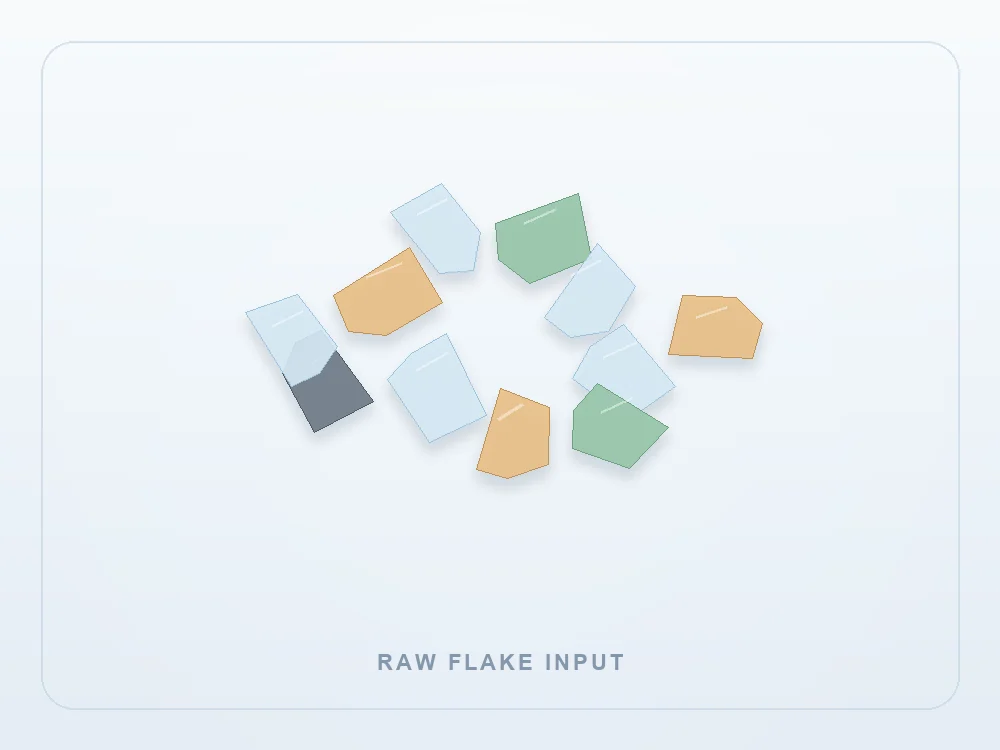
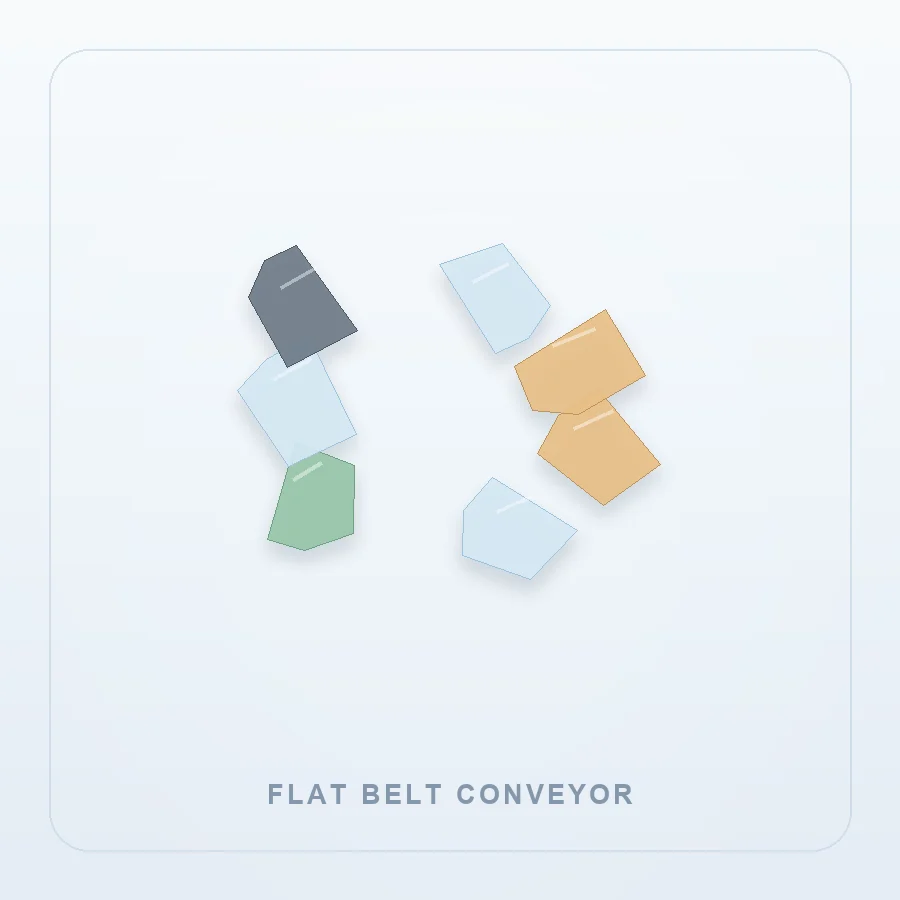
Four families of defect decide the price your flake fetches. All four are handled in one pass — the three pictures underneath are the streams that leave the machine: raw input, accepted flake and the reject tray.
Off-colour flakes in a clear or natural stream
Blue, green, amber, grey and black flakes riding along in clear PET or natural HDPE are the difference between bottle grade and downcycle grade. Sorting is done on hue, saturation and brightness across the whole flake face, so a pale green flake next to clear ones is caught without re-teaching the machine for every bale.
Caps, labels, sleeves and PETG fragments
PP caps, PE labels, PETG and printed shrink-sleeve pieces survive sink-float washing and still spoil a bottle-grade flake. They are separated on colour and opacity against the clear stream — which is the coloured and opaque fraction, and that is most of what a washing line actually carries over.
Metal, rubber, glass and stones
Screws, foil, rubber crumbs, glass shards and stones that reach the flake line score extruder screws and blind screens. They are ejected on colour and surface texture, not on chemistry — the note below says exactly where that limit sits.
Black specks in regranulated pellets
For regranulators: cross-colour pellets, black specks and carbonised particles are removed on the way to the bagging silo, before a customer's extruder finds them and returns the lot.
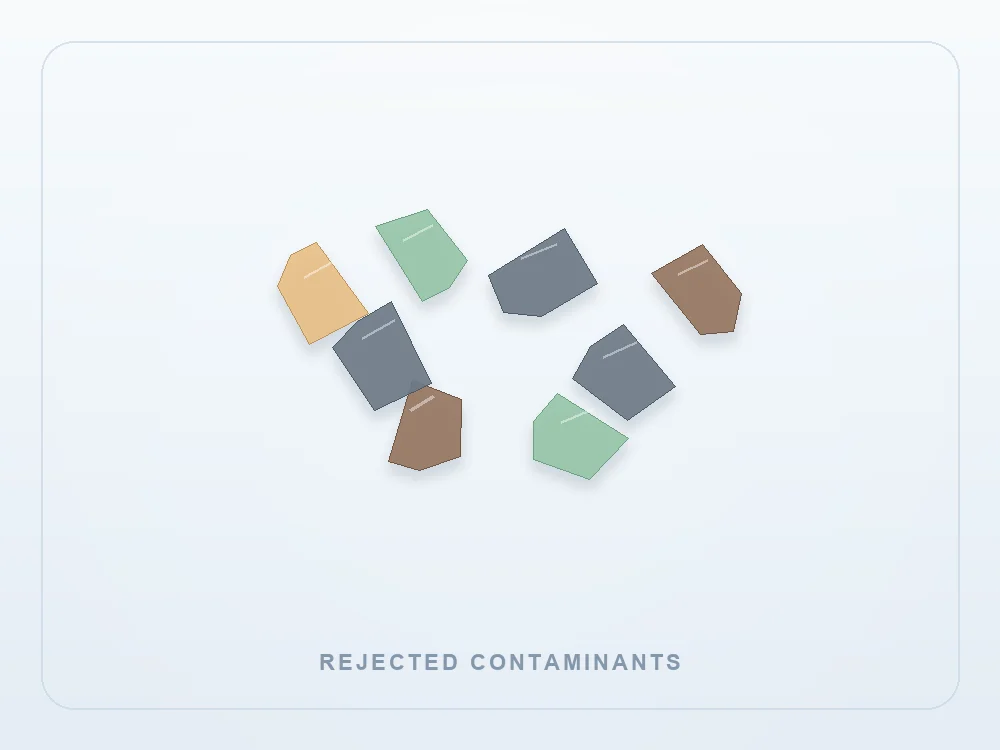
Placeholder frames until the factory sends the PET and HDPE trial photos. Send a sample and we shoot the same three frames on your material.
What a colour camera cannot see — said before you buy
Clear PVC flake and clear PET flake are identical under visible light, and no colour camera anywhere separates them. If your specification is written on ppm of clear PVC, say so at quotation stage: it decides the optical configuration we quote, whether that turns out to be a spectral channel or a separate X-ray step — and we would rather have that conversation before the order than after the installation. What the belt machine delivers without argument is the visible fraction: coloured and opaque PVC, caps, labels, PETG, metal, rubber, glass and off-colour flake. Send a sample and the test report tells you where your own material actually lands, including the case where the answer is a second machine you would not buy from us.
Why a Belt Conveyor, Not a Chute, for Plastic Flakes
Chute sorters were designed for grain: free-flowing, uniform, 3–8 mm and perfectly happy to fall. Plastic flake is none of those things. It is flat, light, static-charged and irregular, and in a chute it planes, flips and drifts on the way past the camera — so the ejector fires at where the flake used to be. On a flat belt the flake lies still at a known speed, and the same valve timing works all shift.
In a chute sorter
- Flakes plane and flip: the camera sees an edge instead of a face
- Light flakes are blown sideways by the air blast and take their neighbours with them
- Thick or curled regrind bridges the chute and slides in fits and starts
- Static pins thin flakes to the chute wall, out of the camera's depth of field
- Every mis-aimed ejection carries good flake into the reject bin
On a flat belt sorter
- Each flake lies flat and reaches the camera at the belt speed it was calibrated for
- Ejection is a short horizontal push, so the blast lands on the flake it was aimed at
- 5–50 mm flake, thick regrind and curled pieces all convey the same way
- Anti-static belt plus belt cleaner stop the build-up that blinds the viewing glass
- A steady stream keeps the valve timing table valid for the whole shift, not the first hour
A measured ejection window, not an estimated one
Flake that leaves a chute is still accelerating and still rotating when it crosses the camera. On the belt, speed is the belt speed: the controller knows how many milliseconds the flake needs to travel from lens to nozzle, and that number does not change when the feed rate does. This is the single reason a belt machine holds accuracy on flake where a chute machine has to be de-rated.
Built for 5–50 mm flake, including the awkward pieces
The three capacity bands in the table below are the honest way to size a plastic line: a 5–15 mm bottle flake and a 30–50 mm shredded regrind do not flow at the same rate through any machine. Thick, curled and half-melted pieces that bridge a chute convey flat on the belt.
A belt specified for abrasive, sharp-edged regrind
PET flake edges are sharp and mildly abrasive, and a belt that tracks badly is a belt that frays at the edge and then mis-tracks worse. The conveyor is specified with an anti-static compound, edge banding and a tracking system, and tracking and tension are set at commissioning and re-checked at each service.
Dust, fines and static: the three things that blind a plastic sorter
A recycling plant is a dusty place and flake carries fines and static with it. Automatic cleaning of the viewing glass, a sealed optical box and a grounded frame are not extras here — without them the machine sorts well for a week and then starts missing pale defects, which is exactly the failure nobody reports until a customer rejects a load.
Six Things That Decide the Purity of Your Flake
What a buyer actually pays for is repeatability — the same purity on the worst bale of the month as on the demo sample. These are the six things that decide it.
Colour and gloss together, not colour alone
A silver label fragment, a matt piece of regrind and a glossy clear flake can share one average brightness. The AI model on a 5400-pixel full-colour CCD head weighs hue, saturation, brightness, gloss and outline shape together, with more than 16 million colour combinations to work from.
A valve bank sized for flake, not for grain
Sub-2 ms response and a 1 billion cycle rating matter here for a different reason than in a rice mill: the blast has to be short enough to move one light flake without dragging its neighbours off the belt. Short, late or over-long blasts are what put good flake in the reject bin.
Carryover you can put a number on
The plastic models are published at >20:1 reject-to-accept carryover. On a line running 4 T/H that is the difference between a reject stream you re-run once a week and one you re-run every shift — and it is paid back in good flake, not in brochure language.
One-touch recipes per stream
PET bottle flake, natural HDPE, coloured PP and ABS regrind each get a stored recipe: sensitivity, valve duration, belt speed and reject delay. Changing bale source is a parameter change on the touchscreen, not an engineer visit.
Throughput quoted by flake size
Every capacity figure on this page is given in three bands — 5–15, 15–30 and 30–50 mm — because quoting one number for plastic is how lines end up 40% short of their design tonnage.
We tell you where colour sorting stops
The honest limit is on this page in plain text, above the fold of the specification table. A supplier who promises chemical polymer separation from a colour camera is selling you a second purchase you did not budget for.
Belt-Type Models & Technical Specifications
Three production belt models plus a small unit for trial work, all on the same camera and software platform. Capacity is quoted in three flake-size bands because one number for plastic would be meaningless. Click a model for its full page.
| Model | Belt width | Capacity by flake size (T/H) | Accuracy | Carryover | Power | Weight | L×W×H (mm) |
|---|---|---|---|---|---|---|---|
| CS-LA600 | 600 mm | 5–15 mm: 2.5–3.5 15–30 mm: 3–5 30–50 mm: 4–6 | ≥99.99% | >20:1 | 6 kW | 750 kg | 1400×2430×1200 |
| CS-LA1200 | 1,200 mm | 5–15 mm: 2.5–3.5 15–30 mm: 3–5 30–50 mm: 4–6 | ≥99.99% | >20:1 | 6 kW | 1,150 kg | 2430×2000×1198 |
| CS-LA1200D | 1,200 × 2 mm | 5–15 mm: 5–7 15–30 mm: 6–10 30–50 mm: 8–12 | ≥99.99% | >20:1 | 9 kW | 2,300 kg | 2810×2000×2088 |
CS-LA300 (300 mm belt, 64 nozzles, 1.75 kW, 320 kg, 0.5–1.5 T/H) is the small single-belt unit for trial and lab work — ask for its flake figure on your own material. Where two models carry the same published rating we quote both as published rather than invent a difference; belt speed and layer thickness are set per job. Air supply 0.6–0.8 MPa, power supply configurable to your local voltage. Capacity assumes surface-dry flake with normal contamination.
The Three Parts That Decide Plastic Sorting Quality
Camera, belt and ejector. Missed pale defects, good flake in the reject bin, or accuracy that quietly falls off after three weeks — almost every complaint about a plastic sorter traces back to one of these three.


See a Belt-Type Plastic Sorter Running
Thirty seconds tells you more than a spec sheet: watch mixed flake go in at the top and clear flake and the reject tray come out at the bottom in the same frame. Sorting footage on your own PET or HDPE stream can be filmed on request.

Video slot reserved — plant and sorting-test footage is being prepared. Until it is published, ask for the clip of your material on WhatsApp and we will send it directly, with before/after photos of your own sample.
Which Belt Model Fits Your Line?
Flake size and the defect you are chasing change the answer as much as tonnage does. Treat this as a shortlist, then confirm with a sample test.
| Your situation | Typical model | Why |
|---|---|---|
| PET bottle flake, 2–3.5 T/H, colour plus caps | CS-LA600 | The single-belt workhorse for a 5–15 mm bottle flake line; 600 mm of belt is enough to spread a 2–3 T/H stream to one flake layer. |
| PET flake, 3–6 T/H, one pass to bottle grade | CS-LA1200 | Twice the belt width, same published throughput band — buy it for the wider spread, not for tonnage, and re-run less. |
| Reject stream you want to re-sort in one machine | CS-LA1200D | Double deck: 8–12 T/H at 30–50 mm, coarse pass on top and polish pass underneath, without a second machine and a second footprint. |
| HDPE / PP regrind with dark specks and cross-colour | CS-LA600 / CS-LA1200 | Colour and gloss together, because a black speck in natural HDPE is a brightness problem while a printed fragment is a hue problem. |
| Black specks in pellets before bagging | CS-LA300 / CS-LA600 | 0.5–1.5 T/H up to 1–3 T/H — saving the whole lot for a handful of specks is the cheapest rejection decision in a compounding plant. |
| Trial, lab or a line you are still designing | CS-LA300 | Small single-belt unit for sample work; we run your material on it and quote the line against measured numbers instead of a datasheet. |
Starting points only — final sizing depends on flake size, layer thickness, contamination load and shift pattern. Read the capacity planning guide or send your tonnage and flake size and we will size it for you.
Plastic Flake Color Sorter FAQ
How much does a plastic color sorter cost?
Price is set by belt width, valve count, the double-deck option and the optics you need — a 600 mm single-belt flake sorter and a 1,200 mm double-deck machine are not comparable. Send your flake size, hourly tonnage and the defect you are chasing, and the quotation names the model, the valve set and the spare-parts kit line by line. Our 2026 price guide explains what moves the number.
Can it separate clear PVC from clear PET?
Not on colour — they are optically identical under visible light, and any supplier who says otherwise is describing an NIR or X-ray machine, not a colour sorter. What the belt sorter removes is the visible fraction: coloured and opaque PVC, printed sleeve fragments, caps, labels, PETG, metal, rubber, glass and off-colour flake. If your contract is written on ppm of clear PVC, plan an NIR or X-ray step as well — we will say so in the quotation rather than at commissioning.
What capacity do I need for my line?
Size on flake size first, tonnage second. A 5–15 mm bottle flake runs about 2.5–3.5 T/H on the CS-LA600, while 30–50 mm regrind on the same belt reaches 4–6 T/H because it needs a thicker layer to fill the belt. Add headroom for re-runs, and remember the number that matters is your worst bale, not your average.
Do the flakes have to be dry?
Surface-dry, yes. Water on the flake face scatters light and the camera ends up looking at the water instead of the polymer, so the sorter belongs after the dewatering and drying step, not before it. Flake that is merely damp sorts — flake that is dripping does not, and no amount of sensitivity tuning fixes it.
Why a belt machine and not a chute machine for plastic?
Because flake is flat and light. In a chute it planes and flips, so the camera sees an edge instead of a face, the air blast pushes light flakes sideways, and static pins thin pieces to the wall. On a flat belt the flake lies still at a known speed and the ejection window is measured. That is why our chute range is not offered for flake.
How much compressed air and power does it use?
Air is supplied at 0.6–0.8 MPa; the consumption figure for your model and valve set is confirmed in the quotation, because it depends on how often the valves actually fire on your defect load. Power is 1.75 kW on the small belt unit, 6 kW on the CS-LA600 and CS-LA1200, and 9 kW on the double-deck CS-LA1200D.
Will it handle film, or only rigid flake?
Rigid flake, regrind and pellets are what this machine is built for. Thin film is a different problem: it is light enough to be moved by the air blast that should be ejecting it and by the static it carries. We test film on request and tell you what the machine actually achieves on your material instead of promising a number.
Can I test my own material before buying?
Yes — send 5–20 kg and we run it on the model we would recommend, then send before/after photos, a weighed reject analysis and a capacity figure for your flake size. The test is free; you cover the courier. If the answer is that colour sorting will not reach your specification, the test report says that too.
Built in Our Own Factory, Tested on Real Flake
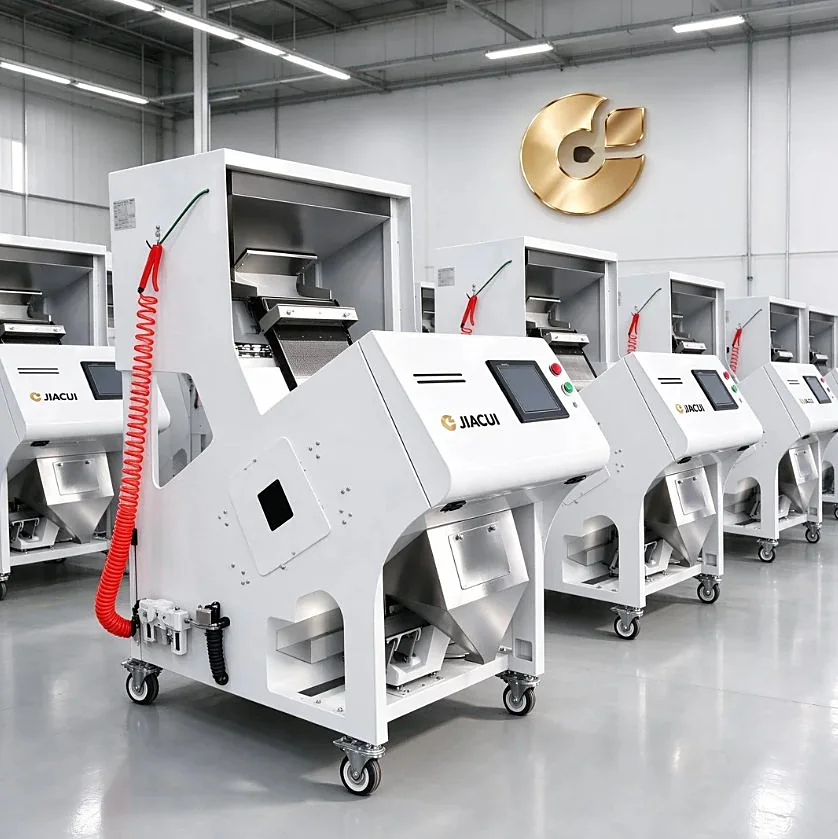
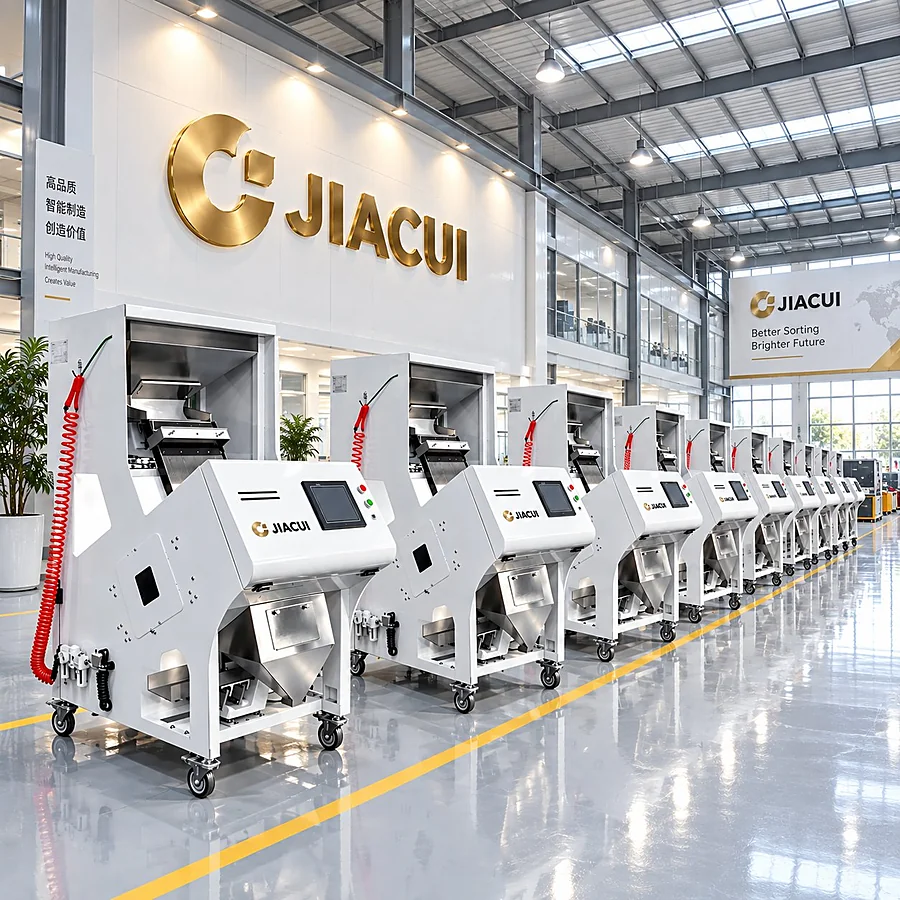
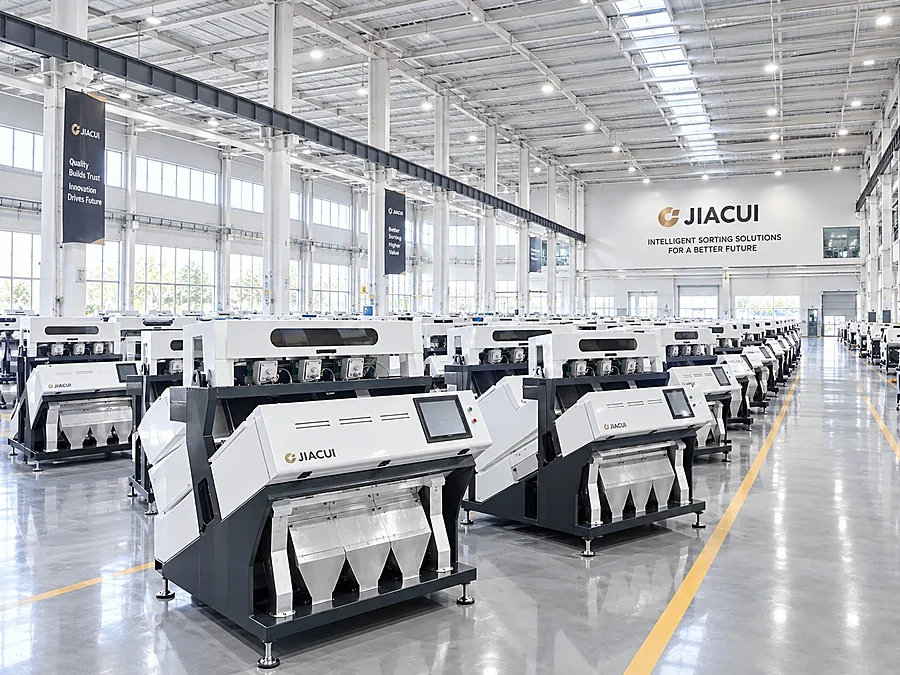
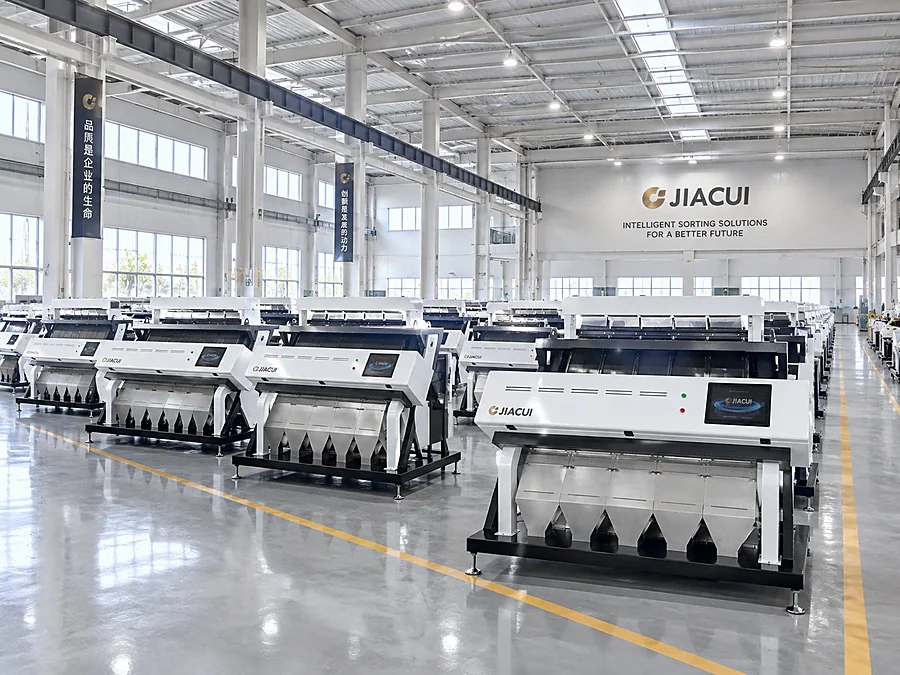
Every sorter is assembled, calibrated and test-run before shipping, and leaves with a report on the material it was set up for. CE and ISO 9001 certified production, with spare belts, valves and optical parts held for models still in service.
Keep Reading on Plastic & Belt Sorting
Deeper guides on the technology, the reject stream and the numbers behind a recycling line.
Get a Plastic Sorter Quote & Free Sample Test
Tell us the polymer, the flake size, the hourly tonnage and the defect you are chasing. You get a line-item quotation naming the model, valve set and spare-parts kit — and we will run your sample before you commit. Reply within 12 hours on business days.


