



Rice Color Sorter Machine · Chute-Type Optical Sorting
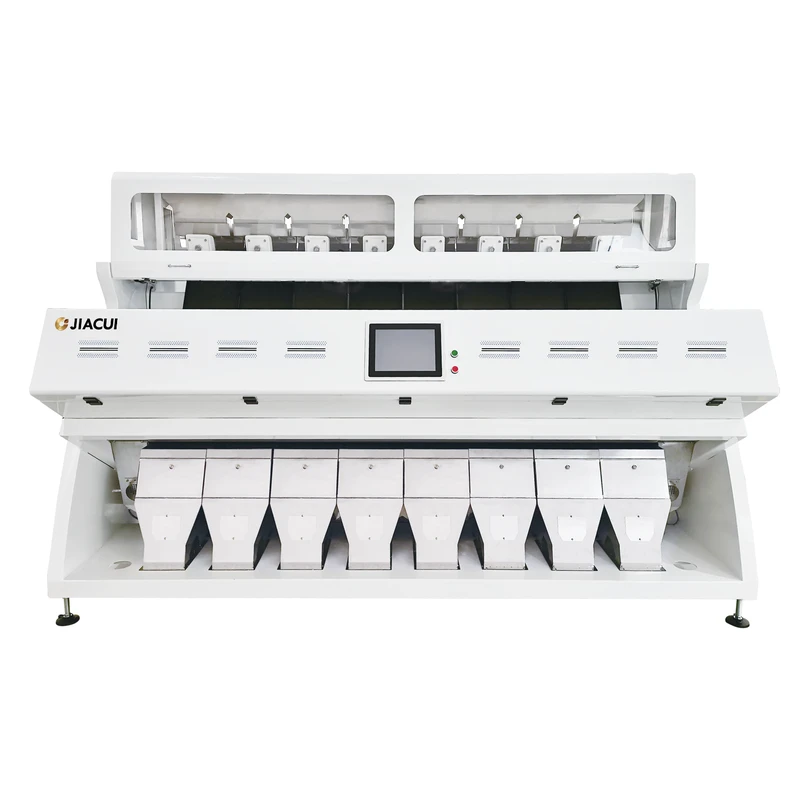
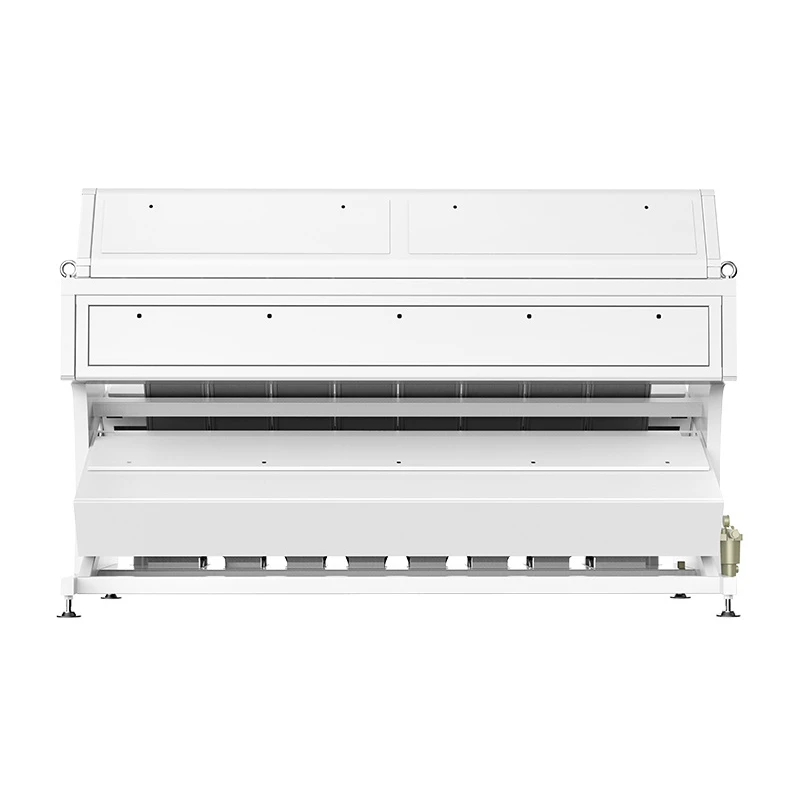
A rice color sorter decides whether your lot ships as Grade A. JIACUI machines clean white, parboiled, basmati, jasmine and glutinous rice at up to 99.99% accuracy — removing yellow tips, chalky kernels, black-spot damage, paddy and glass, with a carryover ratio you specify rather than hope for. Fifteen models from 0.5 to 12 T/H, built for mills that run 24 hours.
What Can a Rice Color Sorter Remove?
Each defect below is a reason a buyer rejects a container. The sorter has to remove them before the bag is sewn — not have them discovered at the port. A single pass handles all four categories; the pictures underneath show the three streams you get out of the machine.
Yellow tips & chalky kernels
Discoloured tips, belly-white (chalky) grains and immature kernels are separated from sound head rice in one pass — the difference between Grade A and a discounted lot.
Black-spot & damaged grains
Insect damage, mould spots and heat-damaged kernels are caught on colour and shape together, not on average brightness alone, so dark specks in an otherwise white stream do not slip through.
Paddy, red & off-variety grains
Unhusked paddy, red rice and stray grains of another variety break the uniformity buyers check first. They are ejected before the bag is sewn, not discovered at the port.
Glass, stones & plastic
Dense foreign matter that survives destoning is flagged optically. Transparent glass and clear plastic are the hardest calls for any optical sorter — send a contaminated sample and we will tell you honestly what a CCD configuration achieves on your material.


Photos of the input, accepted and reject streams from a rice trial. Send a sample and we will shoot the same three frames on your material.
Why Rice Mills Choose JIACUI Sorters
Six things that decide your cost per tonne after the machine is installed — and what we do about each of them.
Carryover you can specify, not guess
Models are available at >10:1, >30:1 and >120:1 carryover. For premium rice a high-ratio valve set keeps sound grain out of the reject stream — that is profit per tonne, not a brochure number.
One-touch presets for rice varieties
Basmati, jasmine, long grain, parboiled and glutinous profiles are stored in the controller. Switching variety is a parameter change, not a hardware change or an engineer visit.
5400-pixel full-colour cameras
RGB spectrum capture with more than 16 million colour combinations separates a faintly yellowed tip from sound white rice — the call that a monochrome or low-resolution head cannot make.
Sub-2 ms ejectors, 1 billion cycles
High-frequency solenoid valves rated for 1 billion cycles with a response under 2 milliseconds. Fewer misfires, less compressed air, longer service intervals.
Built for dusty, hot mill floors
Dust-proof enclosure, automatic cleaning of the viewing glass and engineered heat dissipation for continuous 24/7 shifts in a rice mill environment.
Remote commissioning & after-sales
IoT remote debugging, video-guided installation and calibration, 24/7 technical response and spare parts shipped worldwide — support that does not depend on a flight.
Rice Color Sorter Models & Technical Specifications
Fifteen production models, from a 0.02 T/H bench unit for sample work to the 12 T/H CS-12C. Every model is a chute-type optical sorter with the same camera and software platform; what changes is chute count, valve grade and footprint. Click a model for its full page.
| Model | Capacity (T/H) | Accuracy | Carryover | Power (kW) | Weight (kg) | L×W×H (mm) |
|---|---|---|---|---|---|---|
| CS-QB16 | 0.02 – 0.1 | ≥99.99 | >30:1 | 0.2 | 66 | 330×700×1000 |
| CS-CH32 | 0.25 | ≥99.99 | >120:1 | 0.7 | 105 | 450×1100×1500 |
| CS-1C64 | 0.5 – 1.0 | ≥99.99 | >10:1 | 1.2 | 350 | 955×1630×1550 |
| CS-1A64 | 0.8 – 1.5 | ≥99.99 | >30:1 | 1.0 | 157 | 800×1260×1550 |
| CS-1A80 | 0.8 – 1.5 | ≥99.99 | >30:1 | 1.5 | 189 | 820×1720×1550 |
| CS-1C96 | 1.0 – 1.5 | ≥99.99 | >10:1 | 1.8 | 500 | 1045×1630×1550 |
| CS-1C80 | 1.2 – 2.5 | ≥99.99 | >120:1 | 1.8 | 290 | 1152×1697×1708 |
| CS-2C160 | 1.5 – 2.0 | ≥99.99 | >10:1 | <2.2 | 600 | 1330×1630×1550 |
| CS-3A | 3.5 – 4.0 | ≥99.99 | >120:1 | 2.6 | 640 | 1620×1490×1690 |
| CS-6C | 4.0 – 6.0 | ≥99.99 | >10:1 | 4.8 | 1350 | 2528×1595×2040 |
| CS-7C | 4.0 – 7.0 | ≥99.99 | >10:1 | 4.8 | 1650 | 2765×1570×1850 |
| CS-6A | 5.0 – 10.0 | ≥99.99 | >10:1 | 4.8 | 1060 | 2580×1490×1690 |
| CS-8C | 5.0 – 8.0 | ≥99.99 | >10:1 | 4.6 | 1800 | 3152×1595×2040 |
| CS-10C | 7.0 – 10.0 | ≥99.99 | >10:1 | 5.5 | 2200 | 3910×1595×2040 |
| CS-12C | 8.0 – 12.0 | ≥99.99 | >120:1 | <7.5 | 2600 | 4668×1595×2040 |
Capacity is rated on standard white rice at normal impurity levels; long grain, parboiled and high-defect lots run lower. Accuracy and carryover are the values published on each model page. Air supply 0.6–0.8 MPa; power supply configurable to your local voltage.
The Three Parts That Decide Sorting Quality
Camera, ejector and chute. Almost every complaint about a rice sorter — missed yellow tips, good grain in the reject bin, accuracy dropping by mid-shift — traces back to one of these three.


See a Rice Color Sorter Running
A 30-second clip tells you more than a spec sheet: watch the input stream, the accepted rice and the reject tray in the same frame. Machine walk-around and sorting-test footage for your specific rice variety can be filmed on request.

Video slot reserved — factory and sorting-test footage is being prepared. Until it is published, ask for the clip of your rice variety on WhatsApp and we will send it directly, together with before/after photos of your own sample.
Which Rice Color Sorter Fits Your Mill?
Rice type changes the answer as much as tonnage does. This is where most quotations start — treat it as a shortlist, then confirm with a sample test.
| Your rice / situation | Typical model | Why |
|---|---|---|
| Basmati & long grain for export | CS-6C / CS-7C | 4–7 T/H with a narrow chute pitch keeps long grains aligned so length and tip colour are judged properly. |
| Jasmine & fragrant rice | CS-10C | 7–10 T/H for mills that need export-grade brightness without a second polishing pass. |
| Parboiled rice | CS-6A | 5–10 T/H and a darker product stream, where contrast between sound and damaged kernels is lower. |
| Glutinous / sticky rice | CS-3A | 3.5–4 T/H on smaller volumes, where off-colour grains matter more than raw throughput. |
| Brewer's & broken rice | CS-12C | 8–12 T/H with >120:1 carryover when volume, not appearance, is the commercial driver. |
| Sample room / small mill | CS-1A80 or CS-QB16 | 0.8–1.5 T/H and 0.02–0.1 T/H bench units for trials, lab work and small lot contracts. |
Starting points only — final sizing depends on your impurity load, target grade and shift pattern. Read the capacity planning guide or send your daily tonnage and we will size it for you.
Rice Color Sorter FAQ
How much does a rice color sorter cost?
Price is driven by capacity, number of chutes, valve grade and the carryover ratio you specify — a 1 T/H chute machine and a 12 T/H line with >120:1 valves are not comparable. Send your capacity, rice type and target grade and you will get a line-item quotation with the model, valve set and spare-parts kit named. Our 2026 price guide explains what moves the number.
What capacity do I need for my daily tonnage?
Divide daily output by real working hours, then add headroom: a mill processing 100 t/day over 20 effective hours needs about 5 T/H, so a 6 T/H model is the right starting point, not a 4 T/H one. Rated capacity is stated on standard white rice; long grain, parboiled and high-impurity lots run lower, so confirm with a sample test.
Can one machine sort basmati, jasmine and parboiled rice?
Yes. Variety recipes are stored in the controller and recalled with one touch; no hardware change is needed between aromatic, parboiled and glutinous runs. What does change is the capacity you actually achieve.
What is carryover ratio and why should I care?
Carryover (or carry-over) is how much good grain leaves with the rejects. At 10:1, roughly one sound grain is lost for every ten defects ejected; at 120:1 the loss is far smaller. On premium rice the difference pays for the higher valve grade within a season.
Can it remove glass, stones and plastic?
Stones and dense foreign matter are reliably rejected. Transparent glass and clear plastic are the difficult cases for every optical sorter, because they look like the background. Tell us the contamination profile and we will confirm in a sample test what is achievable — we would rather show you a result than promise one.
What power and air supply does it need?
Power ranges from 1.2 kW on a small 64-channel unit to under 7.5 kW on the CS-12C; exact figures per model are in the table above. Compressed air is supplied at 0.6–0.8 MPa, and the consumption figure for your model is confirmed in the quotation.
How long does installation and training take?
A single chute machine is normally running within a day: levelling, air connection, calibration on your rice and operator training. Multi-chute lines take two to three days. Installation is guided by video and remote support, or by an engineer on site if you prefer.
Can I test my own rice before buying?
Yes — send a 5–20 kg sample and we run it on the model we would recommend, then send you before/after photos, a reject-stream photo and a capacity figure for your material. The test is free; you cover the courier.
Built in Our Own Factory, Tested on Real Rice
Sorters are assembled, calibrated and test-run before shipping — each unit leaves with a test report on the material it was set up for. CE and ISO 9001 certified production, with spare parts held for models still in service.


Keep Reading on Rice Sorting
Deeper guides on cost, capacity, technology and the buying mistakes that cost mills a season.
Get a Rice Color Sorter Quote & Free Sample Test
Tell us your daily tonnage, rice type and target grade. You get a line-item quotation with the model, valve grade and spare-parts kit named — and we will run your sample before you commit. Reply within 12 hours on business days.