


Most sorting decisions are made on the wrong axis. Buyers compare cameras, channels and prices without first answering a more basic question: what physical property actually separates my defect from my good product?
Every sorting technology measures exactly one physical property. If you pick the wrong one, no amount of specification will help — the machine will work perfectly and still not find your defect. This article sets out the three properties a sorter can measure, and the specific situations where density detection wins outright.
Three properties, three technologies
Sorters can only distinguish materials that differ in something physically measurable, and there are three such properties in practical use:
| Property | Measured by | Band / method |
|---|---|---|
| Surface colour | RGB or visible spectroscopy, reflection | 400–700 nm |
| Chemical composition | NIR / SWIR spectroscopy, reflection | 750–2500 nm (InGaAs 900–1750 nm) |
| Atomic density | X-ray transmission | Transmission, not reflection |
The first two are reflection techniques: light strikes the surface and returns. The third is a transmission technique: radiation passes through the object and what is absorbed depends on density and thickness.
That structural difference — reflection versus transmission — is what gives X-ray its distinctive capability. Reflection only ever samples the surface. Transmission samples the whole object, including its interior.
We cover the optical side in detail in Color sorter light sources explained; this article focuses on where transmission is the correct answer.
How X-ray transmission sorting works
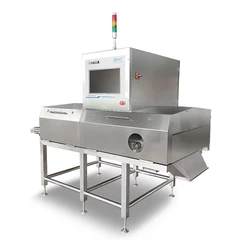
Product passes through a controlled X-ray beam, and a detector array on the far side measures how much radiation survived. Attenuation depends on the material's atomic density and its thickness. Materials of higher effective atomic number absorb more; lower-density material absorbs less.
Advanced systems use dual-energy measurement, reading attenuation at two different energy levels. Because different materials absorb the two energies in different ratios, dual-energy measurement separates materials that would produce identical single-energy readings — which substantially improves discrimination in mixed streams.
The practical result is a density signature for every particle, computed in the same millisecond window as any optical decision, and fed to the same kind of ejection array.
What X-ray finds that optics cannot
The value cases are specific and worth listing precisely, because they are all situations where colour and chemistry are both useless:
Glass, stones and metal in food. A glass fragment in grain, or a stone in a nut stream, is often close to the product in size and not reliably different in colour. Nor, in the case of glass, is there necessarily a useful NIR signature that distinguishes it from the surrounding product at speed. Density separates it cleanly.
Internal defects hidden inside an intact exterior. Hollow kernels, internal pest damage, voids in seeds — these have no external signature at all. Reflection techniques inspect the surface and see a perfectly good seed. Transmission sees the missing interior.
Bone fragments in processed food. A classic and well-established application, and one where the density contrast is strong and reliable.
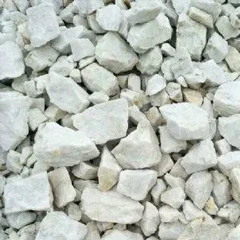
Mineral separation where colour is useless. In many ore bodies, valuable and waste rock are visually identical, and even compositionally similar at the surface. Where they differ in density, X-ray transmission separates them.
Chlorinated plastics in a PET stream. PVC and PET can be difficult to separate by colour, particularly in dark or opaque fractions, but PVC's chlorine content gives it a materially different density and X-ray attenuation — so X-ray identifies it where visible sorting struggles.
The unifying feature: in every case, the defect and the product are sufficiently similar in appearance and chemistry that looking at them cannot work. X-ray works because it does not look at them.
Where optical sorting remains the better choice
X-ray is a specialist tool, and there are clear cases where it is the wrong investment.
X-ray does not grade by subtle colour. If you are removing chalky, yellow or insect-damaged kernels from rice, the defect is a surface colour difference and visible-light sorting finds it directly, cheaply and with a camera the operator can see through. X-ray offers no advantage and costs substantially more.
X-ray will not replace NIR for polymer identification. For separating PET, HDPE, PP and PS flakes by resin type, NIR reads the molecular absorption signature directly and is the established, economical solution.
Cost. X-ray systems carry a significant premium over comparable optical machines — the generator, detector array, shielding and compliance all cost money. If visible or NIR solves your problem, that premium buys you nothing.
Simplicity. Optical machines have no radiation source, which simplifies installation, maintenance, staffing and paperwork.
The compliance overhead buyers underestimate
This is the part that most often surprises first-time X-ray buyers, and it is worth budgeting before committing.
X-ray sorting equipment contains a radiation source, which brings real obligations: shielded enclosures and interlocks, supervised installation, operator training, registration or licensing under national radiation-safety regimes, periodic inspection and leak testing, documented operating procedures, and controlled procedures for maintenance, transport and eventual disposal.
None of this makes X-ray impractical — the technology is routine in food processing worldwide. But it is a genuine ongoing operating obligation, and it should be evaluated as part of the purchase rather than discovered afterwards. Plants without the administrative capacity to maintain compliance should think carefully.
A decision matrix
| Your defect differs by… | Correct technology |
|---|---|
| Surface colour or discolouration | Visible / RGB |
| Resin type, moisture, internal chemistry, shell vs kernel | NIR / SWIR |
| Density — glass, stone, metal, internal voids, ore grade | X-ray transmission |
| Several of the above simultaneously | Combined multi-sensor |
The discipline is to name the property before comparing machines. Most disappointing purchases come from buying a technology that measures the wrong one.
Why combined systems increasingly make sense
In practice the decision is not always either/or, because real product streams contain multiple defect classes at once. A nut line, for example, may need to remove shell fragments (chemistry / NIR), discoloured kernels (colour) and stones (density).
Multi-sensor machines address this by combining detection principles on one platform: visible cameras, NIR sensors and X-ray in a single inspection pass, with all the decisions sharing a common ejection array. The trade-off is cost and complexity against the capability to handle a mixed defect population in one machine.
The practical guidance is to configure to your actual defect population rather than to every available option. Adding a sensor that will spend its life finding nothing is pure cost.
How this fits the JIACUI range
We build to the same decision logic:
- Visible-light CCD sorting across the grain, bean and nut lines, where defects are surface-colour defects
- NIR and multi-spectral configurations for coffee and cashew, where internal quality and chemistry matter as much as appearance
- X-ray transmission for the density-based separations described above
- Mineral and plastic configurations built around their specific defect populations
- Chute machines from CS-QB16 (20–100 kg/h) through CS-HA32, CS-4A, CS-5A to CS-7A (6–12 T/H), and belt machines CS-LA300, CS-LA600, CS-LA1200, CS-LA1200D
Our published baseline across the range is sorting accuracy ≥99%, stated at its test condition — polished japonica-type rice at approximately 2% foreign content — because a percentage with no stated condition cannot be compared between suppliers.
FAQ
Is X-ray sorting safe for food products?
Yes. This is established, widely used technology in food processing, and the radiation dose involved in transmission sorting does not make the product radioactive or unsafe. Regulatory frameworks exist to control the equipment, not the food.
Can X-ray replace my metal detector?
It addresses a different need. A metal detector is a compliance device that finds metal and documents it; an X-ray sorter finds metal plus glass, stone, bone and density defects, and removes them. Many plants run both, since metal detection is often a mandatory control point.
Will X-ray sort black plastics?
Not usually. Black plastics are separable by NIR at the appropriate wavelength extension, since the issue there is chemistry rather than density. X-ray's plastic application is narrower and more specific — principally identifying chlorinated PVC in PET streams.
What does an X-ray sorter cost to run?
Beyond the capital premium, budget for electricity, periodic source inspection and certification, trained and authorised operators, and documented procedures. Ask the supplier to specify the compliance obligations for your jurisdiction in writing before purchase.
Can I retrofit X-ray onto an existing optical machine?
Rarely and awkwardly. The radiation source, shielding and detector array are integral to the machine structure, not bolt-on modules. If you expect to need X-ray, specify it at purchase.
How do I decide without over-buying?
Test with your own material. A competent supplier should run your product, at your throughput, and show you separation results with the reject stream sorted by hand. That single exercise settles the technology question faster than any specification sheet — and it is the same discipline we recommend in measuring sorting accuracy honestly.