


Ask ten buyers what matters in an optical sorter and nine will talk about cameras, channels or throughput. Very few ask about the light — yet illumination is the component that decides whether a defect is physically visible to the machine in the first place.
An optical sorter cannot detect contrast that its light source never creates. If a stone and a grain of rice reflect identical wavelengths under your illuminant, no amount of processing power or camera resolution will separate them. The light source defines the physical contrast available; everything downstream only decides how well that contrast is used.
This article maps the four illumination and detection families used in modern sorting — visible/RGB, near-infrared, ultraviolet and X-ray — onto the materials they actually solve, so you can match the technology to the defect instead of buying the most expensive configuration and hoping.
Illumination comes first in the sorting chain
Every sorter works through the same five-stage chain: material is presented in a single layer, illuminated, imaged, classified, then ejected. Illumination sits second, and it constrains every stage after it.
The reason is simple. CCD and CMOS sensors do not "see" objects; they measure photons arriving at each pixel. What arrives depends on three things — the spectral content of the source, how the target material reflects or absorbs that spectrum, and the spectral sensitivity of the sensor itself. Change any one of the three and the same physical object produces a completely different signal.
This is why the most useful question in a supplier conversation is not "how many cameras?" but "under what illumination, and for which defect?"
Visible light and RGB: the 400–700 nm baseline
Visible-spectrum sorting uses the 400–700 nm band — the range the human eye sees — captured by trilinear line-scan cameras on a red/green/blue sensor.
This is the workhorse configuration, and for good reason. Most food and agricultural defects genuinely do differ in visible colour: chalky and yellow rice kernels, insect-damaged beans, discoloured coffee, mouldy nuts, off-colour plastic flakes. Published configurations for optical food sorters specify 0.3–0.5 mm per pixel across the lane with line rates up to 6,000 lines per second, which is enough to resolve sub-millimetre spots on product moving at 2.5–3.5 m/s.
RGB sorting is also the cheapest configuration and the easiest to operate, because the operator sees on screen exactly what the camera sees.
Its limit is structural, however. Three colour bands carry no chemical information. A defect that matches the product in visible colour is invisible to an RGB camera no matter how good the camera is. Independent work on plastics recycling illustrates the gap: where a visible-spectrum spectroscopy sorter reached 96.5% purity and 91.7% efficiency separating clear PET from light blue and light green bottles, an RGB camera achieved 86.5% and 77% on the same stream.
That 15-point efficiency gap is not a camera-quality problem. It is a wavelength problem.
Near-infrared: 750–2500 nm, where you sort chemistry instead of colour
Near-infrared spectroscopy moves the measurement from appearance to composition. The NIR band spans roughly 750–2500 nm; industrial sorting systems commonly use the short-wave portion, with InGaAs sensors covering 900–1750 nm.
The physics is what makes it useful. Chemical bonds in the material absorb specific wavelengths and begin to vibrate, modulating the spectrum of light scattered back from the surface. Because different materials contain different bonds — carbon-hydrogen bonds in plastics being the classic case — each material returns a distinctive spectral fingerprint. The sorter is no longer comparing colours; it is reading molecular structure.
That capability unlocks separations RGB simply cannot make:
- Polymer identification in recycling. PET, HDPE, PP, PS, ABS and PVC each carry identifiable absorption bands, so flakes can be separated by resin type rather than by colour — including black-on-black, where visible sorting fails completely.
- Nut and kernel separation. Published spectral work on almonds identifies a characteristic feature near 930 nm associated with nut oil content, which separates kernel from shell regardless of how similar the two look to the eye. The same principle applies to cashew and other tree nuts where shell fragments and kernel can be visually near-identical.
- Moisture and internal composition. NIR tracks water content, which makes it usable for detecting internal quality differences in grains and seeds that have no external colour signature yet.
Two practical notes. First, NIR signal strength varies by band: absorption features in the short-wave IR range are markedly stronger than in the near-IR range, which is why SWIR-equipped systems handle difficult targets — thin films, dark samples, contaminated surfaces — more reliably. Second, extending into mid-wave IR around 2900–4200 nm is what makes black plastics separable, since they absorb almost nothing usable in the visible band.
The operational cost is illumination. NIR work has traditionally relied on halogen sources because they cover the infrared range, but halogen brings limited lamp life, high energy draw and significant heat — a real problem in food plants, where lamp heat affects product. NIR-optimised LED sources are progressively replacing halogen for exactly this reason.
Ultraviolet: 100–400 nm and the fluorescence signature
UV sits at 100–400 nm. Its sorting value comes less from reflected colour and more from fluorescence — certain materials absorb UV and re-emit at longer visible wavelengths, producing a signal that is easy to isolate against a dark background.
In practice UV is a specialist tool rather than a general one. It is applied where a contaminant fluoresces and the product does not, including screening applications for certain biological contaminants and residues. The important engineering point is that UV response requires dedicated optics: standard silicon sensors and glass lenses have poor UV transmission, and UV work typically needs UV-enhanced or back-illuminated sensors and appropriate lens materials.
For most food and mineral applications, UV is an add-on to visible or NIR rather than a replacement.
X-ray transmission: sorting by density instead of reflection
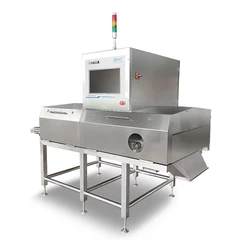
X-ray breaks the model entirely. Visible, NIR and UV are all reflection techniques — light hits the surface and bounces back. X-ray transmission passes radiation through the object and measures what is absorbed, which depends on atomic density and thickness, not surface appearance.
This is what solves the hardest class of sorting problems: defects that are identical in colour, identical in shape, and different only in density.
- Glass, stones and metal inside food streams
- Internal voids, hollow kernels and pest damage hidden inside an intact seed coat
- Bone fragments in processed food
- Mineral separation where valuable and waste rock share surface appearance
Because density is intrinsic to the material, X-ray is also indifferent to surface contamination — dust, moisture film and colour variation do not degrade the signal the way they degrade an optical camera.
We cover the density-based approach in detail separately; for an overview of our X-ray configurations, see the X-ray sorting systems range.
Reflectance or transflectance: the background matters as much as the lamp
One detail that separates well-commissioned machines from poorly commissioned ones is the reference background behind the product.
On belt-type machines the product sits on a conveyor, and the standard arrangement is reflective measurement against a black belt — the belt contributes no spectral signal of its own, so everything the sensor sees came from the product.
On chute and free-fall machines the product is airborne, and a light-coloured reference background — ceramic tile or PTFE surfaces are proven effective choices — enables transflectance measurement, where light passes partly through or around thin material before returning. This is what makes thin flakes, films and translucent materials measurable at all.
Getting this wrong is a common cause of a machine that underperforms despite good hardware. It is also removable: it is a commissioning decision, not a hardware limitation.
Choosing the right illuminant: a practical matrix
| Detection principle | Band | What it measures | Solves | Does not solve |
|---|---|---|---|---|
| RGB / visible | 400–700 nm | Surface colour | Discolouration, chalky grain, mould, foreign colour | Same-colour defects |
| NIR / SWIR | 750–2500 nm (InGaAs 900–1750 nm) | Molecular absorption | Polymer ID, shell/kernel, moisture, black plastics | Density differences |
| UV | 100–400 nm | Fluorescence | Fluorescing contaminants and residues | Most general defects |
| X-ray transmission | — | Atomic density | Glass, stone, metal, internal voids, hidden damage | Surface-only colour grading |
The pattern is that no single technology covers everything, and the useful question is which physical property distinguishes your defect from your product. If it is colour, visible sorting is sufficient and most economical. If it is chemistry, you need NIR. If it is density, you need X-ray.
How this maps onto JIACUI machines
Our range is configured the same way the decision works in practice — by material, then by the property that separates good from bad:
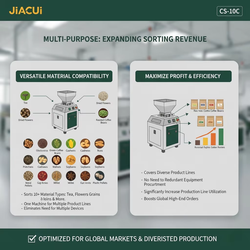
- Visible-light CCD sorting across the grain, bean and nut ranges, where defects are surface-colour defects
- NIR and multi-spectral configurations for coffee and cashew, where chemistry and internal quality matter as much as appearance
- X-ray transmission for density-based separations
- Chute-type machines from the compact CS-QB16 (20–100 kg/h, well suited to laboratory and small-batch work) through CS-HA32, CS-4A, CS-5A to the CS-7A at 6–12 T/H, and belt machines CS-LA300, CS-LA600, CS-LA1200 and the double-deck CS-LA1200D for products that must not free-fall
Across the range our published baseline is sorting accuracy ≥99%, stated at a defined condition — polished japonica-type rice at roughly 2% foreign content — because a percentage without test conditions is not a specification.
FAQ
Can I add NIR to a machine bought for visible sorting?
Sometimes, but treat it as a hardware question, not a software one. NIR requires an infrared-sensitive sensor, appropriate illumination and the right optical path. Retrofitting is possible on some platforms and impossible on others; it is far cheaper to specify it at purchase.
Does a higher-resolution camera compensate for a poor light source?
No. Resolution determines how finely you sample the image; illumination determines whether the target differs from the background at all. Improving resolution on a signal with no contrast just measures the absence of contrast more precisely.
Why does my sorter's performance drift over a long shift?
The most common cause is illumination drift, not sensor failure. Lamp output changes with temperature and age, and dust on the viewing window attenuates light progressively. Modern machines compensate with periodic white-reference calibration; without it, a machine can drift measurably across a single shift.
Do I need X-ray, or will NIR do?
Use the physical test. If your defect differs from good product in colour or chemistry, NIR or visible sorting will find it and X-ray will be unnecessary expense. If the defect differs only in density — glass in grain, stone in ore, hollow kernels — NIR will not find it and X-ray is the correct tool.
Is LED always better than halogen?
For visible and near-infrared work with food products, LED generally wins on lamp life, energy use and — importantly — heat, which matters in temperature-sensitive processing. Halogen remains relevant where a broad continuous spectrum across the full IR range is required. The choice is application-specific.
How do I verify a claimed illumination specification?
Test with your own material, at your own throughput, and reject the reject stream by hand. Any supplier figure for accuracy or detection capability should be reproducible on your product — see our guide to measuring sorting accuracy honestly.