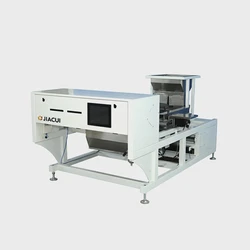



A mill in Huila and a roastery in São Paulo buy the same word when they order equipment — a *coffee color sorter* — and then discover they need very different machines. The confusion is understandable: both pass brownish beans in front of a camera and blow away the bad ones. What changes is almost everything that matters.
Green coffee sorting is a defect removal problem executed at mill throughput, where the beans are hard and the value per kilogram is modest. Roasted coffee sorting is a product protection problem executed at roastery throughput, where the beans are brittle and the value per kilogram is high. The same physical task, opposite engineering priorities.
This article explains exactly what changes between the two, how machine settings differ, and why trying to split the difference usually costs you either grade or yield.
The material itself has changed
Roasting is not merely a color change. A bean that enters a roaster at roughly 10–12% moisture and exits closer to 2% has been through a structural transformation. Understanding three properties is enough to explain every downstream difference:
- Brittleness. Roasted beans crack and shatter on impact. Dropping them 1.5 metres onto a steel plate — completely routine in green coffee handling — damages a measurable percentage of a roasted batch.
- Low density. Mass per bean drops substantially while volume stays similar, so roasted beans are more easily disturbed by air and less predictable in free fall.
- Surface change. Oil migration to the bean surface creates highlights and sheen that read as false color variance to naive algorithms, particularly on darker roasts.
A machine tuned for green coffee assumes hard particles falling in a predictable arc. Feed that same trajectory assumption roasted beans and you will break them, mis-eject them, or both.
Sorting green coffee: throughput and sensitivity
At the mill, the job is volume plus consistency. A typical export facility processes thousands of bags per season, and the grader's defect count is what the buyer pays against.
Targets are the classic defect set: black beans, sour beans, mould damage, insect damage, broken beans, floaters and parchment. Because these mostly present as strong localized contrast against sound green beans, RGB camera systems with well-set thresholds already perform well, and AI models add real value on the borderline cases — partial defects and naturally variable cultivars.
Practically:
| Parameter | Typical approach for green coffee |
|---|---|
| Platform | Chute-type, free-fall (high throughput, beans are hard) |
| Feeding | Wide vibratory feeder, high flow rate |
| Sensitivity | Set to catch all primary defects even at some yield cost |
| Passes | Often two passes: sort, then re-sort the reject |
| Machine class | Multi-channel chute sorters; larger mills use CS-7A class up to 6–12 T/H |
The dominant risk here is under-detection. Missing one black bean can disqualify a sample, so mill configuration leans sensitive. Good equipment for this stage is in the coffee bean color sorter range.
Sorting roasted coffee: protection above all
At the roastery the calculus inverts. You are no longer chasing a few defects in a hundred kilograms; you are protecting beans that have already absorbed the full cost of green coffee purchase, roasting energy, labour and packaging.
The defects are also different. Instead of agricultural damage, roasted sorting targets process defects:
- Quakers — under-developed beans that failed to take roast color properly. Pale, and corrosive to espresso flavour.
- Over-roasted / burnt beans — dark to the point of char, inconsistent within the batch.
- Cracked and broken beans — physically imperfect, and a quality complaint waiting to happen in whole-bean retail.
- Foreign material introduced downstream — bits of chaff, packaging debris, or the occasional stone that survived upstream cleaning.
The dominant risk here is the opposite: over-rejection. Every good roasted bean blown into the reject bin destroys multiples of the value of a missed defect. This is precisely the false rejection problem that roasters most often complain about.
Practically:
| Parameter | Typical approach for roasted coffee |
|---|---|
| Platform | Belt / crawler type, beans conveyed gently at controlled speed |
| Feeding | Gentle feed, minimized drop height, anti-breakage chutes |
| Sensitivity | Tuned for minimum good-product loss, accept slightly higher carry-over of borderline defects |
| Passes | Single pass typical; double-deck units allow second-pass inspection without a second machine |
| Machine class | Crawler platforms such as CS-LA1200D class |
Side-by-side: what actually changes in settings
| Setting | Green coffee | Roasted coffee |
|---|---|---|
| Priority metric | Defect removal rate | Whole-bean yield retention |
| Conveying | Free-fall chute | Belt transport, controlled |
| Feed rate | Maximum sustainable throughput | Deliberately conservative |
| Reject threshold | Aggressive | Conservative toward good beans |
| Camera emphasis | Contrast against green background | Luminance shift, roast uniformity |
| Second machine at site | Often for re-sorting rejects | Sometimes double-deck for second look |
| Consequence of error | Failed grade, rejected lot | Destroyed high-value product |
This table is why the "one machine for everything" compromise fails. Every line requires an opposite setting, and you cannot have both simultaneously on one platform at one feed rate.
The economics: where the money is
Consider two facilities processing roughly equivalent physical volumes:
- Mill: takes in parchment or cherry, produces export green. Sorting errors risk the *entire lot's grade*, so the cost of under-sorting is severe and asymmetric. Tolerance for yield loss is therefore higher.
- Roastery: takes in already-clean green at high cost, produces packaged roasted coffee at several times that cost per kilogram. Sorting errors destroy *finished goods*, so tolerance for shutting off defects is higher, and tolerance for good-product loss is very low.
The roaster should be willing to accept a slightly dirtier accept stream in exchange for keeping every whole bean. The mill should not. None of this is machine quality — it is correct configuration for your position in the value chain.
If you operate both, note that throughput requirements differ so much that two correctly-sized machines will beat one compromise unit on every metric that matters. Several South American operations run exactly this arrangement; the configuration logic is documented in our South American installation notes.
Does platform choice really matter that much?
Yes, and it interacts with everything above. The choice between chute and crawler architectures is covered comprehensively in our dedicated comparison — including flow behaviour, breakage rates and the capacity ranges each handles best: Chute-type versus crawler-type color sorters. Read it together with this article, because platform and product stage reinforce each other: free-fall suits hard green beans, belt transport suits fragile roasted ones.
FAQ
Can I use one machine for both if I change the settings between runs?
If it is a belt-type platform, yes in principle, and small operations do it. The limitation is throughput mismatch: a mill wanting several tons per hour and a roaster wanting a few hundred kilograms per hour cannot both use the same unit efficiently. If you run both in meaningful volume, dedicate a machine to each.
Why does my sorter reject so many good roasted beans?
Because it is probably configured with settings suited to green coffee: too aggressive a threshold, too much feed turbulence, or too long a drop. Review sensitivity first, then physical handling. See the dedicated guide on diagnosing over-rejection.
Is breakage measurable?
Yes, and you should measure it. Run a known mass of roasted beans with the sorter's ejection disabled, weigh the broken fraction, then compare with ejection enabled. The difference is your machine-induced breakage. Anything above roughly one percent on premium whole-bean product is worth investigating.
Should dark roasts be sorted differently from light roasts?
Yes. Dark roasts have less internal color variance, which means defects like quakers show larger relative contrast and detection is easier, but oil sheen creates more false positives. Light roasts have the opposite profile. Store separate recipes.
Do I still need upstream cleaning before sorting roasted beans?
You need less than for green, since the green supply should already be clean. But you must place the sorter after the roaster and before packaging, and ideally after a metal detector. Chaff removal upstream also improves optical consistency materially.
Specifying correctly
Before requesting a quotation, define which problem you actually have. If you are a mill chasing a defect count, optimize for removal and measure success as grade achieved. If you are a roaster protecting finished goods, optimize for yield retention and measure success as kilograms of whole saleable beans recovered.
The machine that solves one is rarely the best answer to the other. Review platform options in the coffee bean color sorter range, then send us a sample — a test run on your own beans settles in one morning what months of specification review cannot.