


Cashew is the most punishing material in the nut sorting business, because the product you are trying to protect is also the product most easily destroyed. A whole white cashew kernel commands a large premium over a split or broken one, often two to three times depending on grade and market. Every handling decision between shelling and packing either protects that premium or erodes it.
Optical sorting sits right in the middle of that sequence, which means it can either be the most yield-destructive station in your plant or the one that recovers the most value. This guide covers the defects that matter, why cashew specifically loses yield, and how to configure both machine and line to keep kernels whole.
Understanding cashew grades — and where the money is
International cashew trade generally references the AFI (Association of Food Industries) standards, under which kernels are classified by count per pound and wholeness. The commercial logic is simple and brutal:
| Grade example | Description | Relative value |
|---|---|---|
| W180 / W210 | Large whole kernels, premium count | Highest |
| W240 / W320 | Standard whole kernels | High |
| Splits (S) | Kernels broken into halves | Substantially lower |
| Butts, pieces, splits lower grades | Fragments | Lowest |
Two things follow. First, wholeness drives value: converting a whole kernel into two halves is not a small loss, it is a category change. Second, color and blemish also count: yellowing, brown spots and insect damage move kernels down even when whole.
A sorter configured carelessly attacks both: it breaks kernels physically and it discards acceptable kernels as perceived defects. A sorter configured well recovers whole kernels that would otherwise have been downgraded.
The cashew defect set
Cashew kernels present a combination of problems rarely seen together in one material: brittleness, low color contrast between defect and sound product, and value concentration in every individual unit.
- Yellow / burnt kernels — from over-roasting or uneven heat during the conditioning process. These are a genuine quality defect but can be subtle at the edges.
- Brown and black spots — often fungal or insect-related; must be removed for food safety as well as grade.
- Attached testa (skin) — small fragments of the thin skin clinging to kernel surface. Difficult because it is close in color to the kernel itself.
- Broken and cracked kernels — not always removable; here the priority shifts from removal to *prevention*, since they should not be created by your handling.
- Foreign material — shell fragments, dust, and occasionally metallic contamination from shelling equipment.
The combination means high-contrast simple detection will miss genuine defects, while aggressive sensitivity will discard acceptable kernels. This is the fundamental cashew sorting tension.
Why AI matters more for cashew than for almost anything else
A basic RGB threshold sorter asks whether a particle's color falls outside a tolerance band. That works when defects are visually obvious — a black bean in green coffee, a dark stone in white rice.
Cashew breaks that assumption badly. A slightly yellowed kernel differs from a perfect one by gradual luminance variation, not categorical difference. Natural variation between kernels is comparable in magnitude to the defect signal itself. A threshold tight enough to catch all yellowing will also reject a significant share of perfectly saleable kernels — which on cashew is an expensive outcome, because those are premium units.
Trained recognition models handle this better because they classify texture, pattern and multi-feature combinations rather than single-color thresholds, and because they learn the acceptable-variation envelope from thousands of real examples. Practically that means higher defect capture at the same yield. The technical background is in our article on AI deep learning in color sorting.
The yield killers: where whole kernels become splits
Most cashew breakage in a sorting line is not caused by the sorting decision — it is caused by handling. The usual culprits:
- Free-fall impact. Kernels dropped onto steel plates or through long vertical chutes fracture on contact. This is the single largest source.
- Turbulent transfer. Elbows, sharp transitions and high-velocity pneumatic transfer create collisions between kernels.
- Overfeeding. Excess feed rate causes kernels to stack and tumble rather than present singly, creating both collisions and mis-detection.
- Aggressive ejector pressure. Air pressure set higher than necessary can damage neighbouring kernels, not just the target one.
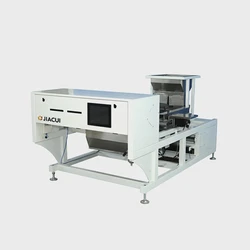
The countermeasures are unglamorous but effective: belt-type conveying instead of free fall, reduced drop heights, food-grade impact-absorbing surfaces at transitions, carefully tuned ejector pressure, and conservative feed rates. This is why belt-type platforms dominate cashew applications despite costing more than equivalent-capacity chute machines. Our chute versus crawler comparison covers the trade-off quantitatively.
Recommended line configuration
| Stage | Purpose | Notes |
|---|---|---|
| Pre-cleaning | Remove dust, shell fragments | Protects optics and improves detection |
| Destoning | Remove dense foreign material | Reduces sorter load |
| Primary optical sorting | Remove major defects | Usually belt-type for cashew |
| Eject re-inspection | Recover good kernels from reject | Important — reject contains acceptable product |
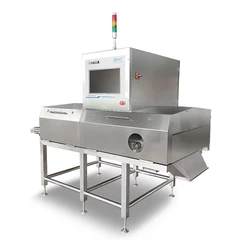
| Metal detection | Safety compliance | Placement before packing |
| Grading / packing | Size and count grading | Final step |
The re-inspection stage deserves emphasis. When running sensitive settings to catch subtle defects, the reject stream inevitably contains some acceptable kernels. Rather than accepting that loss, route reject through either a second pass or a smaller dedicated unit. Most well-run cashew lines recover meaningful yield this way.
Choosing capacity — and not overshooting
A common mistake is sizing purely to nameplate peak. On cashew especially, running at maximum feed rate hurts you twice: detection degrades because kernels overlap, and breakage rises because material tumbles.
Better practice is to specify so routine production sits around 60–75% of rated maximum, accepting that a slightly larger machine costs more initially but recovers that difference quickly in yield alone. Cashew kernel value per ton is high enough that this trade is almost always favourable.
Smaller operations handling whole kernels at lower volumes, or doing sample and pilot runs, may find a compact unit appropriate — see the cashew color sorter range for capacity tiers, and our article on how to choose the right color sorter for the general sizing methodology.
Food safety considerations
Cashew is a high-risk product for both mycotoxin and allergen cross-contact programmes, and the sorting station is a legitimate control point — provided its limits are understood correctly.
A sorter cannot measure toxin content. What it does is remove visible mould damage and spotted kernels, which correlates with risk, and this should be documented as a control measure within your HACCP plan, not as a substitute for laboratory testing. Full details are in our compliance guide covering HACCP, FDA and EU requirements.
Equipment construction also matters: food-contact surfaces should be appropriate stainless grades, and the machine must be cleanable between lots. Raise these two points specifically when evaluating quotes, because they are frequently underspecified.
FAQ
Why does my sorter remove so many acceptable kernels?
Almost always either too-aggressive sensitivity relative tofeed stability, or poor single-layer presentation causing overlapping kernels to read as defects. Tune feed presentation first — it frequently resolves the problem without changing sensitivity at all. See also our troubleshooting guide on over-rejection.
Can I sort both whole kernels and splits on the same machine?
Yes, and many processors deliberately use the sorter to separate whole from split rather than merely removing defects, since the two have different market destinations. This requires size and shape discrimination capability, so confirm this specifically when specifying.
Should I sort before or after peeling?
Usually after. Sorting before testa removal means the machine is judging partly on skin characteristics rather than kernel quality, and you lose the ability to detect defects revealed by peeling. Most lines sort post-peel, pre-grading.
How much whole-kernel loss is acceptable?
There is no universal figure because input conditions vary enormously. Benchmark yourself: measure the difference between breakage entering the sorter and breakage leaving it. That delta — machine-induced loss — is what you control, and anything above roughly one percent on premium whole grades warrants investigation.
Does moisture content affect sorting?
Yes, materially. Kernels at incorrect moisture are either more brittle (too dry) or more prone to clumping (too damp). Conditioning kernels to specification before sorting both improves optic consistency and reduces breakage.
How often should the machine be cleaned on cashew?
Cashew dust and oil are more aggressive on optical surfaces than most dry grains. Expect to clean optical windows and feed surfaces more frequently than a rice or bean operation would need. The schedule is broken down in the maintenance checklist.
Bottom line
On cashew, sorting strategy should be organized around a single question: does this decision protect or erode whole-kernel yield? Every configuration choice — platform, feed rate, sensitivity, ejection pressure, second pass — either preserves premium units or converts them into lower-value ones.
Review platform options in our cashew color sorter range, and note that the same delicacy applies broadly across nut sorting generally. The most reliable way to evaluate a machine remains a test run: send us a sample and inspect both accept and reject streams with your own graders.