


Introduction
Global plastic production exceeds 400 million metric tons annually, yet only about 9% of all plastic ever produced has been recycled. The U.S. Environmental Protection Agency (EPA) reports that the national plastic recycling rate hovers around 8–9%, while Europe achieves approximately 32–35% under the European Plastics Converters (EuPC) recycling framework 1. The Ellen MacArthur Foundation estimates that transitioning to a circular plastic economy could generate USD 4.5 trillion in economic value by 2030—but only if recycling infrastructure can deliver virgin-quality recycled material at scale 2.
The single greatest technical barrier to achieving this is contamination in recycled plastic streams. Mixed colors, polymer cross-contamination, and foreign material all degrade recycled resin quality, capping its market value and limiting its use to low-grade applications. Optical sorting—specifically plastic recycling color sorting—has emerged as the decisive technology for breaking through this barrier. This article examines how modern optical sorters leverage CCD sensors, AI deep learning, and high-frequency pneumatic ejection to transform PET, HDPE, and ABS recovery, drawing on the VALUESORT (悦选) series from Zhengzhou Jiacui Machinery Equipment Co., Ltd. (JIACUI).
Why Color Sorting Matters in Plastic Recycling Streams
The Contamination Economics Problem
Recycled plastic is a commodity priced by purity. The Association of Plastic Recyclers (APR), the leading North American trade organization for plastic recycling, has established that even 1–2% cross-contamination between polymer types can render a bale unsuitable for bottle-to-bottle or food-grade applications 3. The economic consequences cascade through the value chain:
- Contaminated PET flake containing PVC labels loses 40–60% of its market value, because PVC degrades at PET processing temperatures, causing discoloration and structural defects.
- Mixed-color HDPE sells at a 30–50% discount compared to natural (clear) HDPE, because pigmented material limits end-use applications.
- ABS regrind contaminated with polystyrene or rubber modifiers exhibits inconsistent melt-flow properties, disqualifying it from precision injection molding markets.
The Waste & Resources Action Programme (WRAP) in the UK has quantified that optical sorting of plastic flakes can improve recycled PET purity from 92% to over 99.5%, increasing the value of each ton of recycled material by GBP 150–300 4.
Why Color Is the Primary Sorting Criterion
Color sorting in plastic recycling serves two distinct purposes. First, color separation (e.g., separating clear PET from green PET) enables color-specific reprocessing, producing recycled resin that matches virgin material appearance. Second, color-based defect identification removes degraded, discolored, or burnt pellets that signal thermal or oxidative degradation during reprocessing.
ASTM D7611, the standard specification for plastic bale categorization in North America, defines bale grades partly by color purity—requiring natural HDPE bales to contain less than 2% colored material 5. Without automated optical sorting, meeting this threshold at industrial scale is impractical.
Understanding Plastic Polymers and Their Optical Properties
How Different Polymers Interact with Visible Light
The effectiveness of optical plastic sorting depends on understanding how each polymer absorbs, transmits, and reflects light across the visible spectrum (380–780 nm) and the near-infrared (NIR) spectrum (780–2500 nm).
- PET (Polyethylene Terephthalate) — Transparent in virgin form, PET absorbs strongly in the UV range but transmits visible light. Post-consumer PET bottles come in clear, green, blue, and amber variants. Color sorting separates these to produce color-pure recycled flake. PET also exhibits a distinct NIR absorption signature at 1660 nm and 2090 nm, enabling polymer-level identification.
- HDPE (High-Density Polyethylene) — Natural HDPE is translucent white. Pigmented HDPE (milk jug caps, detergent bottles) appears in a wide range of colors. NIR sorting exploits HDPE's characteristic absorption bands at 1215 nm and 1730 nm to distinguish it from PET, PP, and PVC.
- ABS (Acrylonitrile Butadiene Styrene) — An opaque engineering plastic, ABS is commonly found in electronics housings, automotive parts, and appliances. Its opaque surface reflects visible light differently from transparent polymers. ABS exhibits a unique NIR reflectance profile between 1680–1720 nm due to its acrylonitrile and styrene components.
The table below summarizes the optical sorting characteristics of the three primary recyclable polymers:
| Polymer | Visible Light Behavior | Key NIR Absorption Bands | Primary Color Sorting Challenge | Typical Recycled Value |
|---|---|---|---|---|
| PET | Transparent (clear/green/blue/amber) | 1660 nm, 2090 nm | Mixed-color flake separation | USD 600–1,200/T (food-grade) |
| HDPE | Translucent white (pigmented variants) | 1215 nm, 1730 nm | Colored vs. natural separation | USD 400–800/T (natural) |
| ABS | Opaque (white/black/colored) | 1680–1720 nm | Removing rubber/PS contamination | USD 800–1,500/T (clean regrind) |
NIR Spectroscopy vs. Visible Light Sorting: Complementary Technologies
Near-infrared (NIR) spectroscopy and visible light (CCD-based) sorting address different sorting problems and are best deployed in sequence. NIR spectroscopy identifies polymer type by analyzing molecular bond absorption patterns invisible to the human eye. Visible light CCD cameras identify color and appearance defects—discoloration, contamination by differently colored material, and surface degradation.
Research published in *Waste Management* journal demonstrates that combining NIR polymer identification with CCD color sorting achieves 99.2% sorting accuracy for mixed plastic streams, compared to 94.5% for NIR alone and 87% for visible light alone 6. The VALUESORT series integrates both approaches: Toshiba CCD sensors for visible color discrimination and AI deep learning algorithms trained on polymer spectral data for material type identification.
How Optical Sorting Technology Works for Plastics
CCD Sensors: High-Resolution Color Discrimination
The VALUESORT series employs Toshiba CCD line-scan sensors imported from Japan, achieving 5,400 × 12K-pixel resolution in full-color RGB high-speed scanning mode. Each scan line captures 5,400 pixels across the material width, scanning up to 12,000 lines per second. This resolution enables the system to detect color differences as subtle as a single shade shift—critical for separating lightly tinted PET from clear PET, or identifying slightly discolored ABS pellets that signal thermal degradation.
For plastic flake sorting, where individual flakes measure 5–15 mm, this resolution ensures that even small flakes receive sufficient pixel coverage for reliable classification. A 10 mm PET flake scanned at 5,400-pixel resolution across a 600 mm belt receives approximately 90 pixels of width coverage—far exceeding the minimum needed for color accuracy.
AI Deep Learning for Polymer Type Identification
Traditional optical sorters rely on fixed threshold algorithms: an operator sets a color tolerance, and the machine ejects anything outside that range. This approach fails for mixed plastic streams where the same polymer appears in multiple colors, or where different polymers share similar appearances (e.g., transparent PET vs. transparent PVC).
VALUESORT's AI deep learning system addresses this by training neural networks on thousands of labeled polymer samples. The AI learns to classify particles by both color and inferred material type, continuously improving accuracy through operational feedback. The system stores 90 parameter groups, each corresponding to a specific sorting recipe (e.g., "clear PET flake from green PET flake," "natural HDPE from colored HDPE," "black ABS from PS contamination"). Operators switch between recipes via touchscreen or the remote APP, enabling rapid material changeover.
Altera FPGA: Real-Time Signal Processing
Once the CCD sensor captures a flake image and the AI classifies it, the system must act within milliseconds—before the flake travels past the ejection nozzle. VALUESORT sorters use Altera FPGA chips (USA-sourced) for real-time parallel processing. Unlike general-purpose CPUs that process instructions sequentially, FPGAs perform pixel-level analysis across all channels simultaneously, achieving sub-millisecond classification-to-ejection latency.
For a belt traveling at 2 m/s, a 1 ms processing delay corresponds to 2 mm of flake travel—well within the nozzle's targeting window. This deterministic latency is essential for maintaining the 99%+ sorting accuracy specification at throughputs up to 12 tons per hour.
High-Frequency Pneumatic Ejection
The ejection system executes the sorting decision with compressed-air nozzles. VALUESORT machines use high-frequency electromagnetic valves engineered for a carry-out ratio of 120:1 and a service life of up to 12 billion actuations. The 120:1 ratio means that for every 120 reject particles ejected, no more than 1 good particle is lost—a critical metric for plastic recycling where every ton of recovered material has direct commodity value.
Valve response time of 0.5–2 milliseconds ensures that the air jet affects only a 2–4 mm segment of the material stream, enabling precise single-flake ejection without disturbing neighboring particles.
VALUESORT Plastic Sorting Applications
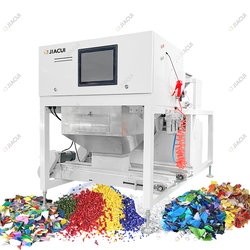
Drawing on field deployments across 50+ countries, JIACUI's VALUESORT series addresses four primary plastic sorting applications:
1. Plastic Pellet Color Sorting (Colored vs. Transparent)
Recycled plastic pellet producers use optical sorters to separate off-color or contaminated pellets from virgin-quality clear pellets. A batch of recycled PET pellets may contain amber (thermally degraded), black (carbonized), or green (cross-contaminated) pellets among clear ones. Color sorting removes these, upgrading the batch from general-purpose grade to food-grade or premium-grade material.
2. Mixed Plastic Flake Separation
Post-consumer plastic waste arrives at MRFs (Material Recovery Facilities) as mixed flake after shredding. VALUESORT sorters separate this stream by polymer type and color simultaneously—producing color-pure PET, HDPE, and PP streams from a single mixed input. AI classification distinguishes polymers that look identical to the human eye but have different NIR signatures.
3. Recycled Plastic Granule Quality Upgrading
Reprocessing facilities that convert flake to granules face quality variability from feedstock inconsistency. Optical sorting of the final granule product removes off-spec pellets (discolored, oversized, or contaminated), ensuring consistent melt-flow index and color uniformity for downstream injection molding or extrusion customers.
4. Plastic Bottle Flake Sorting (Clear/Green/Blue/Brown)
PET bottle recycling produces flake in four primary colors. Separating these enables color-specific reprocessing: clear flake commands the highest price and is used for food-grade rPET; green and blue flake serve colored-bottle applications; amber/brown flake supplies non-food markets. VALUESORT's multi-channel design and 90 stored parameter groups enable rapid switching between color sorting recipes.
Model Selection Guide for Plastic Sorting
Chute-Type Models for Plastic Pellet and Granule Sorting
Chute-type sorters are ideal for pellets, granules, and small flakes where free-fall material flow creates a uniform single-layer curtain for camera inspection. The following VALUESORT chute-type models are suited for plastic sorting applications:
| Model | Nozzles | Power (kW) | Capacity (T/H) | Weight (kg) | Typical Application |
|---|---|---|---|---|---|
| CS-HA128 | 128 | 1.5 | 1.0–2.0 | 280 | Small pellet lines, pilot sorting |
| CS-HA256 | 256 | 2.5 | 2.0–4.0 | 480 | Medium pellet/granule production |
| CS-HA512 | 512 | 5.0 | 4.0–8.0 | 920 | Large-scale pellet sorting |
| CS-HA640 | 640 | 7.0 | 5.0–10.0 | 1940 | Industrial-scale plastic granule upgrading |
Crawler-Type (Belt) Models for Plastic Flake and Shredded Material
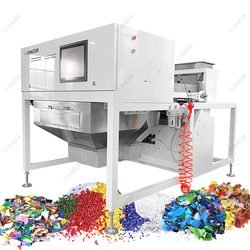
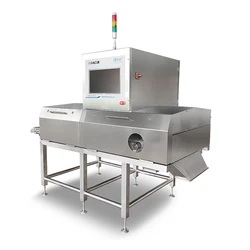
Crawler-type sorters use a conveyor belt to transport material past the optical inspection zone. They are preferred for plastic flakes, shredded material, and irregular particles where a belt provides more stable material presentation than free-fall.
| Model | Band Width | Nozzles | Power (kW) | Capacity (T/H) | Typical Application |
|---|---|---|---|---|---|
| CS-LA600 | 600 mm | 128 | 3.5 | 1.0–3.0 | Small MRF flake sorting |
| CS-LA1200 | 1200 mm | 256 | 6.0 | 2.0–6.0 | Medium MRF and reprocessor |
| CS-LA1200D | 1200 mm × 2 | 512 | 9.0 | 4.0–12.0 | Large-scale mixed plastic sorting |
The dual-belt CS-LA1200D doubles throughput capacity by running two 1200 mm belts in parallel, achieving up to 12 tons per hour—suitable for high-volume MRFs and reprocessing facilities handling baled post-consumer plastic waste.
Sorting Performance Metrics
The table below summarizes the key performance parameters of the VALUESORT series for plastic sorting:
| Performance Metric | Specification | Significance for Plastic Recycling |
|---|---|---|
| Sorting Accuracy | 99%+ | Meets APR purity protocols for food-grade rPET |
| Carry-Out Ratio | 120:1 | Maximizes yield; less than 1 good particle lost per 120 ejected |
| CCD Resolution | 5400 × 12K (Toshiba) | Detects subtle color shifts in translucent pellets |
| Processing Platform | Altera FPGA (USA) | Sub-millisecond classification-to-ejection latency |
| Valve Lifespan | 12 billion operations | Supports continuous 24/7 industrial operation |
| AI Parameter Groups | 90 stored recipes | Rapid changeover between polymer/color programs |
| Remote Control | WiFi APP-based | Reduces MTTR for facilities in remote locations |
ROI: The Economics of Optical Sorting in Plastic Recycling
Contamination Reduction Value
Consider a mid-sized PET reprocessing facility handling 5,000 tons of bottle flake annually. Without optical sorting, the flake achieves approximately 95% purity, selling at USD 700/ton. With a VALUESORT CS-LA1200 sorter achieving 99.5% purity, the same material qualifies for food-grade rPET pricing at USD 1,100/ton.
Annual revenue increase: 5,000 tons × (USD 1,100 − USD 700) = USD 2,000,000 in additional revenue, against a CS-LA1200 equipment cost of approximately USD 45,000–80,000, yielding payback in under one month of operation.
Yield Improvement
The 120:1 carry-out ratio means that for every 120 tons of reject material ejected, only 1 ton of good material is lost. This translates to a yield loss of approximately 0.8%—compared to 3–5% yield loss in older or lower-quality sorters. For a facility processing 10,000 tons annually, the difference between 0.8% and 4% yield loss equals 320 tons of additional recovered plastic, worth USD 192,000–384,000 depending on resin grade.
Industry Standards and Compliance
ASTM D7611: Plastic Bale Specifications
ASTM D7611 defines the standard categories for plastic bales arriving at recycling facilities, including color purity requirements. VALUESORT sorters help MRFs produce bales that meet or exceed these specifications, enabling access to higher-tier buyers and export markets.
Association of Plastic Recyclers (APR) Protocols
The APR Design Guide for Recyclability sets protocols for how plastic packaging should be designed for recyclability, and APR's Critical Guidance Protocol evaluates recycling process compatibility. Optical sorting plays a central role in meeting APR purity benchmarks—particularly the requirement that recycled PET contain less than 100 ppm of PVC (a single PVC label per ton can trigger failure) 3.
European Plastics Converters (EuPC) Recycling Targets
The EU Plastics Strategy targets 50% plastic packaging recycling by 2025 and 55% by 2030. EuPC member organizations have set recycled-content mandates requiring virgin-quality recycled material—achievable only through high-accuracy optical sorting at every stage of the recycling chain.
Frequently Asked Questions
What is the difference between NIR sorting and CCD color sorting for plastics?
NIR (near-infrared) sorting identifies polymer type by analyzing molecular bond absorption patterns in the 780–2500 nm wavelength range—invisible to the human eye. CCD color sorting uses visible light (380–780 nm) to identify color, appearance, and surface defects. The two technologies are complementary: NIR tells you *what polymer* a particle is; CCD tells you *what color* it is and whether it is visually defective. Modern sorters like the VALUESORT series integrate both approaches for maximum sorting accuracy.
Can optical sorters separate clear PET from clear PVC?
Yes, with the appropriate technology. Clear PET and clear PVC appear identical under visible light but have distinct NIR absorption signatures. PET absorbs at 1660 nm and 2090 nm, while PVC shows characteristic absorption at 1718 nm and 2078 nm due to its C-Cl bonds. VALUESORT's AI deep learning system, trained on polymer spectral data, can distinguish these materials even when they are visually identical.
What throughput can I expect for plastic flake sorting?
Throughput depends on the model and material characteristics. The chute-type CS-HA640 achieves 5–10 T/H for pellets and granules. The crawler-type CS-LA1200D achieves 4–12 T/H for mixed plastic flakes. Actual throughput varies with flake size, bulk density, and required purity level—finer sorting tolerances reduce throughput but increase output quality.
How does color sorting improve the value of recycled HDPE?
Natural (unpigmented) HDPE commands a 30–50% price premium over mixed-color HDPE because it can be reprocessed into any color, whereas pigmented material is locked to specific colored applications. By separating natural HDPE from colored HDPE—and further separating by color family—optical sorting enables producers to capture this premium for each color stream.
What maintenance does a plastic color sorter require?
VALUESORT sorters are designed for continuous industrial operation. Routine maintenance includes periodic cleaning of optical glass surfaces (automated by the built-in glass cleaning system), inspection and replacement of solenoid valves after multi-billion-cycle intervals, and calibration of camera gain via the remote APP. The 12 billion-operation valve lifespan and WiFi remote diagnostics minimize downtime, with mean time to repair (MTTR) reduced from days to hours for facilities in JIACUI's 50+ country service network.
Conclusion
Plastic recycling color sorting is not an optional upgrade—it is the enabling technology that determines whether recycled plastic remains a low-value commodity or ascends to virgin-quality, food-grade, and engineering-grade markets. The economics are straightforward: each percentage point of purity improvement translates directly into dollars per ton, and the gap between 95% and 99.5% purity can double the value of recycled PET, HDPE, or ABS.
The VALUESORT (悦选) series from Zhengzhou Jiacui Machinery Equipment Co., Ltd. brings 20+ years of optical sorting manufacturing experience to the plastic recycling sector. With Toshiba CCD sensors at 5400 × 12K resolution, Altera FPGA real-time processing, AI deep learning for polymer identification, high-frequency valves rated at 12 billion operations, and 99%+ sorting accuracy, VALUESORT sorters are deployed across 50+ countries and 4 production bases. The full model range—from the compact CS-HA128 (1 T/H) to the dual-belt CS-LA1200D (12 T/H)—covers laboratory sampling through industrial-scale MRF and reprocessor operations.
To request a model recommendation, sorting test, or quotation for your plastic recycling application:
- Website: www.jcsorter.com
- Email: jiacuichen10@gmail.com
- Phone / WhatsApp: +86-13837166065
- Company: Zhengzhou Jiacui Machinery Equipment Co., Ltd.
About the Author
This article is produced by the engineering team at Zhengzhou Jiacui Machinery Equipment Co., Ltd., a manufacturer with 20+ years of experience in optical sorting technology. JIACUI employs 30+ senior engineers, holds 21 patents, and co-authored 3 industry standards. The company reinvests 12% of annual revenue into R&D and operates 4 production bases across China. VALUESORT products carry CE and ISO certifications, deployed in 50+ countries serving grain, food, industrial product, and plastic recycling applications.
References
- U.S. Environmental Protection Agency. *Plastics: Material-Specific Data.* EPA Facts and Figures about Materials, Waste, and Recycling. https://www.epa.gov/facts-and-figures-about-materials-waste-and-recycling/plastics-material-specific-data
- Ellen MacArthur Foundation. *The New Plastics Economy: Rethinking the Future of Plastics.* https://www.ellenmacarthurfoundation.org/the-new-plastics-economy
- Association of Plastic Recyclers (APR). *APR Design Guide for Recyclability and Critical Guidance Protocol.* https://www.plasticsrecycling.org/
- WRAP (Waste & Resources Action Programme). *Plastic Packaging Recycling Options and Market Analysis.* https://wrap.org.uk/
- ASTM International. *ASTM D7611/D7611M: Standard Guide for Categorizing Plastic Bales by Commodity.* https://www.astm.org/d7611-23.html
- Beigbeder, J. et al. "Near-infrared spectroscopy for sorting plastics: A review." *Waste Management*, Elsevier. https://www.sciencedirect.com/journal/waste-management
- European Plastics Converters (EuPC). *Plastics Strategy and Recycling Targets.* https://www.plasticsconverters.eu/