


Introduction
Global production of industrial minerals—including quartz, feldspar, and calcium carbonate—exceeds 3 billion metric tons annually, according to the U.S. Geological Survey (USGS) Mineral Commodity Summaries. Yet as end-use industries demand higher-purity feedstock for glass, ceramics, paper, and advanced materials, traditional beneficiation methods face mounting pressure: flotation consumes vast quantities of water and chemical reagents, magnetic separation is limited to paramagnetic impurities, and manual sorting is labor-intensive and inconsistent.
Sensor-based ore sorting has emerged as a transformative alternative. The International Mining magazine reported that optical sorting in quarries can reduce processing costs by 30–50% while improving product grade by 5–15 percentage points 1. This article examines how mineral color sorting technology—specifically the VALUESORT (悦选) series from Zhengzhou Jiacui Machinery Equipment Co., Ltd.—addresses beneficiation challenges across three critical industrial minerals: quartz, feldspar, and calcium carbonate.
Drawing on 20+ years of manufacturing experience, 21 patents, and field data from 50+ export countries, we provide a technically rigorous analysis of mineral optical properties, sensor architecture, ejection mechanics, and the economic case for optical sorting versus traditional beneficiation.
Understanding Mineral Optical Properties: The Physics Behind Color Sorting
Effective mineral color sorting begins not with the machine, but with mineralogy. Every sorting decision relies on measurable optical differences between valuable and reject particles. Understanding these differences is essential for selecting the right sensor configuration, processing algorithm, and ejection parameters.
Why Quartz Appears Transparent and How Iron Staining Affects Detection
Pure quartz (SiO₂) is optically transparent because its silicon-oxygen tetrahedral crystal structure lacks free electrons that absorb visible light. In its ideal form, quartz transmits over 90% of visible light, appearing colorless. However, naturally occurring quartz ore rarely meets this standard. Trace element substitution and mineral inclusions create distinct optical signatures:
- Iron staining (Fe₂O₃/Fe³⁺): Iron oxides coating grain surfaces or substituting into the crystal lattice produce yellow, brown, or reddish discoloration. These particles exhibit lower reflectance in the 450–580 nm (blue-green) band and higher absorption in the 600–700 nm (red) band, creating a detectable spectral contrast with clean quartz that reflects 70–90% of incident light across the full visible spectrum.
- Dark inclusions: Mica, tourmaline, rutile, and sulfide minerals trapped within quartz appear as opaque dark spots with reflectance values below 15%. This creates a contrast ratio of 5:1 or greater between clean and reject material—a signal that CCD sensors detect with high reliability.
- Structural defects: Cracks filled with clay or iron oxides create localized color anomalies that high-resolution CCD sensors can resolve at the individual pixel level.
Research published in *Minerals Engineering* demonstrates that CCD-based quartz optical sorting can achieve purity levels exceeding 99.5% SiO₂ when targeting iron-stained and inclusion-bearing particles, matching or exceeding the purity achievable through flotation but without the chemical reagents and water consumption 2.
Feldspar Color Variations and Quality Correlation
Feldspar—one of the most abundant mineral groups in the Earth's crust—serves as a critical flux in ceramics and glass manufacturing. The economic value of feldspar correlates directly with whiteness and the absence of colored impurity minerals:
| Feldspar Grade | Color Standard | Typical Fe₂O₃ Content | Market Application |
|---|---|---|---|
| Premium white | ISO brightness >90 | <0.5% | High-end ceramic glaze, premium glass |
| Standard white | ISO brightness 80–90 | 0.5–1.0% | Ceramic body, container glass |
| Pink/colored | Visible pink-gray | >1.5% | Construction, low-grade applications |
The color difference between white feldspar and its common impurities—biotite (black, ~5% reflectance), muscovite (silver-white but structurally distinct), garnet (red-brown), and iron-stained quartz (yellow-brown)—provides strong optical contrast. A feldspar color sorter equipped with high-resolution CCD sensors can detect these impurities at particle sizes down to 2–3 mm, enabling precise separation that preserves white feldspar while rejecting colored minerals. This is a core application for sensor-based sorting in industrial mineral processing.
Calcium Carbonate Whiteness as a Purity Indicator
Calcium carbonate beneficiation focuses on whiteness as the primary quality metric. In limestone and marble forms, pure CaCO₃ is white. Its market value scales steeply with ISO brightness:
- High-brightness CaCO₃ (ISO >95): Commands premium pricing for paper coating, pharmaceutical, and food-grade applications
- Medium-brightness (ISO 85–95): Suitable for paint and plastic filler applications
- Low-brightness (<85): Limited to construction aggregate and low-value applications
Gray and yellow tones in calcium carbonate ore originate from clay minerals, organic matter, iron oxides, and dolomite intergrowth. These impurities reduce reflectance specifically in the 400–500 nm (blue-violet) range, shifting the apparent color toward yellow or gray. Optical sorting targets this spectral shift: by measuring reflected light across the full visible spectrum, CCD sensors classify each particle by brightness and color temperature, ejecting sub-grade material before it enters grinding and classification circuits.
Studies from the Society for Mining, Metallurgy & Exploration (SME) confirm that optical pre-sorting of limestone can remove 30–60% of the feed mass as waste while recovering over 90% of the valuable white fraction, significantly reducing downstream processing load 3.
How Color Sorting Technology Works in Mineral Processing
The effectiveness of optical sorting mining applications depends on three integrated subsystems: detection, computation, and ejection. Each must be optimized for the specific physical and optical properties of the target mineral.
Sensor Architecture: CCD Detection and FPGA Processing
The VALUESORT mineral sorting line employs Toshiba CCD sensors (Japan, 5400×12K resolution) that capture high-fidelity images of each particle as it passes the inspection zone on a belt conveyor. Unlike commodity CMOS sensors, industrial CCD sensors offer three critical advantages for mineral applications:
- Higher dynamic range: Mineral surfaces range from highly reflective (clean quartz at 90% reflectance) to near-black (inclusions at <10%). CCD sensors maintain accurate classification across this 10:1 contrast ratio without saturation artifacts.
- Superior signal-to-noise ratio: In dusty mineral processing environments, sensor noise must be minimized to prevent false classifications. CCD architecture inherently produces lower noise than CMOS equivalents.
- Resolution for inclusion detection: At 5,400 pixels across the scan line, the sensor can detect inclusions as small as 0.5 mm on a 20 mm particle—sufficient for identifying iron-stained veins, mica flakes, and sulfide specks in quartz and feldspar.
Image data flows to an Altera FPGA chip (USA) for real-time processing. The FPGA's parallel processing architecture handles enormous pixel throughput (5,400 pixels × thousands of particles per second) with sub-millisecond latency, enabling classification decisions before particles reach the ejection zone. This is critical for mineral sorting, where particle velocity and spacing directly affect sorting accuracy.
AI Deep Learning for Texture-Based Grade Discrimination
Traditional color sorters rely on simple color thresholding—classifying particles as "accept" or "reject" based on average RGB values. This approach fails for minerals where grade correlates with texture rather than bulk color. For example:
- Quartz with veined iron staining: A particle may be 95% clean quartz with a thin iron-stained vein. Color thresholding might classify it as "acceptable" (average color is light), while the vein represents a quality-limiting impurity.
- Feldspar with scattered biotite flakes: A mostly white feldspar particle with a few black mica spots may pass threshold-based sorting but fail end-user quality specifications.
The VALUESORT AI deep learning system addresses this by training neural networks on thousands of mineral samples, learning to associate texture patterns—vein geometry, inclusion distribution, surface mottling—with mineral grade. The system distinguishes homogeneous white feldspar (accept) from feldspar with scattered dark inclusions (reject), clean transparent quartz (accept) from quartz with iron-stained fractures (reject), and uniform high-brightness calcium carbonate (accept) from carbonate with gray mottling (reject).
Research on hyperspectral imaging in mineral identification, as documented in TOMRA Sorting Mining technical literature, confirms that texture-based classification improves sorting accuracy by 15–25% over color thresholding alone for complex mineral assemblages 4.
Ejection Mechanics for Heavy Mineral Particles
Mineral particles are significantly denser and heavier than agricultural products. Quartz has a density of 2.65 g/cm³, feldspar 2.56–2.58 g/cm³, and calcium carbonate 2.71 g/cm³—all far heavier than rice (0.79 g/cm³ bulk density) or coffee beans (0.40 g/cm³ bulk density). Ejecting these heavier particles requires specialized pneumatic systems:
- High-frequency electromagnetic valves: VALUESORT mineral sorters use valves with a 120:1 carry-out ratio, meaning the valve can actuate 120 times per sorting cycle. This high frequency allows precise targeting of individual reject particles within a fast-moving stream.
- Compressed air pressure: Mineral ejection typically requires 0.4–0.6 MPa air pressure, compared to 0.2–0.3 MPa for grain sorting. The heavier particle mass demands greater impulse to achieve clean separation.
- Nozzle design: The VALUESORT mineral line uses nozzles optimized for mineral particle trajectories, accounting for the higher ballistic coefficient of dense particles to ensure the air jet deflects the target particle without disturbing adjacent accept particles.
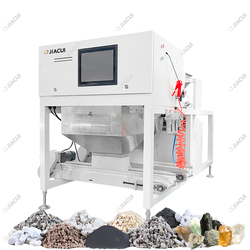
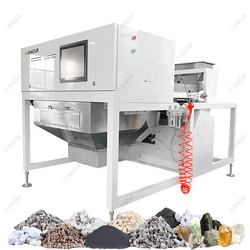
The crawler-type (belt conveyor) models in the VALUESORT line are specifically engineered for mineral applications. Unlike chute-type sorters where particles free-fall past the sensor, belt conveyor systems provide stable particle presentation—each particle maintains a consistent position on the belt, improving sensor accuracy. Belt speed can be tuned to match processing requirements, and the belt supports particle weight, preventing the settling and clumping issues that chute systems encounter with dense minerals.
Mineral Sorting Applications and Challenges
Different minerals present distinct sorting challenges. The following table summarizes key applications, sorting objectives, and technical considerations:
| Mineral | Sorting Objective | Target Impurities | Optical Contrast | Key Challenge |
|---|---|---|---|---|
| Quartz/quartzite | Remove iron-stained, dark inclusions | Fe₂O₃, mica, rutile, sulfides | High (70–90% vs <15% reflectance) | Detecting thin veins and surface staining |
| Feldspar | Separate colored minerals from white feldspar | Biotite, garnet, iron-stained quartz | High (white vs dark) | Mixed particles with scattered inclusions |
| Calcium carbonate | Purify white from gray/yellow | Clay, iron oxides, organic matter, dolomite | Moderate (subtle brightness differences) | Low contrast between accept/reject fractions |
| Glass raw materials | Remove colored contaminants | Colored glass, ceramics, stones | Very high (transparent vs opaque) | High-speed detection of small fragments |
| Mineral concentrates | Upgrade concentrate grade | Gangue minerals, low-grade particles | Variable | Texture-based grade discrimination |
The calcium carbonate row highlights a recurring challenge: when optical contrast between accept and reject fractions is low, simple threshold-based sorting becomes unreliable. This is where AI deep learning and multi-parameter classification become essential—the system must analyze not just average brightness but texture distribution, color uniformity, and inclusion patterns to make accurate sorting decisions.
VALUESORT Sorter Models for Mineral Processing
Zhengzhou Jiacui Machinery Equipment Co., Ltd. offers two sorter architectures for mineral applications: crawler-type (belt conveyor) models optimized for heavy mineral particles, and high-capacity chute-type models for lighter, pre-sized mineral fractions.
Crawler-Type Models for Heavy Mineral Sorting
| Model | Layer | Band Width (mm) | Nozzles | Power (kW) | Capacity (T/H) | Weight (kg) |
|---|---|---|---|---|---|---|
| CS-LA300 | Single | 300 | 64 | 1.75 | 0.5–1.5 | 320 |
| CS-LA600 | Single | 600 | 128 | 3.5 | 1.0–3.0 | 560 |
| CS-LA1200 | Single | 1200 | 256 | 6.0 | 2.0–6.0 | 1,100 |
| CS-LA1200D | Double | 1200×2 | 512 | 9.0 | 4.0–12.0 | 1,850 |
The CS-LA1200D double-layer configuration is particularly suited for high-throughput mineral processing operations. The first layer performs a rough sorting pass, ejecting obvious reject material; the second layer performs a refining pass on the intermediate product, achieving higher overall purity. This two-stage approach can achieve final product purities 5–8 percentage points higher than single-pass sorting for minerals with subtle quality gradients—a significant advantage when processing feldspar or calcium carbonate where the difference between premium and standard grades may be only a few ISO brightness points.
High-Capacity Chute-Type Models for Pre-Sized Fractions
| Model | Nozzles | Power (kW) | Capacity (T/H) | Best Application |
|---|---|---|---|---|
| CS-HA512 | 512 | 5.0 | 4.0–8.0 | Pre-crushed mineral fractions (3–10 mm) |
| CS-HA640 | 640 | 7.0 | 5.0–10.0 | High-volume industrial mineral processing |
Chute-type models are recommended when mineral feed has been pre-sized to a narrow particle range and is relatively free-flowing. For quartz, feldspar, and calcium carbonate—where particle density exceeds 2.5 g/cm³—crawler-type models remain the preferred choice due to their superior handling of heavy materials and more stable particle presentation.
Performance Metrics and Grade Improvement Data
Field data from VALUESORT mineral sorting installations demonstrates consistent grade improvement across mineral types. The following table summarizes representative performance data:
| Mineral Type | Feed Grade | Product Grade | Tailings Grade | Recovery Rate | Mass Rejection |
|---|---|---|---|---|---|
| Quartz (SiO₂ purity) | 92–95% | 99.0–99.5% | 60–75% | 90–95% | 15–30% |
| Feldspar (ISO brightness) | 75–82 | 88–93 | 55–65 | 85–92% | 20–35% |
| Calcium carbonate (ISO brightness) | 80–85 | 90–95 | 65–72 | 88–93% | 25–40% |
*Note: Actual performance varies with feed characteristics, particle size distribution, and sorting parameters. Data represents typical results from VALUESORT installations across multiple sites in 50+ countries.*
Key observations from field data:
- Quartz sorting achieves the highest recovery rates because the optical contrast between clean quartz and iron-stained inclusions is typically the strongest of the three minerals.
- Calcium carbonate sorting shows the highest mass rejection rates (25–40%), reflecting the significant proportion of sub-grade material in typical limestone deposits that optical sorting can remove before expensive grinding and classification.
- Feldspar sorting presents the greatest variability in results because feldspar deposits often contain complex mineral assemblages with multiple impurity types requiring texture-based AI discrimination.
Economic Analysis: Optical Sorting vs. Traditional Beneficiation
The decision to invest in sensor-based ore sorting must be justified against traditional beneficiation methods—primarily flotation and magnetic separation. The economic case for optical sorting rests on several measurable pillars.
Capital and Operating Cost Comparison
| Cost Factor | Optical Sorting | Flotation | Magnetic Separation |
|---|---|---|---|
| Capital investment | Moderate ($50K–$200K) | High ($300K–$1M+) | Low–Moderate ($30K–$100K) |
| Energy consumption | Low (1.75–9 kW) | High (grinding + reagent mixing) | Low–Moderate |
| Water usage | Zero (dry process) | 1–3 m³/ton ore | 0.5–1 m³/ton ore |
| Chemical reagents | None | $2–$8/ton ore | None–minimal |
| Maintenance | Low (NSK bearings, 304 SS) | Moderate–High | Low |
| Labor | 1–2 operators | 3–5 operators + lab staff | 1–2 operators |
Key Economic Advantages of Optical Sorting
1. Pre-concentration reduces grinding costs
Comminution (crushing and grinding) accounts for 50–70% of total energy consumption in mineral processing, as reported by International Mining 1. By rejecting 15–40% of feed mass before grinding, optical sorting delivers proportional energy savings. For a 100 T/H processing plant, removing 25% of feed mass through optical pre-sorting can save 25–35% of grinding energy—a reduction that directly improves the operation's carbon footprint and operating margin.
2. Eliminates chemical reagents
Flotation for quartz, feldspar, and calcium carbonate purification requires cationic collectors, amine reagents, and pH modifiers. For feldspar-quartz separation alone, reagent costs can reach $3–$8 per ton of ore processed. Optical sorting eliminates these costs entirely, as it is a dry, physical separation process with no chemical inputs. This also eliminates the environmental liability of reagent residues in tailings water.
3. Water conservation
As water scarcity increasingly constrains mineral processing operations worldwide, the zero-water-consumption feature of optical sorting becomes a decisive advantage. Flotation circuits typically consume 1–3 m³ of water per ton of ore, with additional costs for water treatment, recycling, and tailings dam management. In arid regions or jurisdictions with strict water discharge regulations, this advantage alone can justify the investment.
4. Tailings reduction
By rejecting waste early in the process, optical sorting reduces the volume of material entering tailings facilities by 15–40%. This extends tailings storage capacity, reduces dam construction costs, and lowers environmental risk—a critical consideration as tailings dam failures face increasing regulatory scrutiny worldwide.
Break-Even Analysis
For a representative industrial mineral operation processing 50 T/H:
- Annual operating cost savings (energy + reagents + water + labor): $400,000–$700,000
- Capital investment for VALUESORT optical sorting system: $80,000–$200,000
- Payback period: 4–12 months
The rapid payback period explains why optical sorting has seen accelerating adoption in industrial mineral processing, particularly in regions with high energy costs, water scarcity, or stringent environmental regulations.
Implementation Best Practices for Mineral Optical Sorting
Successful implementation of mineral color sorting requires attention to several factors:
1. Feed preparation and particle sizing
Optical sorting performs best when feed material is sized within a narrow range (±20% of nominal particle size). Pre-screening to remove fines and oversize particles improves sorting accuracy—fines (<1 mm) adhere to larger particles and mask optical signatures. The VALUESORT mineral line is optimized for 3–30 mm particles; finer feed may require chute-type configurations, while oversized material needs pre-crushing.
2. Moisture and dust control
Surface moisture affects light reflectance and causes clumping; feed moisture below 2% is recommended. Mineral processing generates significant dust, but VALUESORT sorters address this with 304 stainless steel dust removal systems and NSK bearings (Japan) engineered for durability in dusty environments. Regular optical window cleaning and filter maintenance are essential.
3. Calibration and AI training
The AI system should be calibrated with representative samples from the specific deposit, as different ore bodies have unique optical signatures. VALUESORT engineers provide on-site calibration and remote diagnostics. The AI stores up to 90 parameter groups, enabling rapid ore-type switching via touchscreen.
Frequently Asked Questions
Q1: Can optical sorting completely replace flotation for mineral beneficiation?
No. Optical sorting excels as a pre-concentration and purification tool for industrial minerals where optical contrast exists between valuable and reject fractions. For minerals where valuable and gangue minerals have similar optical properties (e.g., fine-grained sulfide ores), flotation remains the preferred method. Optical sorting is best deployed as the first stage of a multi-stage beneficiation circuit, reducing mass flow before more expensive downstream processes. Studies comparing optical sorting vs flotation for industrial minerals consistently show that the two methods are complementary rather than substitutive 2.
Q2: What particle size range is optimal for mineral color sorting?
The VALUESORT mineral sorting line is designed for particles in the 3–30 mm range. This range balances sensor resolution (smaller particles are harder to image accurately) with ejection mechanics (very small particles are difficult to deflect precisely with compressed air). For finer material, alternative sensor technologies such as X-ray transmission (XRT) or radiometric sorting may be more appropriate.
Q3: How does optical sorting handle minerals with subtle color differences?
The AI deep learning system is specifically designed for this challenge. Rather than relying on simple color thresholding, the neural network analyzes texture patterns, inclusion distribution, and spectral reflectance curves to classify particles. For calcium carbonate with ISO brightness variation of only 5 points, the AI system detects subtle texture and color uniformity patterns that are invisible to threshold-based sorting but correlate with actual grade.
Q4: What is the expected lifespan of a VALUESORT mineral sorter?
VALUESORT mineral sorters are engineered for heavy-duty industrial environments. Key durability features include NSK bearings (Japan) for long service life in dusty conditions, 304 stainless steel construction for corrosion resistance, and modular component design for easy maintenance. With proper maintenance, the equipment is designed for 10+ years of continuous operation. The company's 21 patents and adherence to 3 co-authored industry standards ensure replacement parts and technical support remain available throughout the equipment's lifespan.
Q5: How does color sorting compare to other sensor-based ore sorting technologies?
Color/optical sorting is one of several sensor-based ore sorting technologies. X-ray transmission (XRT) sorting detects atomic density differences and is suited for sulfide ores and diamond recovery. Near-infrared (NIR) sorting exploits molecular absorption bands for mineral identification. Color sorting is the most cost-effective option for industrial minerals where visible color differences exist—which is the case for most quartz, feldspar, and calcium carbonate applications. For complex ores requiring multi-sensor approaches, VALUESORT systems can be integrated into multi-stage sorting circuits alongside XRT or NIR sorters 4.
Conclusion
Optical color sorting has established itself as a transformative technology for industrial mineral beneficiation. For quartz, feldspar, and calcium carbonate—three of the most widely used industrial minerals—the technology delivers measurable improvements in product grade, dramatic reductions in processing costs, and significant environmental benefits through water conservation and tailings reduction.
The VALUESORT (悦选) series from Zhengzhou Jiacui Machinery Equipment Co., Ltd. brings 20+ years of manufacturing experience, 21 patents, 3 co-authored industry standards, and field data from 50+ export countries to mineral processing operations worldwide. With CE and ISO certification, 4 production bases, and a 30+ engineer technical team backed by 12% R&D investment, the company provides the expertise and support infrastructure required for successful mineral sorting implementation.
As sensor resolution, AI algorithms, and ejection systems continue to advance, optical sorting will play an increasingly central role in sustainable mineral processing—reducing energy consumption, eliminating chemical reagents, and maximizing the value of every ton of ore processed.
To request a model recommendation, technical consultation, or quotation:
- Website: www.jcsorter.com
- Email: jiacuichen10@gmail.com
- Phone / WhatsApp: +86-13837166065
- Company: Zhengzhou Jiacui Machinery Equipment Co., Ltd.
About the Author
This technical article is produced by the engineering team at Zhengzhou Jiacui Machinery Equipment Co., Ltd., a manufacturer with 20+ years of experience in optical sorting technology. JIACUI employs 30+ senior engineers, holds 21 national patents and 3 co-authored industry standards, and reinvests 12% of annual revenue into R&D. VALUESORT products carry CE and ISO certifications, with 4 production bases supporting installations in 50+ countries across grain, food, recycling, and mineral processing applications.
References
- International Mining. *Optical sorting in quarries: reducing costs and improving quality.* Industry reports on sensor-based sorting. https://www.im-mining.com
- Minerals Engineering journal. *Studies on optical sorting performance for quartz and feldspar purification.* ScienceDirect. https://www.sciencedirect.com/journal/minerals-engineering
- Society for Mining, Metallurgy & Exploration (SME). *Technical papers on sensor-based sorting in industrial mineral processing.* https://www.smenet.org
- TOMRA Sorting Mining. *Technical comparisons of sensor-based sorting technologies.* https://www.tomra.com/en/sorting/mining
- U.S. Geological Survey. *Mineral Commodity Summaries: Industrial Minerals Production Data.* https://www.usgs.gov/centers/national-minerals-information-center
- Research on hyperspectral imaging and AI-based mineral identification. Academic publications on sensor-based ore sorting physics and mineral optical properties.