



Sesame Color Sorter · Micro-Seed Optical Sorting
Sesame is 2–3 mm across and lighter than almost anything else on a sorting line, which is why the same machine that works well on rice can blow good seed into the reject bin and still miss a white stone. JIACUI builds the head, the chute and the valve for the small end of the seed scale: a 5400-pixel CCD that resolves a color shift across a single seed, a shallow micro-seed chute that stops the bounce, and short low-pressure pulses that take the one seed aimed at. Optional near-infrared reads composition instead of color, for the stones no camera can see.
What an AI Sesame Color Sorter Removes
Manual inspection of 2 mm seed is not possible at commercial volume, and sieving only separates by size. An optical sorter is the only stage that can act on the five defects that decide a sesame lot's grade.
Discolored and off-color seeds
A red or brown seed in a white hulled lot, or a faded grey seed in a black lot, is a grade failure that costs the whole consignment its premium. Subtle shade differences across a 2 mm surface need resolution, not sensitivity: the head images each seed at 5400 pixels per line with more than 16 million color combinations, so a seed that is one shade off is separated from its neighbours instead of averaged with them.
Moldy, rotten and heat-damaged kernels
Mould is not only a color defect — it is the visible end of a toxin risk. A discolored, shrivelled or heat-damaged kernel is flagged on color and surface texture together, which is what aflatoxin-conscious buyers ask for as one control in the chain. Sorting reduces the risk in a lot; it does not rescue a lot that arrived contaminated, and no honest supplier should tell you otherwise.
Stones, soil clods and glass
Dense foreign matter that survives destoning and screening is the defect that stops a line — a stone in a container means a rejected shipment or a broken mill. Color sorting catches the dark ones; a white stone in white sesame needs near-infrared, which reads material composition rather than surface shade. That is an option on our machines, and we will tell you when you need it and when you do not.
Weed seeds, fiber and insect-damaged seed
Nightshade and other weed seeds, jute or bag fiber, and seeds holed by insects are non-sesame bodies with a different geometry. The network judges seed outline, area and texture, so a round weed seed of the same color is still rejected — the call a threshold-based sorter cannot make at all.
Hull fragments and residual unhulled seed
On a dehulling line the fault moves: hull flakes, partly hulled seeds and unhulled seed left in a hulled lot. All three sit in the same color family as the product, so they are separated on shape and edge detail and, in a second pass, on the brightness of the exposed kernel.
Removal rates depend on the defect, the variety and the feed rate. The trial report states what your seed actually achieves — including where a call is marginal and a second pass is the honest answer.
Sorted by Sesame Type and Grade
White, black, red, hulled and roasted sesame do not share a single threshold between them. The recipes are saved per product, so switching from a white hulled lot to a black lot is a selection on the touchscreen, not a recalibration visit.
Running seed alongside other small commodities? The same platform handles them with a different chute profile — see the grain and seed hub and the AI color sorter range.
Engineered for a 2 mm Seed, Not a Grain Kernel
Six details separate a machine that works on sesame from one that works on rice and is sold to a sesame buyer anyway.
- A head sized for a 2 mm subject
At 5400 pixels per line across a narrow chute, one sesame seed covers enough pixels for the classifier to judge a spot on its surface. Widen the chute or lower the resolution and the same seed becomes a smudge — which is exactly why a machine rated for rice throughput under-performs on seed.
- A chute that stops the bounce
Light, round seed bounces. Every bounce changes the speed at the nozzle and the angle at the camera, and both show up as false ejections. Shallow U-profile chutes with a matched surface finish and a controlled feed rate keep the seed on one trajectory from camera to valve.
- Air set for light seed, not heavy grain
A nozzle tuned for rice throws a sesame seed across the chute and takes three good neighbours with it. Micro-seed recipes run lower pressure with a shorter pulse, so the ejection is aimed rather than blasted. This is the single setting that decides your carryover ratio on sesame.
- Ejectors rated to keep up
High-frequency solenoid valves with a response under two milliseconds and a one-billion-cycle rating. On small seed the valve fires far more often per tonne than on rice, so valve life — not headline speed — is what keeps accuracy stable in month six.
- Optics that stay clean in an oily room
Sesame dust is fine and slightly oily, and it films a viewing glass faster than grain dust does. Automatic glass wiping, a sealed optical enclosure and an air purge on the camera window are what keep accuracy from drifting across a shift.
- Recipes per variety, taught in one pass
Feed a small batch of good seed and a small batch of the defect, and the controller builds the recipe. White, black, hulled, roasted and oil-grade profiles live in the machine, so a product change is a menu selection and not a service call.
Stones That Match the Seed: What Color Can and Cannot Do
This is the question every sesame buyer asks, and the honest answer has four parts.
What full-color CCD does well
Dark stones, soil clods, dark hull fragments and most weed seeds differ from sesame in shade as well as shape, and a 5400-pixel color head separates them reliably at full rate. This covers the majority of real consignments, which is why most sesame lines are sold without any spectral option at all.
Where color stops working
A white stone, a piece of clear glass or a lump of the same clay as the seed's own dust can match the product almost exactly. No amount of resolution fixes that, because there is no color difference to resolve. Any supplier promising otherwise with a visible-light camera is describing a machine that does not exist.
What near-infrared adds
An InGaAs short-wave infrared channel reads how the material absorbs light, which differs between a seed and a stone of the same color. It is fitted as an option for buyers whose specification names stone count, and it is not standard equipment on any sorter at this price level — including ours.
What we do instead of guessing
Send 2–5 kg with the stones and clods still in it, as they come off your destoner. The trial report states what the color head removes and what it misses, and whether the miss rate justifies the spectral option for your material. That answer is worth more than a specification sheet.
If your specification names a stone count, send the stones with the sample. We will report the miss rate of the color head and quote near-infrared only if the number justifies it.
Sesame Color Sorter Models and Specifications
Seven chute models from a 100 kg/h hulling unit to a 100 t/day export plant. All are the same CCD and software platform; chute count, valve grade and footprint are what change. Click a model for its page and full parameter sheet.
Swipe the table sideways for power, weight and dimensions.
| Model | Capacity (T/H, rice rating) | Carryover | Power (kW) | Weight (kg) | L×W×H (mm) |
|---|---|---|---|---|---|
| CS-1C64 | 0.5 – 1.0 | >10:1 | 1.2 | 350 | 955×1630×1550 |
| CS-1C96 | 1.0 – 1.5 | >10:1 | 1.8 | 500 | 1045×1630×1550 |
| CS-1C80 | 1.2 – 2.5 | >120:1 | 1.8 | 290 | 1152×1697×1708 |
| CS-2C160 | 1.5 – 2.0 | >10:1 | <2.2 | 600 | 1330×1630×1550 |
| CS-3A | 3.5 – 4.0 | >120:1 | 2.6 | 640 | 1620×1490×1690 |
| CS-6C | 4.0 – 6.0 | >10:1 | 4.8 | 1350 | 2528×1595×2040 |
| CS-10C | 7.0 – 10.0 | >10:1 | 5.5 | 2200 | 3910×1595×2040 |
Capacity is rated on rice at normal impurity levels and is not a sesame figure — see the sizing table below for indicative seed throughput. Accuracy is ≥99.99% on every model; air supply 0.6–0.8 MPa; power supply configured to your local voltage.
How to Size a Sesame Sorting Line
Three questions settle the model, and all three are about money rather than about machinery.
Size from your daily intake, not from the plate
A sesame line usually runs 20 hours; divide the tonnes you process in a day by the hours and add the peak you see at harvest. Seed is light, so a machine rated at 4 T/H on rice will not pass 4 T/H of sesame — plan roughly 50–70% of the rice rating and confirm the number on a trial.
One pass or two?
Raw sesame off a destoner often needs one pass; hulled sesame usually needs two, one after dehulling for hull fragments and one before packing for final grade. Two passes on one machine at half the rate is frequently cheaper than two machines — and if your carryover is already above 120:1 the second pass has little to recover.
Carryover is where the money is on small seed
At >10:1 you lose about one good seed per ten rejects; at >120:1 you lose one per hundred and twenty. On a 5 t/day line that difference is a measurable share of your saleable output every single day, which is why the valve grade matters more here than the headline capacity.
| Your line | Indicative sesame throughput* | Models to start from | |
|---|---|---|---|
| Small hulling unit, 1 – 2 t/day | 100 – 200 kg/h | CS-1C64 | CS-1C64 |
| 5 t/day line | 300 – 400 kg/h | CS-1C96, CS-1C80 | CS-1C96, CS-1C80 |
| 10 – 15 t/day | 700 – 900 kg/h | CS-2C160 | CS-2C160 |
| 30 t/day | 1.5 – 2.0 T/H | CS-3A | CS-3A |
| 50 t/day | 2.5 – 3.5 T/H | CS-6C | CS-6C |
| 100 t/day export plant | 5.0 – 7.0 T/H | CS-10C | CS-10C |
*Indicative for seed at normal fault levels. Heavy fault loads, unhulled raw seed and very fine grades run lower; the trial report gives the figure for your material. Capacity and payback planning turns kg/h into cost per tonne sorted.
Where the Sorter Sits in a Sesame Line
The same machine does a different job at three different points, and the recipe changes with the position. Most factories end up with two of the four below.
Before dehulling
Sort the raw seed first to take out stones, clods and mouldy kernels before they reach the huller. A stone in a dehuller costs a set of rollers; a mouldy kernel in the press costs the oil batch.
After dehulling
The second job is different: hull flake, partly hulled seed and unhulled seed in a hulled lot. This pass is set for whiteness and edge detail, not for dark defects, and it is the pass that decides whether the lot reads as one color in a buyer's sample tray.
Before packing
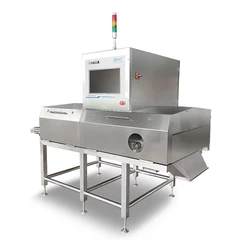
A final pass after roasting or grading catches the foreign bodies added by the building itself — bag fiber, plastic thread, a fragment of screen. Where metal or glass is a known risk, an X-ray inspection unit at the end of the line covers what optics cannot see.
Air, dust and floor space
A sesame line needs a compressor sized for the nozzle count plus a refrigerated dryer, and dust collection at the feed. We send the utility sheet with the quotation so the ancillaries can be sourced locally instead of shipped as air.
Admixture, Aflatoxin and Buyer Specifications
Sesame is an export commodity with a short list of things that get a container held. Sorting addresses one of them well, one of them partly, and none of them on its own.
Admixture is the number buyers test
Most contracts name a total admixture figure and a defect list, and a sample is checked against both before the container is sealed. Sorting to a stated number — and being able to repeat it lot after lot — is what turns a one-off sale into a supply agreement.
Aflatoxin is a lot risk, not a sorting problem
Aflatoxin comes from mould that may leave no visible trace on every affected seed. Sorting removes the visibly mouldy and damaged kernels, which lowers the load, but it is not a decontamination step. Buyers in the EU and Gulf test for it at the border, and a supplier who claims a sorter guarantees a passing result is selling you a problem later. Moisture control and storage matter as much as the machine.
Traceability and audit evidence
Food-safety schemes ask for evidence that foreign-body controls exist and work. An optical sorter with logged recipes, a documented reject stream and a maintenance record is exactly that evidence — see foreign-body control and food safety for what an auditor actually looks at.
Other Small Seeds on the Same Platform
Everything a sesame machine gets right — narrow chute, low air, high resolution — transfers to the rest of the small-seed list. Only the chute profile and the recipe change.
Send 2–5 kg of any of these and we will report what the color head achieves, rather than promise a number we have not measured.
What Sets the Price of a Sesame Color Sorter
Two quotations for "a 1 t/h sesame sorter" can differ by a factor of three, and it is rarely the margin. These five lines account for the gap.
Capacity and chute count
A single-chute unit and an eight-chute line share software, not hardware. Capacity is the largest line in any sesame sorter quotation.
Camera resolution and chute width
Resolution only helps if it is concentrated on a narrow chute. A wide chute with the same sensor sees fewer pixels per seed, which is how a "high resolution" machine still misses a spot on a 2 mm seed.
Ejector count and valve grade
More nozzles mean finer ejection and a higher carryover ratio, plus a bigger compressor. On micro-seed this is the line that decides how much good product you lose per shift.
Spectral options (NIR)
An InGaAs channel adds real cost and is only worth it where the specification names stones. We will quote it when the sample justifies it, and say so when it does not.
Ancillaries, freight and commissioning
Compressor, dryer, dust collector, elevator, spare valve kit. Ask for the utility sheet and for FOB and CIF side by side before comparing suppliers on price alone.
What to send us for an accurate quotation
- The sesame type and grade: white, hulled, black, red or brown, oil-grade, roasted.
- What must come out: off-color seed, mouldy kernels, stones, weed seed, hull flake.
- Your real throughput in tonnes per hour, and how many hours a day the line runs.
- The admixture figure your buyer tests against, if you have it in writing.
- Local voltage and frequency, and the air supply already on site.
Five answers give a firm budget figure; a sample with the stones left in it turns it into a guaranteed one.
Sesame Color Sorter FAQ
Can the sorter tell a white stone from a white sesame seed?
Not on color alone, and nobody's visible-light camera can. A white stone and a white seed reflect almost the same spectrum. Adding an InGaAs near-infrared channel lets the machine read how the material absorbs light, which does separate seed from stone — it is an option, quoted when your sample shows the problem is real and frequent enough to pay for itself.
Does the air blast blow away good sesame because the seed is so light?
That is the failure mode of a machine set up for grain, not of a machine set up for sesame. Micro-seed recipes run lower pressure with a shorter pulse and a nozzle position matched to the seed trajectory, so the ejection is targeted. The trial report states the carryover ratio actually measured on your seed, which is the number that matters.
Can one machine sort both white and black sesame?
Yes. White, black, hulled, red and roasted profiles are stored in the controller and a change is a menu selection plus a short calibration pass. Factories that pack both colors on alternate days do this routinely; what you must not do is run a white recipe on black seed and expect the same result.
How much sesame can one machine process per hour?
Roughly half to two-thirds of the published rice rating, because seed is far lighter per unit volume and the chute is run shallower. The sizing table above gives indicative tonnes per hour by model; the figure for your seed, grade and fault level is confirmed on a trial before you order.
Will it remove mouldy seeds well enough for an aflatoxin-conscious buyer?
It removes the visibly mouldy, discolored and damaged kernels, which measurably lowers the load in a lot. It is not a decontamination process and we will not present it as one: if the incoming lot is contaminated, sorting reduces risk but does not make it compliant. Moisture control from field to warehouse is the control that matters most.
One pass or two for hulled sesame?
Usually two — one after dehulling for hull fragments and partly hulled seed, one before packing for final grade. Both can run on the same machine at half rate, which is normally cheaper than buying two. If your carryover is already above 120:1 the second pass recovers very little and we will say so.
How difficult is the machine to run and maintain?
Operators work from a touchscreen: select a recipe, set the sensitivity, start the feed. Daily work is wiping the glass, checking the air dryer and emptying the reject bin; the consumables are nozzles, coils, glass and filter elements, all shipped by courier. Remote IoT debugging means most parameter problems are solved without a visit.
What do you need from me to quote?
The sesame type and grade, the defects you must remove, your tonnes per hour and shift pattern, the admixture figure your buyer tests against, and your local power and air supply. A 2–5 kg sample with the stones left in it turns a budget figure into a guaranteed one.
Further Reading on Micro-Seed Sorting
Send 3 kg of your sesame, stones included. We will send back the result.
Our lab runs your seed through the model we recommend, photographs the accepted and rejected streams, and reports removal rate, carryover and anything the color head cannot catch on your material — before you commit to a purchase order. Trial reports are free; you cover the courier.