


In the global food processing and recycling industries, optical sorting has become the definitive line between premium-grade product and costly waste. At the heart of every modern color sorter lies a critical decision: CCD or CMOS image sensors? This choice determines sorting accuracy, throughput, maintenance intervals, and return on investment.
With food safety regulations tightening worldwide—under the FSMA and EU Regulation 2017/625—achieving 99%+ optical sorting accuracy is a compliance baseline, not a competitive advantage. This article provides an engineering-level comparison of CCD and CMOS technologies, drawing on research from Hamamatsu Photonics, the USDA Agricultural Research Service (ARS), and field data from JIACUI's 20+ years of manufacturing experience across 50+ countries.
Understanding Image Sensor Fundamentals
How CCD (Charge-Coupled Device) Sensors Work
A CCD sensor operates on the principle of charge transfer. When photons strike the silicon photodiode array, they generate electron-hole pairs proportional to incident light. These charge packets move sequentially—pixel by pixel, row by row—through a parallel register to a serial register, and finally to a single output amplifier that converts accumulated charge into an analog voltage.
This serial readout architecture gives CCD sensors their hallmark characteristics: extremely low read noise (typically 2–5 electrons RMS), high pixel-to-pixel uniformity, and excellent photoresponse linearity—critical for precise color measurement in CIELAB color space (L\*, a\*, b\*), as documented by Hamamatsu Photonics [1]. The trade-off is speed: sequential charge transfer creates a bottleneck requiring careful clocking design for high-speed line-scan applications.
How CMOS (Complementary Metal-Oxide-Semiconductor) Sensors Work
CMOS sensors take a fundamentally different approach. Instead of shuttling charge to a single amplifier, each pixel has its own charge-to-voltage conversion circuit at the photosite. Voltage signals are read out through row and column multiplexers, enabling parallel data paths and random-access pixel addressing.
According to TAIHO Industrial research, modern CMOS image sensors achieve 4× higher parallel processing capability and 2× greater data throughput, enabling real-time processing at extremely high frame rates [2]. The architectural cost is fixed-pattern noise (FPN) and higher per-pixel read noise, because each pixel's amplifier has slightly different gain and offset. While correlated double sampling (CDS) mitigates FPN, residual non-uniformity remains a consideration for applications demanding sub-pixel color discrimination.
The 3CCD System: Prism-Based Color Separation
A third architecture relevant to optical sorting is the 3CCD system. Incoming light passes through a dichroic prism assembly that splits the optical path into red, green, and blue channels, each projected onto a dedicated sensor. This captures full-resolution color without interpolation, delivering higher SNR, sensitivity, and dynamic range than single-sensor Bayer-filter designs [3]. The disadvantage is cost: three sensors plus a precision prism assembly make 3CCD systems significantly more expensive.
CCD Sensors in Professional Color Sorting: The JIACUI Approach
Toshiba 5400×12K Line-Scan CCD: Industry-Leading Resolution
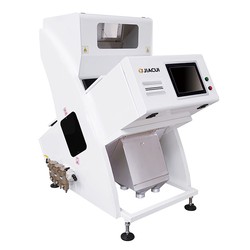
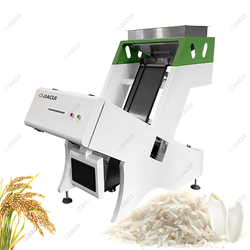
JIACUI's VALUESORT (悦选) series CCD color sorter machines use Toshiba CCD sensors imported from Japan, featuring an industrial-grade 5400×12K full-color high-speed line-scanning CCD sensor with top-tier sorting optics. In practice, this means 5,400 pixels per line in the cross-feed direction—resolving features as small as 0.03 mm²—with 12,000 lines of linear array depth producing continuous, high-fidelity image strips as product flows through the inspection zone.
For rice sorting—the most demanding application in color discrimination—the difference between a healthy grain and one affected by belly white, light yellow, or darkening can be as subtle as ΔE (color difference) of 2–3 in CIELAB space. Hamamatsu's research confirms that CCD-based RGB sensors enable simultaneous tristimulus measurement with direct digital output [1].
Detecting 0.03 mm² Disease Spots: What This Means for Food Safety
The ability to identify disease spots as small as 0.03 mm² has direct food safety implications. USDA ARS research found that image-based sorting systems achieved 10–20% higher accuracy than commercial color sorters when separating red wheat from white wheat, and reached 83% accuracy on popcorn with blue-eye damage—a defect traditional sorters detected at 0% accuracy [4].
In rice sorting, the diseases detectable at this resolution include bakanae disease (pale yellow grains), kernel smut (dark spore masses), pecky rice (stink bug damage), and belly white (chalky regions reducing milling yield). JIACUI's smart system further pushes detection to 0.01 mm² spots using multi-megapixel high-resolution color CCD, enabling identification of microscopic mold colonies before visible mycotoxin development.
Multi-Camera Arrays: From 2 to 20 Cameras
JIACUI scales camera count according to processing capacity. The complete model range:
| Model | Camera Count | Sensor Type | Resolution | Air Holes | Processing Capacity |
|---|---|---|---|---|---|
| CS-HA32 | 2 | CCD | 5400×12K | 32 | 0.25 T/H |
| CS-1A64 | 2 | CCD | 5400×12K | 64 | 0.8–1.5 T/H |
| CS-2A128 | 4 | CCD | 5400×12K | 128 | 1.2–2.5 T/H |
| CS-3A | 6 | CCD | 5400×12K | 192 | 2.5–4 T/H |
| CS-6A | 12 | CCD | 5400×12K | 384 | 5–9 T/H |
| CS-8A | 16 | CCD | 5400×12K | 512 | 7–10 T/H |
| CS-10A | 20 | CCD | 5400×12K | 640 | 7–10 T/H |
| CS-LA300 | 2 | CCD | 5400×12K | 64 | 1.2–3 T/H |
| CS-LA600 | 4 | CCD | 5400×12K | 128 | 2.5–6 T/H |
| CS-LA1200 | 8 | CCD | 5400×12K | 256 | 5–12 T/H |
| CS-LA1200D | 16 | CCD | 5400×12K | 512 | 5–12 T/H |
The flagship CS-10A with 20 cameras and 640 air holes shows that sensor count scales not just coverage width but also redundancy—critical for maintaining accuracy during continuous 24/7 operation.
Technical Comparison: CCD vs CMOS for Sorting Applications
| Parameter | CCD (Line-Scan) | CMOS (Area-Scan) | Impact on Sorting |
|---|---|---|---|
| Read Noise | 2–5 e⁻ RMS | 8–25 e⁻ RMS | CCD detects subtler color differences |
| Dark Current | 1–10 pA/cm² | 50–500 pA/cm² | CCD better for long integration |
| Dynamic Range | 70–90 dB | 60–75 dB | CCD handles mixed reflectivity |
| Pixel Uniformity | < 1% variation | 2–5% (after FPN correction) | Consistent color across field |
| Line Rate | 5–140 kHz | 100–800 kHz | CMOS faster for high-speed lines |
| Data Throughput | Limited by single ADC | Parallel ADCs per column | CMOS offers 2× throughput [2] |
| Power Consumption | Higher | Lower | CMOS runs cooler |
| On-Chip Integration | Minimal | ADC, ISP, timing on-chip | CMOS reduces system complexity |
| Cost (industrial) | Higher | Lower | CMOS wins on unit economics |
| Fill Factor | 80–100% | 30–70% | CCD captures more photons |
Signal-to-Noise Ratio and Color Fidelity
For optical sorting, SNR is the single most critical sensor parameter because it determines the smallest detectable color difference (ΔE). CCD's single-amplifier architecture eliminates inter-pixel gain variation, producing a uniform noise floor. In practical terms, a CCD system can reliably distinguish a grain with ΔE = 1.5 from the reference population, while a CMOS system may require ΔE ≥ 3.0 for the same false-reject rate.
Bühler's SORTEX sorters combine full-color cameras with InGaAs near-infrared cameras to achieve up to 50% higher reject concentrations while innovative ejection algorithms minimize false rejects [5]. JIACUI follows a similar philosophy: using CCD's color fidelity as the primary discriminator, supplemented by shape recognition and near-infrared channels.
Processing Speed and Data Throughput
CMOS sensor sorting holds a structural advantage in raw speed. TAIHO's research confirms 4× parallel processing and 2× data throughput, enabling real-time processing at extremely high frame rates [2]. For applications where speed outweighs fine color discrimination—such as recycling stream sorting—CMOS delivers the necessary line rates without multi-tap CCD complexity.
JIACUI addresses the CCD speed limitation differently: rather than pushing a single sensor faster, they parallelize across multiple cameras. A CS-10A with 20 CCD cameras achieves 20× the throughput of a single camera, each operating at optimal SNR. The Altera FPGA chip then handles the aggregate data stream with deterministic, hardware-level parallelism.
Long-Term Stability and Maintenance
CCD sensors have a proven track record of long-term stability in industrial environments. Their simpler pixel architecture—photodiode plus transfer gate—has fewer failure points than CMOS's active pixel array, which embeds 3–4 transistors per photosite. In continuous-duty applications running 6,000–8,000 hours annually, this reliability difference translates to reduced downtime and lower maintenance costs.
The Image Processing Chain: Beyond the Sensor
Altera Cyclone IV FPGA: Real-Time Pixel Processing
The sensor is only the first link. The image processing color sorter system determines whether captured data converts into accurate ejection commands within the millisecond-scale window as product transits the inspection zone.
JIACUI employs Altera FPGA chips (Cyclone IV, imported from the USA) as the core processing engine, providing up to 150,000 logic elements for parallel implementation of color space conversion, threshold comparison, and morphological operations. Embedded memory blocks (up to 4,140 Kb) support line buffering and LUT storage for real-time CIELAB classification. Unlike software processors, FPGA logic executes in fixed clock cycles—ensuring deterministic latency from pixel acquisition to solenoid valve trigger.
This enables JIACUI's industry-unique light-color sorting mode, simultaneously addressing light yellow, diseased, dark, and black rice. The first carry-out ratio reaches ≥1:1, the second ≥15:1—the reject stream contains at minimum 15 times more defective material than the accept stream loses good product.
AI Deep Learning Algorithms for Defect Classification
Modern sorting increasingly integrates convolutional neural networks (CNNs) for defect classification. Key Technology's platforms exemplify this hybrid approach, combining high-resolution Vis/IR, Tri-chromatic, or UV cameras with IR or Fluo lasers, while FMAlert tracks foreign material and RemoteMD monitors sorter conditions [6].
Color + Shape Sorting: JIACUI's Dual-Mode Innovation
JIACUI's original color+shape sorting mode adds a second decision dimension: each grain is evaluated in RGB/CIELAB space against reference color regions, then the same pixel cluster is analyzed for area, aspect ratio, and convexity. Only grains failing both criteria are ejected—reducing false rejects when color alone is ambiguous. This is particularly valuable for separating white rice from broken rice, which share near-identical color but differ in dimensional characteristics.
Emerging Technologies: Hyperspectral and Multispectral Imaging
The frontier of optical sorting extends beyond visible-light RGB imaging into hyperspectral and multispectral imaging, capturing data across dozens to hundreds of spectral bands.
Hamamatsu Photonics' research highlights VNIR spectroscopy spanning 400–2500 nm. Hyperspectral imaging detects chemical composition, moisture and sugar content, foreign bodies, contamination, and freshness indicators—non-destructively [1].
Fluorescence Imaging for Mycotoxin Detection
A particularly promising application is fluorescence imaging for mycotoxin detection. Aflatoxin-contaminated grains exhibit characteristic fluorescence under UV excitation (365 nm), producing emission peaks at 430–480 nm invisible to standard RGB cameras. Key Technology integrates UV cameras with Fluo lasers for this purpose [6]. For exporters facing strict mycotoxin limits (EU: 4 ppb aflatoxin B1; FDA: 20 ppb), fluorescence-augmented sorting offers a critical compliance tool—and CCD's low read noise maximizes fluorescence sensitivity.
Selecting the Right Sensor Configuration for Your Application
| Material | Primary Defect | Required ΔE | Recommended Sensor | JIACUI Model | Cameras |
|---|---|---|---|---|---|
| Premium white rice | Belly white, diseased | ≤ 2.0 | Toshiba CCD 5400×12K | CS-6A / CS-8A | 12–16 |
| Parboiled rice | Dark, pecky, broken | 2.0–4.0 | Toshiba CCD 5400×12K | CS-2A128 / CS-3A | 4–6 |
| Coffee beans | Black, sour, insect | 3.0–5.0 | CCD or high-end CMOS | CS-1A64 / CS-HA32 | 2 |
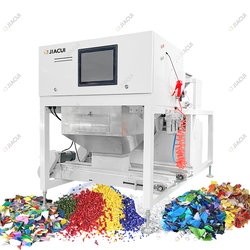
| Plastics recycling | Polymer type (NIR) | Spectral | CCD + NIR channel | CS-LA600 / CS-LA1200 | 4–8 |
| Nuts & seeds | Shell, mold | 2.5–4.0 | Toshiba CCD 5400×12K | CS-3A / CS-LA600 | 4–6 |
| Grains (wheat) | Diseased, discolored | 2.0–3.0 | CCD line-scan | CS-6A / CS-10A | 12–20 |
| Industrial minerals | Color, impurities | 5.0+ | CMOS (cost-optimized) | CS-1A64 | 2 |
Key selection criteria: If defects differ from accept product by ΔE ≤ 3.0, CCD's superior SNR is recommended. For >5 T/H throughput, multi-camera arrays (CS-6A+) are necessary. Food safety applications with mycotoxin requirements benefit from CCD's low noise floor for fluorescence integration.
How JIACUI Ensures Sensor Reliability with Global Components
Sensor performance is only as reliable as the system supporting it. JIACUI's global best-in-class component sourcing includes:
- Toshiba CCD cameras (Japan): 5400×12K full-color line-scan imaging with 0.03 mm² defect resolution
- Altera Cyclone IV FPGA chips (USA): Deterministic, low-latency pixel-to-ejection processing
- NSK deep-groove ball bearings (Japan): High-speed radial and axial load support for vibration feeders, preventing mechanical drift that misaligns the optical path
- MW switching power supplies (China, 5th globally) and DELIXI components (Sino-French JV): Stable power delivery under variable mains conditions in export markets
- YSC air filters: Clean compressed air for the high-frequency solenoid valve array—preventing contamination that degrades ejection precision
- Ultra-high-frequency solenoid valves: Shape recognition + center positioning algorithm achieves carry-out ratios ≥120:1, with service life up to 12 billion operations
Conclusion
The CCD vs CMOS debate in optical sorting is not one technology universally defeating the other. CCD sensors deliver superior SNR, pixel uniformity, dynamic range, and color fidelity—preferred for applications demanding fine color discrimination (ΔE ≤ 3.0) such as premium rice, grain, and nut sorting. CMOS sensors offer higher integration, greater throughput, lower power consumption, and better unit economics—making them attractive for high-speed, cost-sensitive applications where defect color differences are less subtle.
For operators targeting 99%+ sorting accuracy in food safety environments, CCD-based systems—exemplified by JIACUI's Toshiba 5400×12K architecture—remain the engineering standard. Paired with Altera Cyclone IV FPGA processing, shape recognition algorithms, and globally sourced components, this configuration delivers the color fidelity, processing determinism, and long-term stability that premium sorting demands. As hyperspectral and fluorescence imaging mature, the CCD platform's low noise floor positions it as the natural foundation for next-generation multi-spectral systems.
Ready to evaluate the right sensor configuration for your sorting application?
- Website: www.jcsorter.com
- Email: jiacuichen10@gmail.com
- Phone/WhatsApp: +86-13837166065
- Company: Zhengzhou Jiacui Machinery Equipment Co., Ltd. (CE & ISO certified | 21 national patents | 50+ export countries)
About the Author
JIACUI Engineering Team — Zhengzhou Jiacui Machinery Equipment Co., Ltd. (Brand: JIACUI / VALUESORT 悦选)
With 20+ years in optical sorting equipment, 30+ senior engineers, and 12% annual R&D investment, the JIACUI team designs color sorting systems combining Japanese Toshiba CCD imaging, American Altera FPGA processing, and globally sourced components. The company holds 21 national patents, has contributed to 3 industry standards, and exports to 50+ countries. All systems are CE and ISO certified.
References
[1] Hamamatsu Photonics. "Driving Agri-Food Tech Towards Sustainability." 2024. https://www.hamamatsu.com/eu/en/news/featured-products_and_technologies/2024/driving-agri-food-tech-towards-sustainability.html
[2] TAIHO Industrial. "CMOS Image Sensor Technology in Color Sorting." ChinaColorSort.com. https://www.chinacolorsort.com
[3] "3CCD System: Prism-Based Color Separation." Optical Engineering References. https://baike.baidu.com
[4] USDA Agricultural Research Service. "Image-Based Sorting for Wheat and Popcorn Quality." https://www.ars.usda.gov
[5] Bühler Group. "SORTEX Optical Sorting Technology." https://www.buhlergroup.cn
[6] Key Technology. "High-Resolution Sorting with Vis/IR, Tri-Chromatic, and UV Camera Systems." https://www.key.net