
- Home
-
Color Sorters
Optical Color Sorters
-
Solutions
Solutions
- Service Support
- News Center
- About Us
- Contact Us


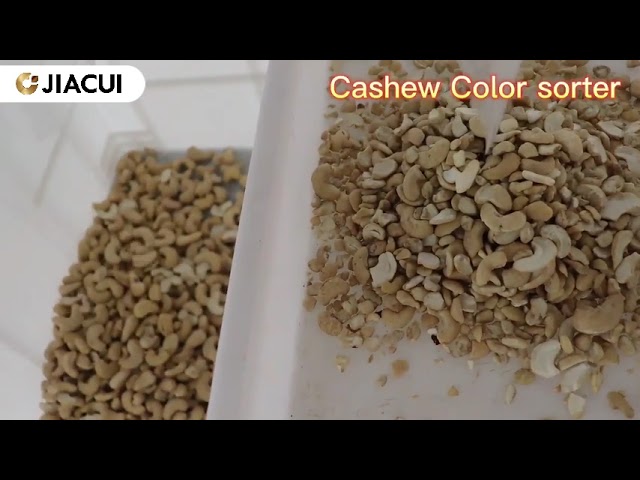
Cashew Grading by Size and Quality
Cashew kernels are graded for size and quality at the same time in this belt run. Belt transport matters here because kernels are fragile: a free-fall chute adds breakage, while the belt carries them flat and the ejector only has to move the piece a short distance.
Published 9 July 2025 · JIACUI Color Sorter · Watch on YouTube
What the video shows
Raw cashews leave the hopper in a single layer on the belt. The camera inspects colour and shape, and the ejector bank removes off-grade kernels into a separate stream. The accept belt continues to the next grade or to packing. Because the belt carries the kernel instead of dropping it, the reject action is short and does not throw the piece against a hard surface.
Why grading and sorting belong together
- Buyers usually define grades by a combination of size and appearance, so a machine that only removes discoloured kernels still leaves size grading to manual work.
- Belt speed and camera framing can be set per grade band, letting one machine serve several cut sizes with saved recipes.
- Lower air pressure reduces the risk of cracking kernels during ejection, which matters for whole-kernel grades.
What changes between raw and roasted cashews
Roasting darkens the surface and changes how defects contrast with good kernels, so a recipe built on raw cashew will not transfer directly. Grade definitions also differ by buyer: what one plant calls a split, another may accept as a piece grade. Agree the defect list before the test run, then tune thresholds against that list.
Sizing the machine
Capacity is set by kernel size, target purity and how many grades you separate. A single-pass run with a clean reject stream is easier to sell than a high headline figure with hidden carry-over. Compare both streams on your own sample before fixing belt width and lane count.
Watch the full video on YouTube →