

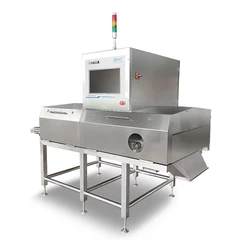
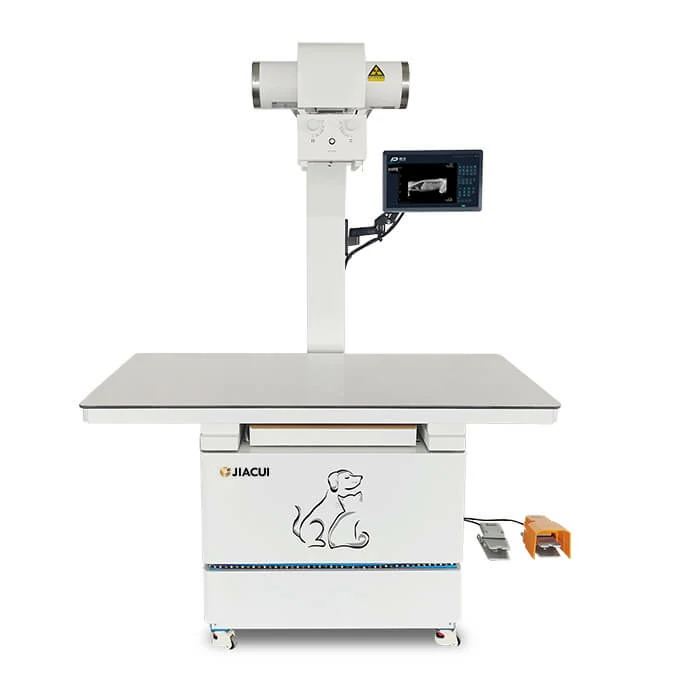

In green coffee trade, the gap between "specialty" and "commercial" is not an opinion. It is a defect count.
The Specialty Coffee Association's physical grading of a 350 g washed Arabica sample allows zero Category 1 defects and no more than five Category 2 defects for specialty grade. That single line explains why dry mills, washing stations and exporters invest so heavily in the last step of the line: defect removal. Get it wrong and a lot that cupped at 85 points is sold as an 80-point lot — or returned.
This article breaks down which defects actually cost you, what optical sorting can and cannot fix, and how a properly configured two-pass sorting setup holds purity without throwing away good beans.
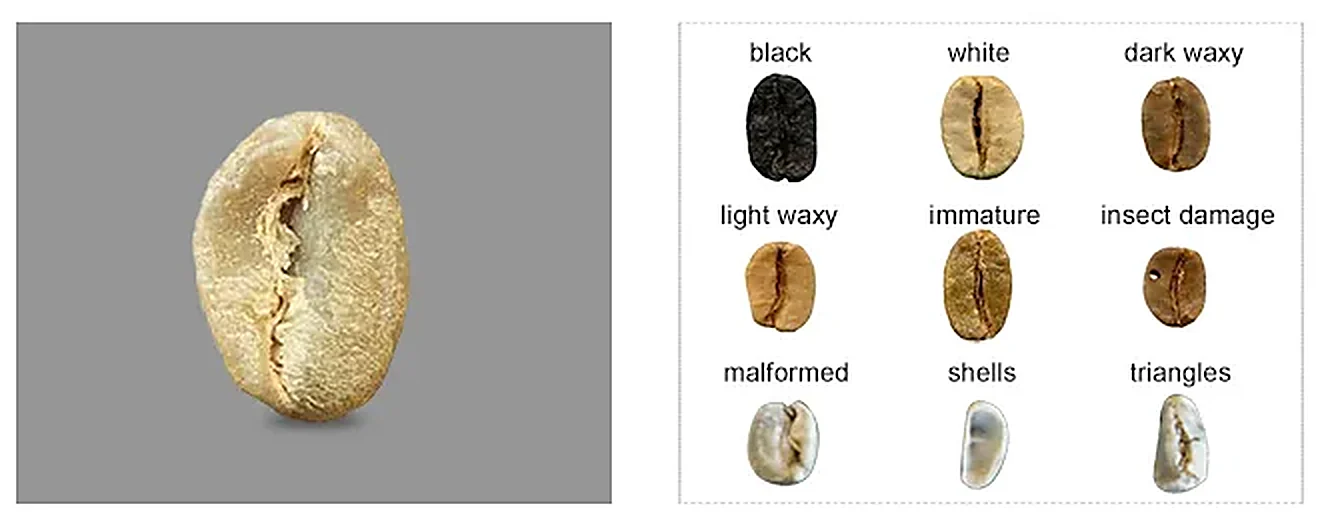
Category 1 defects are visible after parchment removal - and they are what buyers count first.
The Hidden Cost of Coffee Bean Defects
Defects are not all equal. SCA grading separates them by how badly they damage the cup, and the counting rules show how unforgiving the top grade is.
Category 1 (primary) defects — each one counts fully
- Full black — over-fermented, pigmented by microbial activity. Cup impact ranges from ferment and acetic notes to moldy, phenolic, or rancid. Also an ochratoxin risk flag.
- Full sour — yellowish to brown-red, vinegary smell when the bean is cut or scraped. Caused by overripe or fallen cherries, contaminated wash water, uncontrolled fermentation, interrupted drying.
- Fungus damage — powdery yellow to brown-red spore patches that spread to neighbouring beans in the bag.
- Dried cherry / pod and foreign matter (stones, sticks, glass, metal).
- Severe insect damage.
Category 2 (secondary) defects — counted in ratios
Partial black and partial sour count 3 beans to 1 full defect. Parchment, floaters, immature/unripe, withered, shells, broken/chipped/cut beans and husk count 5 to 1. Light insect damage counts 10 to 1.
The commercial consequence is direct. A lot that exceeds the specialty defect ceiling cannot be sold as specialty regardless of cupping score, and the buyer's remedy is a price claim, not a conversation. In export markets where the whole margin is built on the grade premium, defect control is a pricing tool.
Where defects can and cannot be removed
Even SCA's own defect guidance is candid about the limits of earlier steps. Black and sour beans become visible only after parchment removal; they are slightly smaller and less dense, so screening and density sorting help, but the guide describes the most effective removal as manual sorting or a mechanical color sorter. Heavily fungus-damaged beans can be removed by color sorting; lightly damaged beans are usually only caught by hand.
That is the honest framing: optical sorting removes the great majority of visible and measurable defects at speed and consistency, and it does not replace every function of human QC — it replaces the volume of work that makes human QC impossible to sustain.
How Modern Optical Sorting Detects Defects
Color first, then shape and texture
Conventional color sorting compares pixels against thresholds. That works on a black bean in a pale lot and fails on everything that is *not* mainly a color problem: a bean with one insect hole, a shell, a chipped half, a floater with normal color, a piece of parchment the same shade as the bean.
AI-based recognition changes what a sorter can be held to. Our ValueSort platform classifies good and defective product through deep-learning software rather than fixed color thresholds, records the classification automatically, and combines shape recognition with a center-positioning algorithm so the ejector pulse is fired for the exact length of the target object. The imaging front end is high-speed full-color line-scan CCD, specified to identify spots down to 0.01 mm and disease spots at 0.03 mm.
For coffee that means the machine can be trained on your defect list rather than on "the wrong color": full black, full sour, partial black, fungus, insect damage, immature, chipped, shell, husk tags, and the foreign matter that arrives with the lot — stones, sticks, plastic, glass.
When color is not enough
Some quality problems are internal or near-invisible at green stage. Internally degraded beans, and above all quakers, are not reliably detectable by surface color, which is why the SCA evaluates quakers on a 100 g roasted sample, not on green coffee, and permits exactly zero.
Where an application needs material-property discrimination, the industry uses infrared or multispectral imaging in addition to RGB cameras. Ask your supplier directly which sensor channels the machine has and which defects each channel is proven against on coffee — not on rice. On our machines, the honest capability today is high-resolution color, shape and texture recognition with AI classification; where a lot's main problem is quakers, the answer is post-roast sorting rather than a greener claim.
Recipe memory and dust control
Two practical features matter more than headline accuracy on a working mill floor:
- Recipe memory. A mill handling washed, natural and honey lots from different altitudes needs one machine that behaves like several. JIACUI sorters store 90 material recipes, selectable on the touchscreen in seconds, so the operator stops re-tuning thresholds for every lot.
- Automatic optical cleaning. Coffee skin dust and husk fines coat the viewing glass, and the machine silently degrades through the shift. Chute models in our range include an automatic dust-removal device specified to hold separation accuracy in high-dust environments; the cleaning cycle time and period are operator-settable, with 304 stainless and food-grade alloy components in the dust-cleaning system.
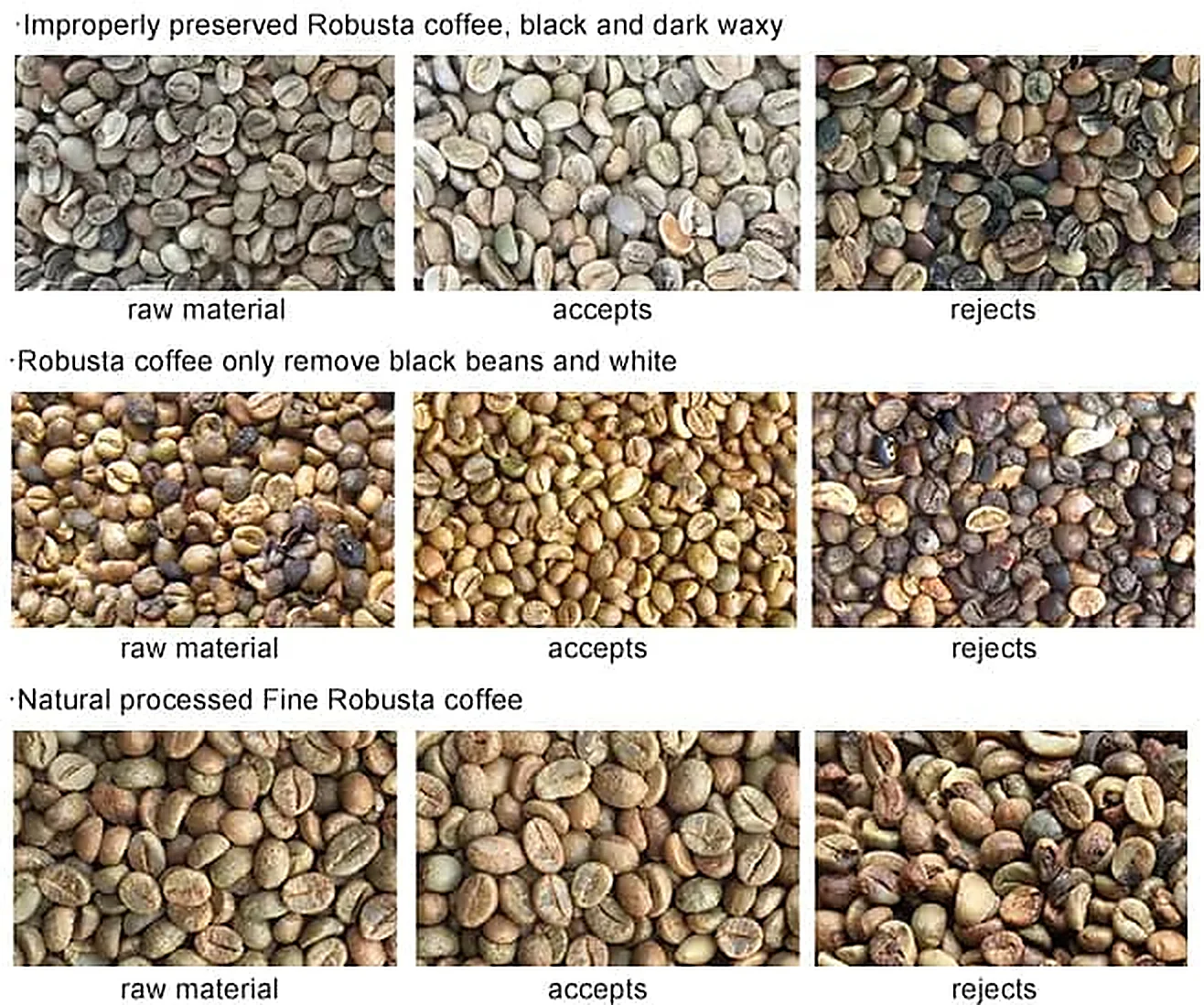
AI classification plus shape recognition catches defects that a color threshold misses.
Single-Pass vs. Multi-Pass Sorting: Optimizing Purity and Yield
A single pass forces a compromise. Push the sensitivity up to hit zero defects and you blow good beans into the reject stream. Ease it off to protect yield and defects pass through.
Two-pass (re-sort) configuration removes the compromise. The main channel ejects a reject stream; instead of discarding it, that stream passes through a second sorting stage that recovers the good beans carried out by mistake. The economics are obvious on specialty coffee: the recovered fraction is saleable at full price.
Two ways to get there:
- Chute sorter with re-sort function — our CS-1A80 single-channel machine is built for exactly this: one machine performing a re-selection pass, giving high cleanliness with low carryover at small and mid-scale throughput (0.8–1.5 t/h).
- Double-deck crawler sorter — CS-LA1200D runs two stacked belts and separates three grades of material in one pass, so a mill can produce accept, secondary and reject fractions simultaneously at 8–12 t/h without a second machine.
A sensible commissioning sequence on coffee: run the first pass conservative, measure what is in the reject stream, then tighten. Judge the setup by two numbers, not by how clean the accept stream looks — defect count per 350 g and good beans per 100 g in the reject stream.
Real-World Sorting Performance
Publishing your own measured test report is worth more than any specification claim, and it is the single most persuasive block on a coffee sorting page. Record and show:
- Category 1 defects / 350 g
- Category 2 defects / 350 g
- Full black / full sour count
- Foreign matter (stones, sticks, plastic)
- Good beans in reject stream (%)
- Throughput (kg/h) and shifts
- Machine model and recipe used
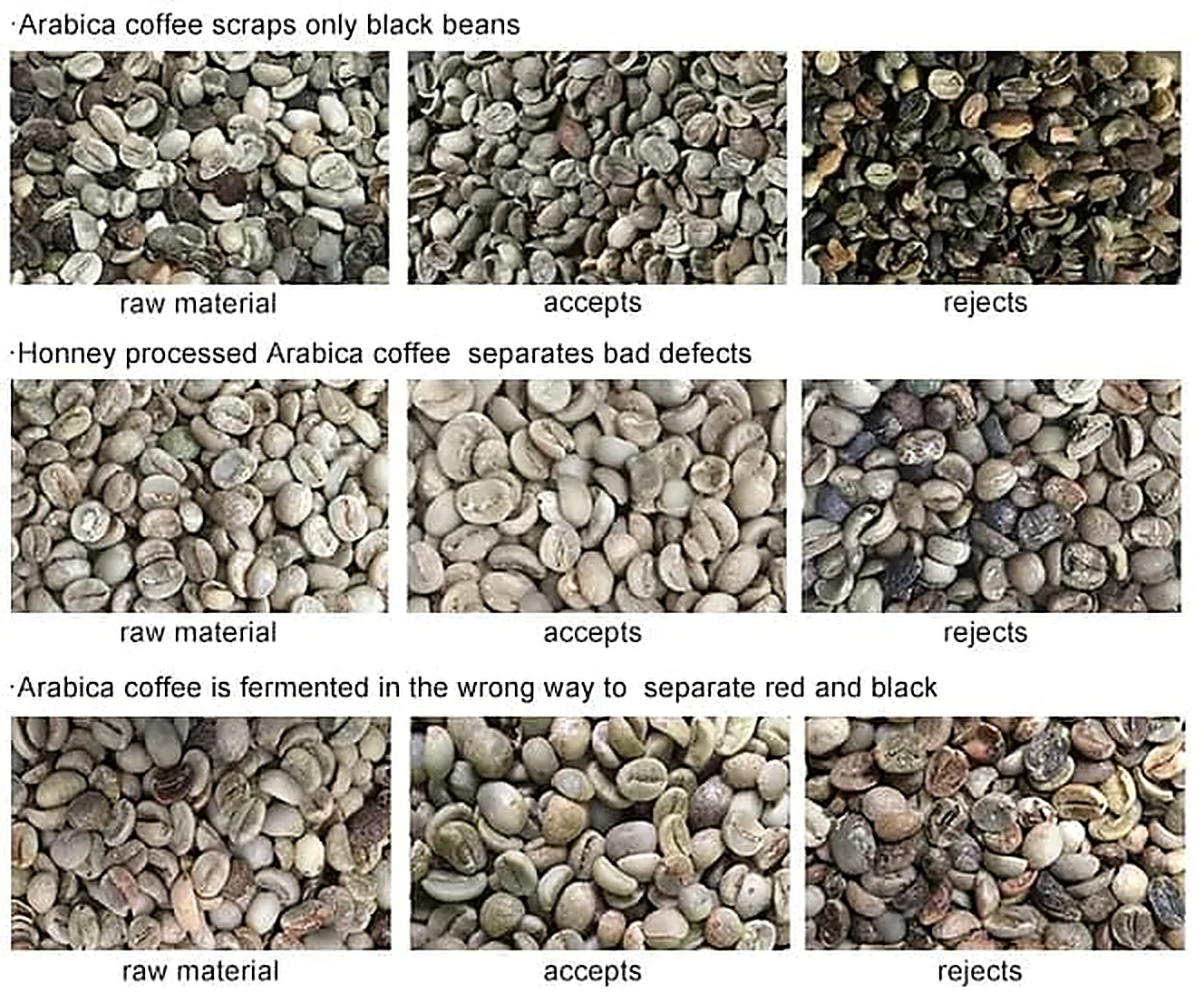
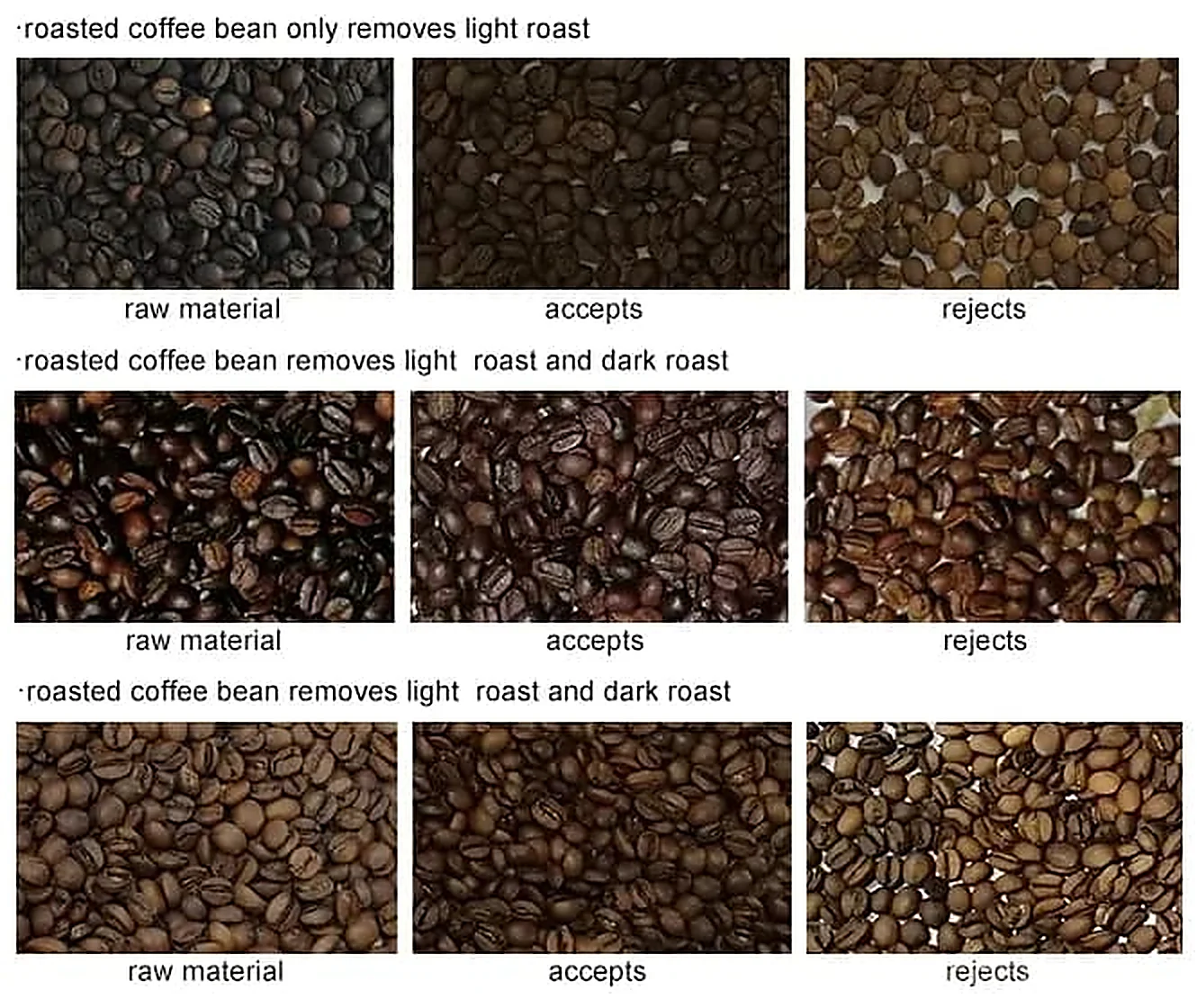
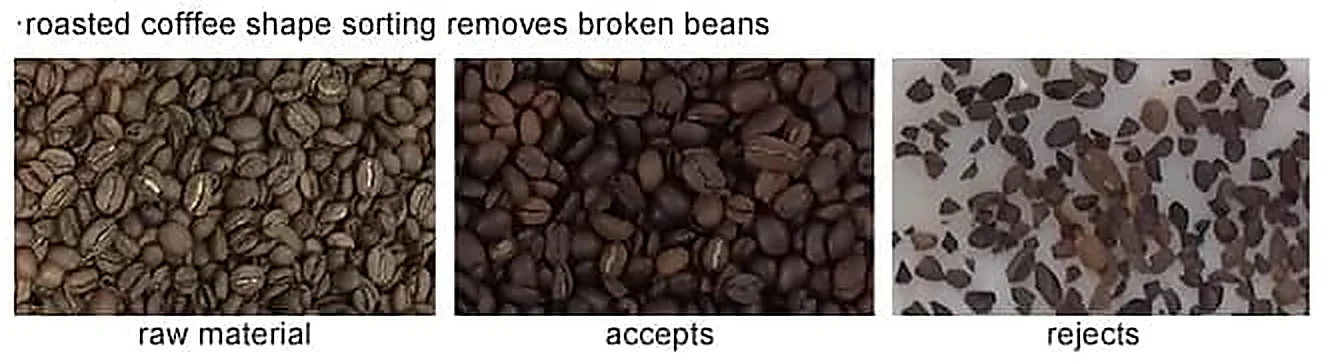
Alongside the table, use original photographs — not stock imagery — of the three fractions on a grading mat: raw input, accepts, rejects. A before/after image set plus a signed test report is what importers and Q graders actually ask for when they vet an equipment supplier.
Conclusion
Defect control is where green coffee quality becomes measurable, and therefore sellable. AI color, shape and texture sorting on a machine with automatic dust cleaning and recipe memory holds that standard across a whole shift; a re-sort pass holds it without paying for purity in lost yield.
Send us a sample of the lot you are struggling with and we will return a defect-count test report on your own coffee: Request a green coffee sorting test. See the machines built for this: green coffee defect sorter models.
FAQ
How many defects are allowed in specialty green coffee?
Under SCA physical grading of a 350 g sample of washed Arabica, specialty grade requires zero Category 1 defects (full black, full sour, fungus damage, dried cherry, foreign matter, severe insect damage) and no more than five Category 2 defects.
Can a color sorter remove black and sour beans?
Yes — these are the defects color sorting handles best, because both are visible color deviations after parchment removal. SCA's own defect guidance names mechanical color sorting (alongside hand sorting) as the effective removal method.
Can a color sorter remove quakers from green coffee?
Not reliably. Quakers are immature beans that do not brown during roasting, and they are usually indistinguishable in green coffee; SCA judges them on a 100 g roasted sample and allows zero. The dependable route is post-roast optical sorting.
What is a re-sort pass and is it worth it?
A re-sort pass runs the reject stream through a second sorting stage to recover good beans ejected by mistake. On specialty coffee it usually pays back in recovered kilos within a short time, and it lets you run the primary pass at higher sensitivity without losing yield.