


A single fermented bean or a handful of black beans can drag a full production down a quality grade — and a grade is where the price difference lives. That is why coffee mills, exporters and roasteries that have outgrown hand-sorting tables start looking at an optical coffee bean color sorter.
But the buying decision is rarely about the machine's brand. It is about three practical questions:
- Chute-type or belt-type (crawler) for your bean and your line?
- Which four technical specifications actually determine your losses?
- How fast does the machine pay for itself against hand-sorting labor and downgrade risk?
This guide answers all three with numbers you can check, and ends with a capacity-matching table for green and roasted coffee.
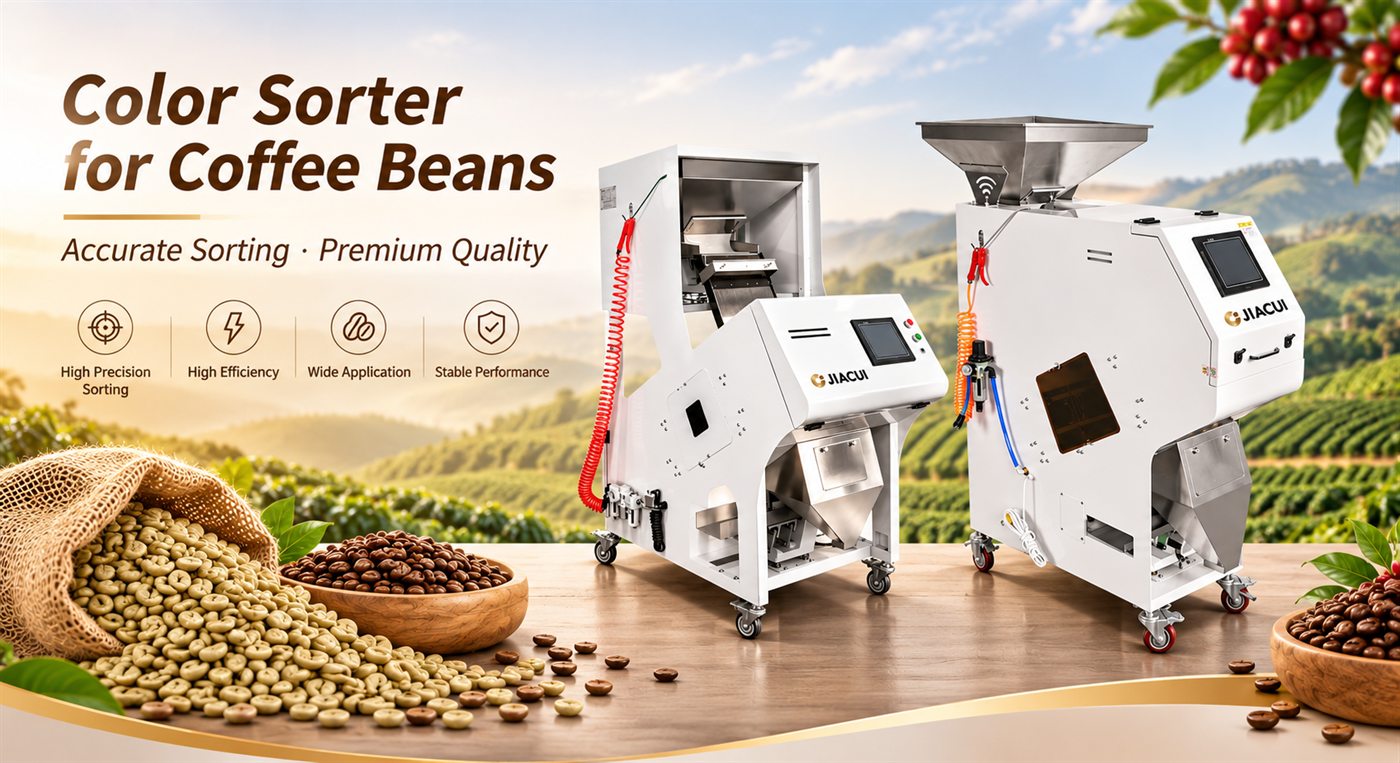
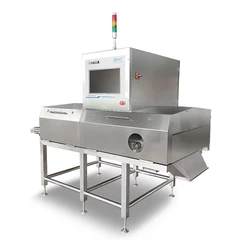
Chute and crawler coffee color sorters - one platform for green and roasted beans.
Chute-Type vs. Belt-Type Coffee Color Sorters: Which Fits Your Line?
Both machine families do the same job: beans fall past cameras, software flags anything that fails your criteria, and a row of air jets ejects it. The difference is how the product gets in front of the camera.
Chute-type (gravity-fed)
Beans slide down a series of parallel chutes. It is the simplest and most cost-efficient way to get a high, stable flow of free-flowing product past the optics.
Best for: green coffee after hulling and grading — dense, dry, free-flowing, and tough enough to handle a gravity drop. Also the standard choice for parchment, cherry effluent screening, and commercial-grade volume.
Trade-offs: more vertical drop means more impact on fragile product, and chute walls pick up oils, so a roasted-coffee line needs more frequent cleaning. Chute machines also need more installed height, which can mean structural work in an existing building.
Belt-type / crawler-type
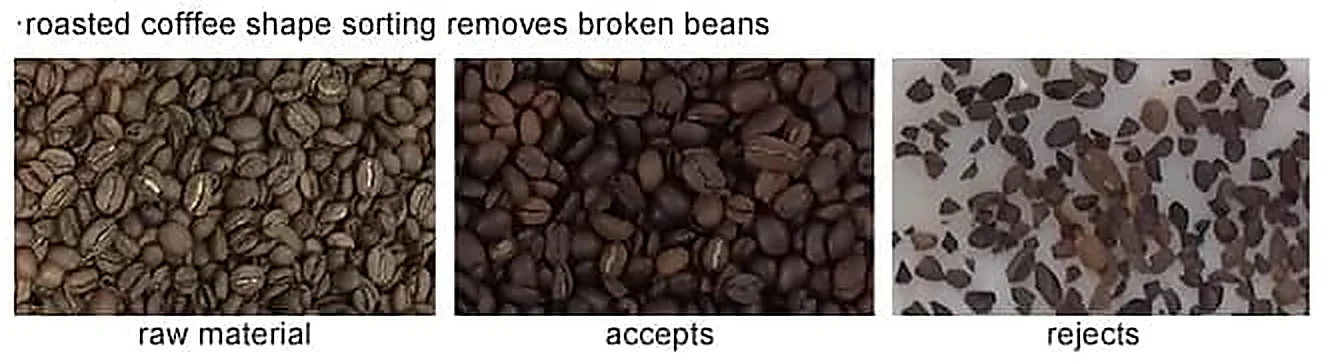
Product rides a flat, fast-moving belt (in our case a crawler belt) through the viewing zone instead of falling. Industry equipment suppliers consistently describe belt-fed sorting as the gentler option: lower product breakage, and a horizontal installation that avoids the elevation changes a chute machine requires — which reduces facility modification and installation cost.
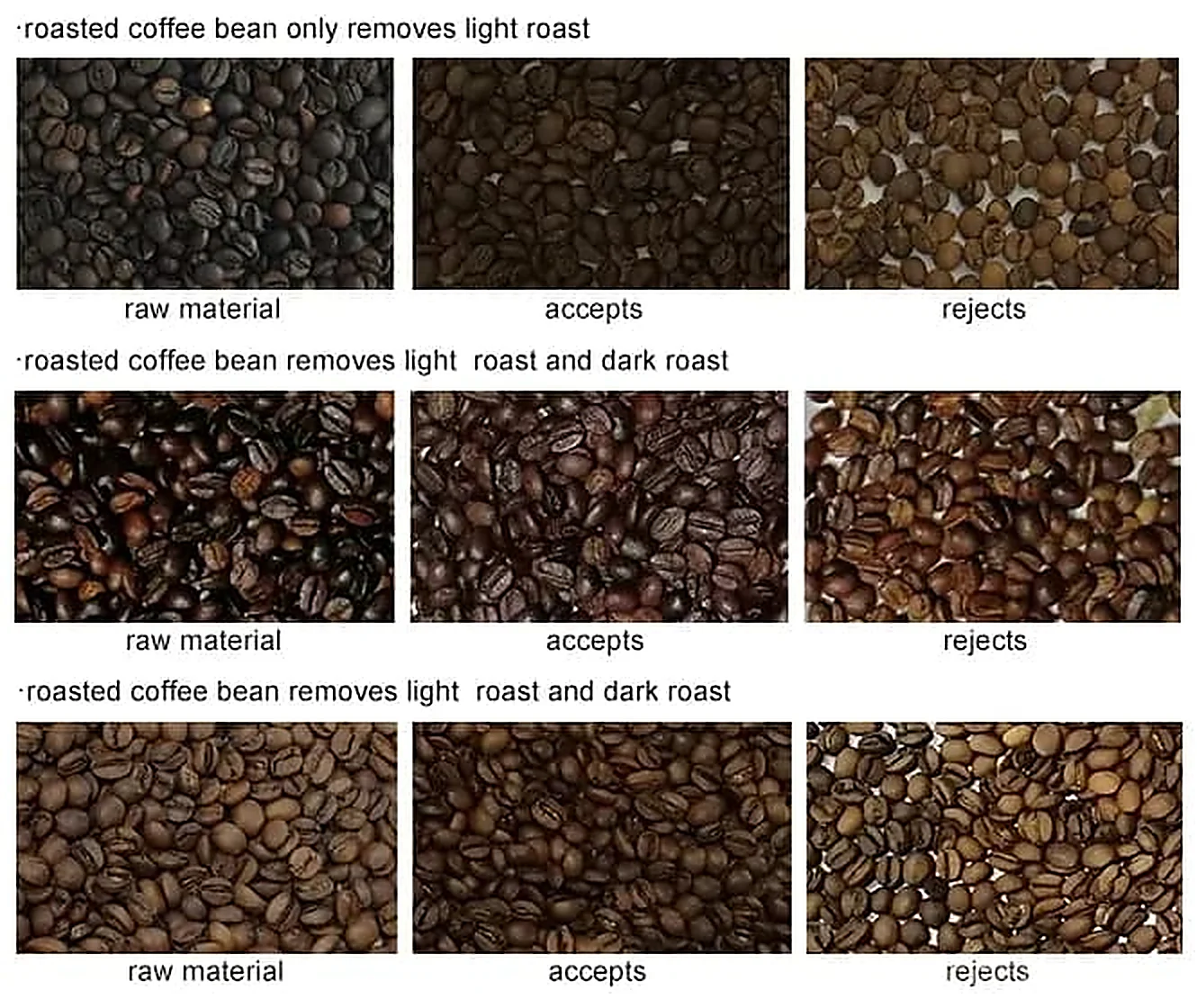
Best for: roasted coffee, delicate light-roast and low-density beans, freeze-dried and coated coffee products, peaberries and odd-shaped lots, and any line where broken beans cost you money. Also the right answer for high-dust dry environments (ores, husk residue) because the product is not sliding down glass.
Trade-offs: higher purchase price per unit of throughput, and belt surfaces need periodic replacement.
Quick comparison (JIACUI ValueSort range)
| Factor | Chute type | Belt / crawler type |
|---|---|---|
| Feed method | Gravity slide through chutes | Horizontal crawler belt |
| Typical capacity | 0.25–10 t/h depending on channels | 1.2–12 t/h by particle size band |
| Product impact on beans | Higher drop energy | Anti-crushing design, minimal impact |
| Installed height | Needs drop height | Horizontal, less structural work |
| Best product state | Green / roasted on a budget | Roasted, delicate, dusty, irregular |
| Typical model | CS-1A64 → CS-10A | CS-LA300 → CS-LA1200D |
If you sort mostly green coffee at volume, a chute machine is the rational purchase. If your main job is post-roast defect removal or your beans are fragile, look at the belt-fed crawler coffee color sorter line.
4 Key Technical Specs You Must Check Before Buying
Marketing sheets list twenty specifications. Only four decide whether a sorter earns its keep on coffee.
1. Camera resolution and light path
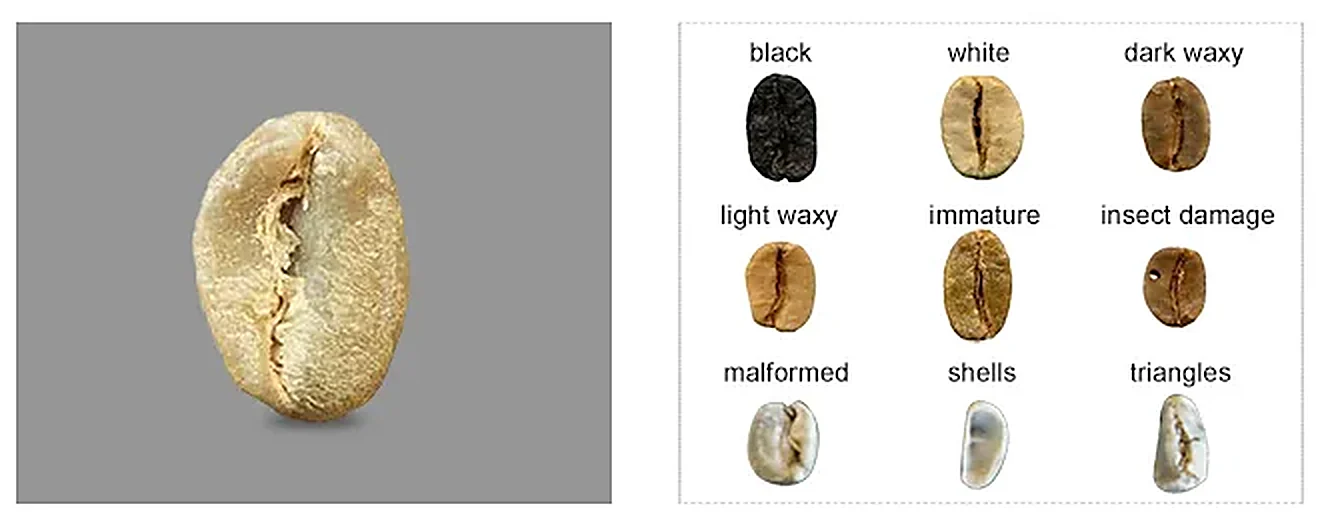
Color sorting on coffee is a resolution problem before it is an algorithm problem. Green coffee defects are often subtle — a partial black, a yellowish sour bean, a bean with one insect hole. Our chute and crawler machines use high-definition full-color line-scan CCD sensors (dual cameras on the smallest models, up to 20 on the 10-channel CS-10A) with a documented spot-detection capability down to 0.01 mm and disease-spot recognition at 0.03 mm on the high-end imaging platform.
Ask any supplier two questions: what is the smallest defect their optics can reliably trigger an eject on, and how they prove it. Reputable machines come with a spec sheet; the good ones will demonstrate on *your* sample.
Beyond color, some sorter platforms add infrared or multispectral channels to read material properties rather than surface color. That matters for detecting internally degraded beans or foreign matter of similar color. Where color alone cannot see the defect, no amount of software will fix it — so be honest with your supplier about which defects you are trying to remove.
2. AI and shape recognition, not just color
Coffee rejects are as much shape failures as color failures: chipped beans, shells, parchment tags, sticks, stones, insect-damaged beans with holes, and the flat/rounded difference of a peaberry lot.
Machine-vision deep learning has changed what a sorter can be asked to do. Our AI module classifies good versus defective product automatically and stores the result, so defect recognition is not limited to "is it the wrong color". Shape recognition combined with center-positioning algorithms lets the ejector fire at the exact length of the target bean, which is what protects your yield on expensive lots.
If you are sorting two or three different origins or roast levels on the same machine, ask how many product recipes the machine stores. JIACUI machines keep 90 material recipes, so switching from Ethiopian washed to Brazilian natural is a selection on the touchscreen, not a re-commissioning job.
3. Valve response and air consumption — the carryover question
Ejector valves are where the money is. Two valve-related numbers determine your real cost:
- Carryover / reject ratio — how much good product is blown out with the defects. Our crawler machines are specified at a bad/good carryover ratio of 20:1 or better; the valve-and-algorithm platform on our high-end imaging system is described as capable of far more selective removal (up to 120:1 in manufacturer testing). Insist on this being measured on *your* sample, not a demonstration lot.
- Air consumption — the machine only earns money when the compressor can support it. ValueSort chute models range from ≥0.2 m³/min (CS-HA32) to ≥2.4 m³/min (CS-6A) at 0.6–0.8 MPa. Under-sized air supply shows up as soft ejects and lost defects, not as an alarm.
Also check whether the machine has automatic glass/chute cleaning. Coffee dust and surface oil fog the optics; the practical result is a machine that sorts well at 9 a.m. and poorly by 2 p.m. Chute models in our range include an automatic dust-removal device specifically so separation accuracy holds in high-dust conditions.
4. Channel count matched to real throughput
Buy too few channels and you run the machine as a bottleneck next to a mill that could produce more; buy too many and you have paid for idle capacity and air.
| Operation | Typical daily volume | Recommended model | Capacity |
|---|---|---|---|
| Micro-roastery, sample & small batches | under 500 kg/day | CS-HA32 | 0.25 t/h, 0.3 m² floor |
| Small roastery / boutique mill | 0.5–3 t/day | CS-1A64 / CS-1A80 | 0.8–1.5 t/h |
| Mid-size mill or roasting plant | 3–10 t/day | CS-2A128 / CS-3A | 1.2–4 t/h |
| Export mill, cooperative hub | 10–30 t/day | CS-4A / CS-5A / CS-6A | 3–9 t/h |
| Large dry mill, 3-grade separation | 30 t/day+ | CS-LA1200 / CS-LA1200D | 8–12 t/h (double-deck outputs 3 grades in one pass) |
Size from your peak hour, not your daily average. Harvest-season peaks are where sorters either keep a mill honest or become a queue.
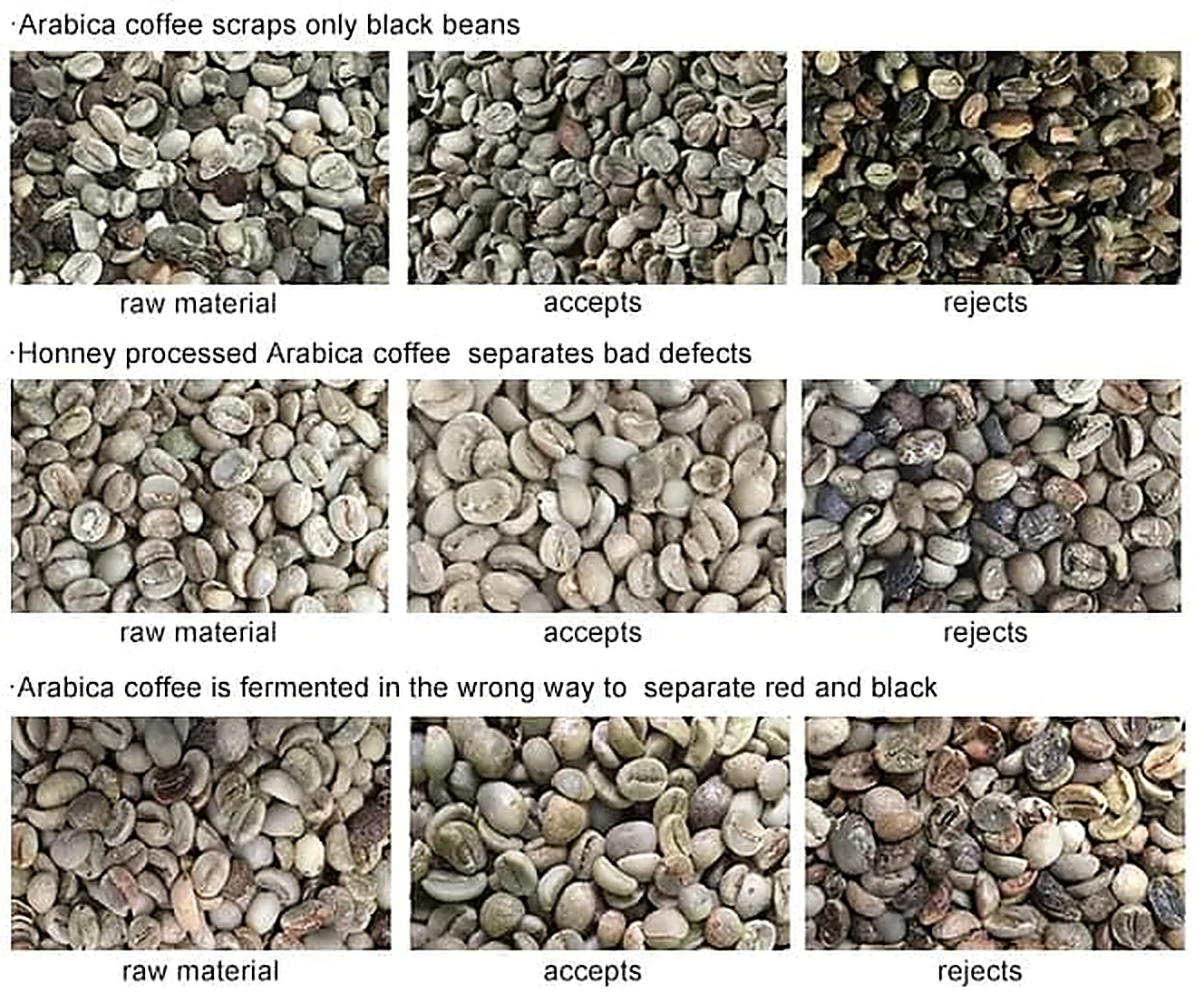
Camera, shape recognition and air-valve timing decide the real carryover figure.
Calculating the ROI: How Fast Does a Coffee Color Sorter Pay for Itself?
There is no universal payback figure, because labor cost, grade premium and volume differ by origin. But the calculation is simple and you should insist on doing it with your own numbers before ordering. Four lines:
1. Hand-sorting labor replaced.
A published study by the Indonesian Coffee and Cocoa Research Institute measured hand grading at roughly 743 kg per worker-day, versus about 1,870 kg per worker-day for a conveyor grading table (third-party research data, 2006). Hand sorting is slower, varies by shift, and is the first cost that rises every year. Multiply the workers you can redeploy by fully loaded annual cost.
2. Grade-loss avoided.
This is the line most buyers forget, and usually the biggest one. Under the Specialty Coffee Association's physical grading, a specialty-grade washed Arabica sample (350 g) must contain zero Category 1 defects — full black, full sour, dried cherry, fungus damage, foreign matter — and no more than five Category 2 defects. A lot that misses that bar does not become "slightly worse coffee"; it becomes a different product at a different price, often settled as a claim rather than a negotiation. Value one grade downgrade per year that you prevent.
3. Yield protection.
Carryover and breakage are losses measured in kilos of saleable coffee per shift. A machine that keeps good beans in the accept stream is worth more than a cheap one that does not.
4. Running cost.
Electricity plus compressor load. Our chute models draw between 0.7 kW (CS-HA32) and 5.6 kW (CS-6A) — most small and mid-size roasteries can run the mini machines on single-phase 220 V supply without electrical work.
Illustrative example — replace the assumptions with your own. A mill hand-sorting 4 t/day with 8 sorters at a fully loaded $12/day each spends about $23,000 a year on that step alone. A mid-size sorter replacing most of that labor, running 3.2 kW for 10 h/day at $0.10/kWh, adds roughly $230 in electricity plus air compressor cost. On labor alone the machine closes the gap inside its first year — and that excludes the avoided downgrade and the consistency the QA team can now prove to buyers.
Ask us for this calculation rebuilt on your volume, wage rate and electricity price. We will do it with you before you commit to a model.
What to Test Before You Buy
Send a sample — 5 to 10 kg of the actual product you struggle with, not your best lot — and require a test report showing:
- Defect removal rate on your named defect list (black, sour, fungus, insect, immature, chipped, foreign matter)
- Carryover: good product found in the reject stream
- Breakage difference: before/after bean count in a 300 g sample
- Stable accuracy across a full dusty shift, not the first five minutes
A supplier who cannot produce a test report on your own sample is asking you to buy an assumption.
Conclusion
For green coffee at volume, choose a chute-type sorter. For roasted coffee, delicate lots and dusty environments, choose a belt/crawler machine. Then check only the four specs that decide your economics: optics resolution, shape-aware AI, valve response and carryover, and channel count matched to your peak hour.
If you want to know which coffee bean color sorter matches your throughput — and what your own ROI looks like — send us a sample and your daily volume, and we will return a test report and a sizing proposal: Request a free coffee sorting test.
FAQ
What is the capacity of a mini coffee color sorter?
Our smallest machine, CS-HA32, runs about 0.25 t/h on a 0.3 m² footprint and weighs 105 kg, so it can be wheeled into a small roastery and plugged into single-phase 220 V power. The next step up, CS-1A64, handles 0.8–1.5 t/h.
Can one color sorter handle both green and roasted coffee beans?
Mechanically yes, but choose the feed type for the harder duty. Roasted beans are brittle and oily, so a belt/crawler machine with an anti-crushing path and automatic optical cleaning keeps accuracy over a long shift; a chute machine set up for green coffee needs more frequent cleaning and gentler calibration for roasted product.
What is carryover in coffee sorting?
Carryover is good product ejected with the defects. It is measured as a reject-to-good ratio, and it is the specification that turns a cheap machine into an expensive one, because you lose saleable coffee every hour the machine runs.
Does a color sorter remove quakers?
Quakers are extremely hard to identify in green coffee and are normally judged after roasting, when they appear pale. Post-roast sorting is the reliable route — see our guide on that.