

Rice color sorting is a capacity decision as much as a defect decision. A mill that knows its defect profile, its target tonnage and its packing standard can choose a chute count with confidence. This hub collects the grain evidence JIACUI has published, the 2-12 t/h line configurations we quote most often for milled rice, and the sample test that settles the final specification.
The short answer
Rice color sorting removes discoloured kernels, chalky grains, red and yellow kernels, peck damage, stones and foreign matter at 2-12 t/h per machine, with accuracy up to 99.99% and a carryover ratio above 20:1 on a well-tuned chute. Most white rice mills run 2-8 t/h per sorter; export mills on continuous shifts move to 9-12 t/h machines. Parboiled and long-grain lines are usually sized lower to protect kernel integrity.
Documented results
There is no published rice installation in the JIACUI case library, so this page does not claim one. The nearest documented grain evidence is the corn line in Kaduna, Nigeria: a 10-channel sorter with infrared detection installed in mid-2023 to remove aflatoxin-affected kernels from roughly 60 tons of maize per day. Reported results were aflatoxin-affected kernel removal above 95%, 8 t/h processing capacity with minimal downtime, contracted orders up 25% and manual sorting staff reduced by 40%. The full account is in the Nigeria corn case study.
That case is adjacent evidence, not a rice result. Maize and rice share a chute-fed workflow, but the defect classes differ: chalky kernels, red kernels, yellow tips and peck damage do not look like aflatoxin contamination and are not separated the same way. Removal rate also moves with variety, moisture, milling degree and the share of broken kernels in the feed. A figure measured on maize cannot be transferred to a rice mill.
Rice results depend on the mill's own sample. Send paddy or milled rice from the lot you actually buy, and the sample test will show what one pass achieves on your defect profile. JIACUI was founded in 2005, holds 21 patents and has equipment running in more than 50 countries, but none of that substitutes for a test on your material.
Typical line configurations
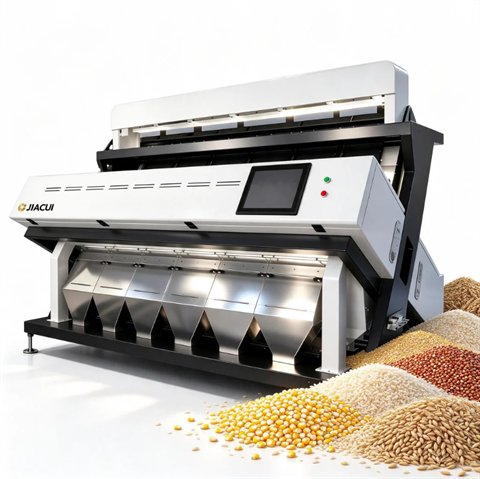
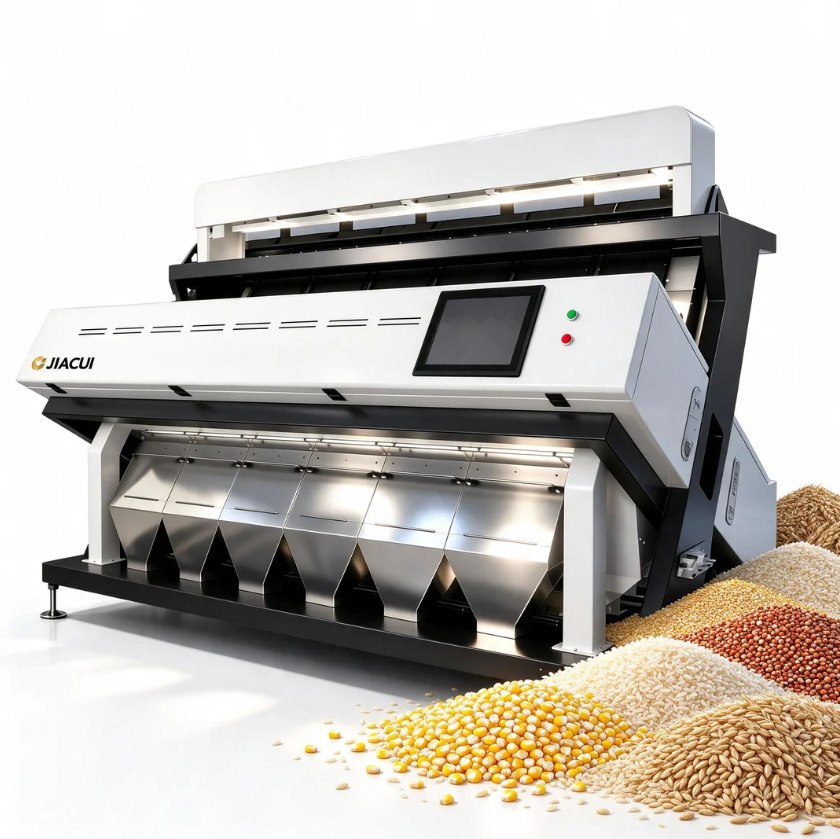
Chute count sets capacity, and chute width sets how much of each kernel the cameras can see. The three rows below are the configurations quoted most often for milled white rice. Final sizing follows the sample test and the mill's shift pattern.
| Capacity | Recommended platform | Typical defect targets |
|---|---|---|
| 2-4 t/h | CS-1C80 or CS-2A128 chute sorter | Chalky kernels, red kernels, peck damage, stones |
| 5-8 t/h | CS-6A-384 or CS-6C-384 chute sorter | Light discolouration, immature grains, broken kernels, foreign matter |
| 9-12 t/h | CS-10C-640 or CS-12C-768 chute sorter | Full export defect set, plus glass and stones |
Where broken-kernel percentage matters more than throughput, the belt platforms are worth quoting: CS-LA600 runs 2.5-6 t/h and CS-LA1200 5-12 t/h, with the CS-LA1200D dual unit for high-capacity lines. Belt conveying reduces the mechanical handling that chips long grain.
Line layout matters as much as model choice. A sorter fed straight from a milling line sees a steadier flow than one fed from a buffer hopper, and a surge at the inlet shows up as carryover at the outlet. Plan aspiration and dust collection ahead of the machine, because a dusty chute is the most common reason a removal rate looks wrong two weeks after installation.
Two checks keep a quote honest. First, ask what the removal rate refers to: one defect class such as chalky kernels, or all rejects combined. Second, ask for good-grain carryover from the same test run, because a high removal rate with heavy good-grain loss is expensive at 8 t/h. JIACUI states accuracy up to 99.99% and carryover above 20:1; ask for both numbers measured on your sample. Chute options are listed on the product page.
What to send for a sample test
Five items make a sample test conclusive. Without them the report can only return a generic curve.
- 2-5 kg of representative material, drawn from the lots you actually buy and packed to keep moisture stable.
- The defect list you want removed, plus the maximum acceptable level for each defect in the finished lot.
- Required throughput in t/h and the hours the line runs per day, so capacity is sized on the shift rather than the peak.
- Power supply details: voltage, phase and frequency at the mill, and whether compressed air is already available.
- Packing standard: bag size, bag material and marking, because the target grade is set by what the buyer will accept.
Related guides
- Grain color sorters: platforms and detection modes
- Corn processing in Nigeria: IR sorting for aflatoxin control
- Quality certifications and testing standards
Book a free sample test for your rice line →
More case studies
- Corn processing in Nigeria: IR sorting for aflatoxin control
- Plastic recycling in Germany: NIR sorting lifts PET purity
To discuss a configuration for your own material, see the contact page.