

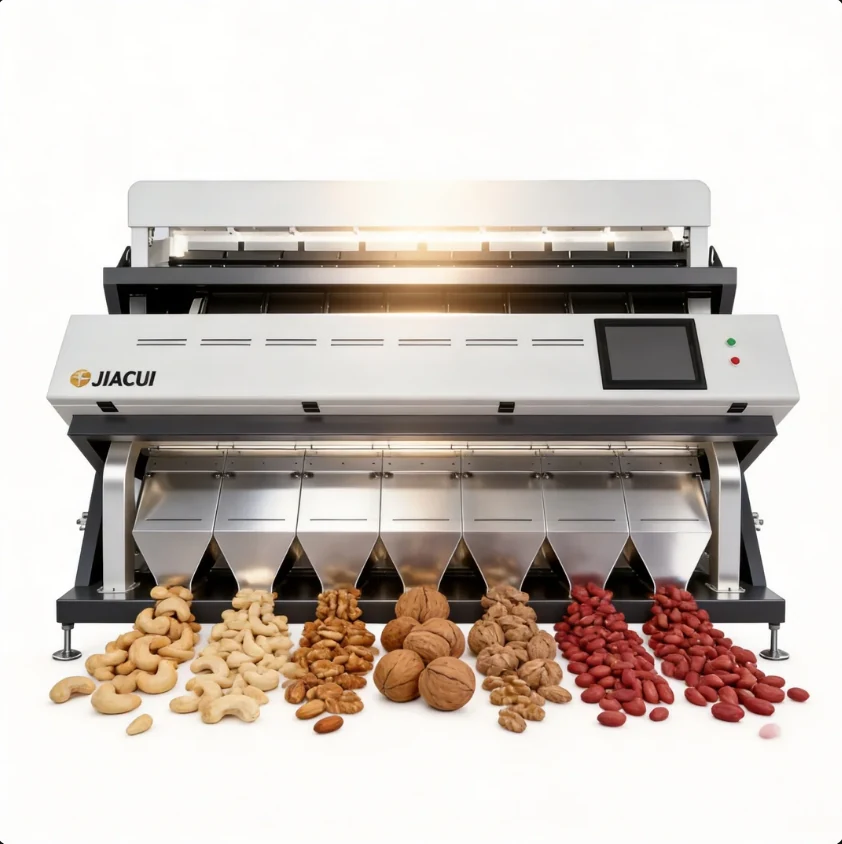
Cashew kernels lose value the moment they break, so the sorting decision is about handling as much as colour. This hub gathers what JIACUI can state with evidence on cashew: the platforms and models that fit each throughput band, the defect classes a kernel line has to remove, and the sample test that settles grade before a purchase.
| Material | Whole cashew kernels, raw, roasted or flavoured |
| Kernel throughput | 1 to 5 t/h, depending on platform |
| Platforms | Chute, CS-2A128 to CS-12C-768; belt, CS-LA300 to CS-LA1200D |
| Published performance | Accuracy up to 99.99%, good-kernel carryover better than 20:1 |
| Defect targets | Shells, peel, stones, splits, scorched and off-colour kernels |
| Evidence base | Published machine specifications; no cashew case study on this site |
The short answer
Cashew color sorting removes shells, testa peel, stones and discoloured or scorched kernels from a whole-kernel stream at 1 to 5 t/h on kernel, depending on platform. A chute machine suits clean, free-flowing whole kernels. A belt machine is the better choice when the stream carries large pieces or splits and breakage has to stay low. The grade you reach is proven on your own sample, not on a specification sheet.
Documented results
No cashew installation is published on this site, so this page quotes no customer name, no country and no measured recovery figure. What can be stated is published machine performance: camera accuracy up to 99.99%, good-kernel carryover better than 20:1 on cashew recipes, and 1 to 5 t/h of kernel throughput across the range. Those numbers describe the equipment. They are not a promise about your crop.
Cashew results turn on the processor's own sample. Variety and origin change the colour of a good kernel as much as the colour of a bad one. Moisture, the shelling and steaming method, and whether the stream is raw, roasted or flavoured all shift what the cameras see and what the ejectors must catch. A kernel scorched in roasting looks very different from one with testa peel still on, and a recipe tuned for one defect will not clear the other. That is why the sample test matters more on cashew than on a commodity grain: the machine is configured against your material, and the report shows defect removal and good-kernel carryover on the same lot you sent.
Treat a published accuracy figure as the ceiling, not the plan. A line is bought on the measured run, and the platform, air settings and recipe all come out of it. If a supplier quotes cashew results with no sample behind them, ask what material the number came from, on which model, and at what carryover.
Typical line configurations
Kernel throughput, not channel count, chooses the platform. Three bands cover most plants, and every figure below is on kernel rather than on a cereal basis:
| Kernel capacity (t/h) | Platform and model | Defect targets |
|---|---|---|
| 1 to 2 | Chute, CS-2A128 | Shells, loose peel, stones, discoloured kernels |
| 2 to 3 | Belt, CS-LA600, rated 2.5 to 6 t/h | Shells, peel, splits, scorched kernels |
| 4 to 5 | Belt, CS-LA1200, rated 5 to 12 t/h | Shells, peel, stones, off-colour kernels |
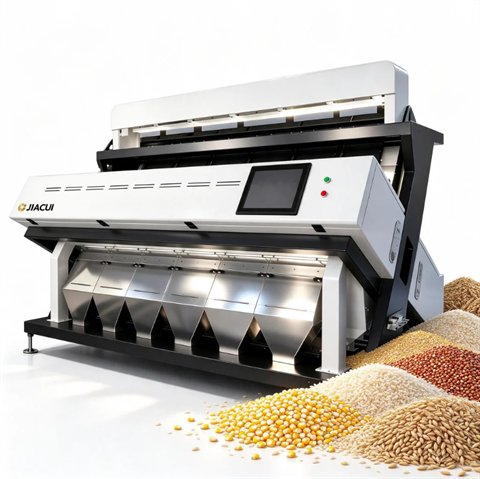
Belt ratings are published on a rice basis. Kernels run lighter and slower, so the same chassis is sized lower on cashew, which is why the capacity column stops at 5 t/h while the machine rating runs higher. Where a plant needs two grades at once or a spare lane for peak intake, the CS-LA1200D runs dual belts on one frame. Chute machines stay the practical choice below 2 t/h, where a belt cannot be fed evenly across its width, and they fit more easily into an existing line with limited headroom.
Defect targets move with the product. Raw kernels carry shells, loose peel and stones. Roasted kernels add scorch and oil marks, and flavoured lines add coating fragments that read as off-colour. Set the recipe before the line is sized, because a stricter target costs capacity on the same chassis.
What to send for a sample test
The test is only as good as the sample. A hand-picked bag proves nothing, and material drawn from a clean lot hides the problem you are buying the machine to solve.
- 5 to 10 kg of representative kernels, taken from the lot that is hardest to clear today.
- Your grade sheet, listing the defect classes you reject now and the limits your buyer enforces.
- Target throughput in t/h on kernel, shifts per day, and how many grades you want separated.
- Photos or a short video of the current reject stream, so the run can be judged against what you see now.
- Destination country, site voltage and available floor space, so the proposal fits the building.
We return a video report with defect removal and good-kernel carryover measured on your own material, plus the model and recipe that produced them. The quote follows from that run, and the build behind it is covered by the certification and patent record.
Related guides
- Cashew color sorter: chute and belt platforms, model by model
- Cashew color sorting in India: what processors ask before buying
- Coffee bean sorting in Colombia: a measured defect-removal case
Book a free sample test for your cashew line →
More case studies
- Corn processing in Nigeria: IR sorting for aflatoxin control
- Plastic recycling in Germany: NIR sorting lifts PET purity
To discuss a configuration for your own material, see the contact page.