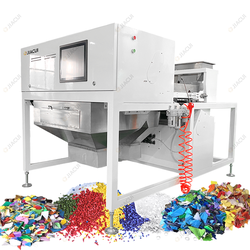


An Indian cashew exporter running 1-4 t/h of kernels should choose a belt sorter such as the CS-LA300 or CS-LA600 rather than a chute, because a stable belt trajectory protects whole kernels, and should accept the machine only after a written test on their own W320 sample.
Where whole-kernel value is lost
Indian cashew processing clusters - Kollam and Kanyakumari in the south, Palasa and Srikakulam on the east coast, and plants across Maharashtra and Goa - all lose money in the same place: the gap between whole kernels and pieces. Steaming, shelling, peeling and grading each add a breakage chance, and the sorter sits at the end of that chain, where the value is highest.
By the time kernels reach the sorter the defects are visible: testa peel left after peeling, scorch marks from roasting, discoloured or bluish kernels, shrivelled immature nuts, shell fragments and stones. Grades are sold by count per pound, from W180 down to W450 and then splits and pieces, and the price gap between a whole grade and pieces is wide enough that one extra break in a thousand matters.
The defects that set your grade
- Testa peel patches. Brown or black skin left in the crevices; a colour task, best seen under even lighting.
- Scorch and burn marks. From roasting; usually dark and localised, and rejected by buyers at very low counts.
- Discoloured, bluish and mouldy kernels. Colour and texture together; mould is a food-safety issue, not only a grade issue.
- Immature and shrivelled kernels. Thin, pale and light; shape sorting earns its keep here.
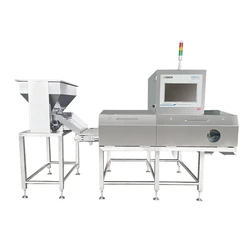
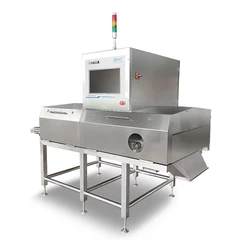
- Shell fragments, stones and glass. Heavy items; a camera sees shell colour but not a white stone, so keep a de-stoner and consider the CS-XCA60 if the contract demands it.
- Broken pieces and splits. Sort them out from whole kernels, but do not create more of them in the process.
Sizing a 1-4 t/h line and picking the platform
Cashew lines are rated on kernel throughput, which is far lower than the green nut intake of the shelling line. Convert peak kernel flow with rated t/h = peak t/h / utilisation, and use 0.80-0.85, because grade changes and belt cleaning take time.
| Configuration | Platform | Planning throughput, kernels | Power and weight | When to choose it |
|---|---|---|---|---|
| CS-LA300 | Belt, 300 mm | 1.2-3 t/h | Confirm at quotation | Small peeling and grading unit, one or two grades |
| CS-LA600 | Belt, 600 mm | 2.5-6 t/h | 2.5 kW, 750 kg | Exporter running 2-4 t/h with mixed grades |
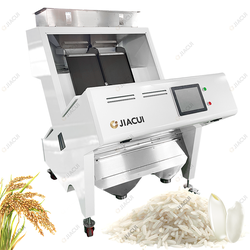
| CS-1C96 | Chute, 96 channels | 1-2 t/h | Confirm at quotation | Clean, uniform splits and pieces where breakage does not matter |
Most exporters in the 1-4 t/h band end up with the CS-LA300 or the CS-LA600. The chute option is cheaper per tonne and is fine for splits and pieces, but it is the wrong tool for whole-kernel grades.
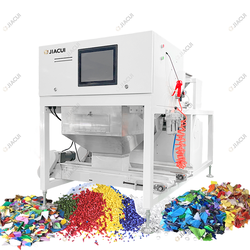
A chute sorter drops the kernel past the cameras. That is fast and cheap, but every kernel lands on the chute surface and again in the accept or reject chute. On a fragile kernel with a natural split line, those impacts show up as extra pieces at the end of the shift. A belt carries the kernel on a flat surface at controlled speed, so the trajectory is stable, the camera sees a consistent top view and mechanical shock is much lower.
Belt width sets capacity: 300 mm for a small unit, 600 mm for the common exporter line, 1,200 mm for high volume. The CS-LA1200 at 6 kW and 1,150 kg, and the dual-layer CS-LA1200D at 9 kW and 2,300 kg, suit plants above 5 t/h or multi-product use across cashew, coffee and pulses.
Dust, testa and air quality
Cashew dust is oily and fine. It coats the window faster than grain dust and it holds onto the belt, so cleaning discipline matters more than on a rice line.
- Use food-grade belting that can be cleaned without shedding, and set a belt wash at every grade change.
- Specify a positive-pressure air purge on the optical box and a window clean every two to four hours.
- Dry the compressed air. Oily, damp air gums ejector valves and causes intermittent misses that look like camera faults.
- Keep the feed spread even. A pile on one side of the belt hides defects underneath and doubles the load on that half of the valve block.
The acceptance test that protects export grade
Do not accept the machine on a demo. Send 10-20 kg of your own kernel grade, with the defects you actually see, at the mix you actually see. Ask for a written report with five numbers: whole-kernel recovery, peel left on accepts, scorch count per 300 g, shell and stone count, and good-kernel loss in the reject stream.
Then run an eight-hour trial on your floor. Weigh the feed and every output, not just the accepts, and compare the recovery figure with the report. Put the pass criteria in the purchase order, with the sample retained and sealed, so there is no argument later about which lot was tested. This single step protects more margin than any specification sheet.
Payback from whole-kernel recovery
A plant sorting 1.5 t/h for 8 hours and 250 days moves about 3,000 tonnes of kernels a year. If careful belt handling and correct settings lift whole-kernel recovery by half a percentage point, 15 tonnes a year move from the pieces bin to a whole grade. At a USD 400 per tonne gap between W320 and pieces, the gain is about USD 6,000 a year before peel and scorch rejections are counted, and those add more when a buyer's defect count is tight.
Add the labour saved by removing a manual picking table and the payback on a CS-LA300 or CS-LA600 usually falls inside two seasons. Use your own grade mix and price gap; a plant selling mostly pieces has a different arithmetic from one shipping W240 to Europe.
Frequently asked questions
Which sorter suits a 1-4 t/h cashew line?
A belt machine, normally the CS-LA300 for 1-3 t/h or the CS-LA600 for 2.5-6 t/h. A chute is cheaper but adds impacts that turn whole kernels into pieces. Confirm the choice with a test on your own kernel grade, because peel load and moisture change the belt speed setting.
How much breakage does a belt sorter add?
Very little when the feed is even and the belt is clean. Most breakage in a cashew plant comes from shelling, peeling and manual handling, not from the sorter. Ask for the belt speed range and the transfer height at both ends, because a badly matched conveyor discharge causes more damage than the machine itself.
Can a color sorter remove testa peel completely?
No machine removes 100%, and no contract asks for it. A well-set sorter removes the visible peel patches that decide the grade, leaving the thin film inside crevices. Ask for the measured peel result on your sample rather than a marketing percentage, and check it under the same lighting your buyer uses.
Do I need X-ray for cashew?
Only for stones, glass or shell fragments that share the kernel colour, and only when a buyer demands documented control. Most exporters cover that risk with a de-stoner and a metal detector. The CS-XCA60 dual-energy X-ray sorter is the option when the contract names X-ray inspection.
Related guides: see the cashew color sorting yield guide for recovery maths, compare platforms on the cashew nut color sorter page, and review documentation on the quality and certifications page.
Request a free sample test and quotation for your cashew line →
How the free sample test works
Send 2-5 kg of your material and we return a written report with before and after photos, measured defect removal and a recommended model. No cost, no obligation.
- Send your sample - 2-5 kg of production material, sealed in a bag or tin.
- Tell us the target - the defects you must remove and the purity or grade you sell against.
- State the line - tonnes per hour, power supply and available floor space.
- We run the test - typically 3-5 working days on a machine matched to your material.
- You get the report - removal rate, carryover, reject ratio, photos and a model recommendation.
- Decide with data - quotation, lead time and spare-parts list follow only if the numbers work for you.