

Plastic recycling lines are judged on one number, the purity of the flake you sell. This hub gathers the documented NIR installation on this site, the PET and HDPE flake configurations behind it, and the defect classes that decide whether a bale becomes food-grade flake or downcycled regrind.
| Material | Post-consumer plastic flake and regrind, PET, HDPE and PP |
| Capacity | 1 to 5 t/h, depending on platform |
| Reference line | 3 t/h from one sorter with NIR and visible-light channels |
| Documented result | PET purity 92% to 98.5%; black contamination down more than 90% |
| Defect targets | PVC, caps, labels, black and off-colour flake |
| Evidence base | Germany case study, customer-reported figures |
The short answer
Plastic color sorting removes PVC, caps, labels and off-colour flake from a PET or HDPE stream. The documented installation on this site ran 3 t/h from a single machine and lifted recycled PET purity from 92% to 98.5%. Small lines sit at 1 to 2 t/h, and a 600 mm belt platform covers 3 to 5 t/h at the top of the flake range.
Documented results
The only plastic case published on this site is the Germany installation, and the figures below come from that page as reported by the plant. It handles roughly 15,000 tons of post-consumer plastic a year, started up in late 2023, and runs a sorter that combines near-infrared polymer identification with visible-light colour rejection. Recycled PET purity rose from 92% to 98.5%. Black plastic contamination fell by more than 90%. The selling price of the flake rose by about 15% on the higher purity, and one machine delivered 3 t/h, reducing reliance on manual sorting lines.
Nothing beyond those numbers is claimed here. The case page does not publish an HDPE purity figure, a measured PVC removal rate or a flake loss percentage, so this hub does not invent them. What the case does establish is the split of duties. NIR decides what a flake is made of, visible light decides what it looks like, and black material needs the NIR channel because it reflects almost no visible light at all.
That split matters when a line is specified. A sorter quoted on camera resolution alone will not separate PET from PVC reliably, and a sorter quoted on NIR alone will not reject a white label sitting on clear flake. Both channels belong in the specification, together with flake preparation upstream, because size, dust and moisture all affect detection stability. Figures on the case page are customer-reported and were not independently audited by JIACUI.
Typical line configurations
Throughput, polymer mix and the contamination list set the platform. Three bands cover most flake plants:
| Capacity (t/h) | Platform and model | Defect targets |
|---|---|---|
| 1 to 2 | Chute, CS-2A128 | PVC, caps, labels, off-colour flake |
| 2 to 3 | Chute, CS-6A-384 | PVC, labels, off-colour flake |
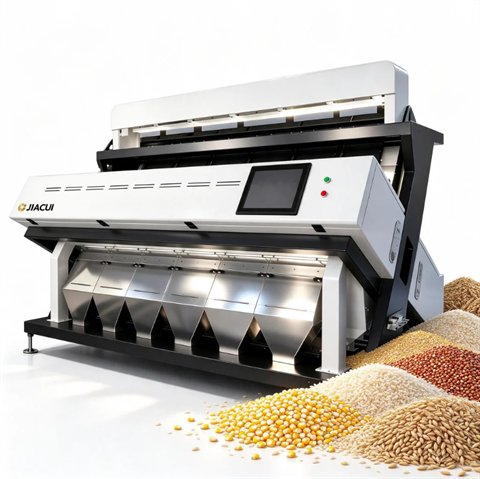
| 3 to 5 | Belt, CS-LA600, rated 2.5 to 6 t/h | PVC, caps, off-colour flake |
Black flake is the case that separates suppliers. Visible-light cameras cannot see it, so a line that has to clear black material needs NIR classification in the same pass, and adding it later usually means a second machine. Caps and labels are a different problem: they are colour and shape cues on otherwise clear flake, and they are removed by tight ejection windows rather than by polymer identification. Flake size also sets the platform. Fine flake from a wash line feeds a chute evenly, while bulky regrind and agglomerate need a belt so material reaches the cameras in a single layer.
What to send for a sample test
The test is only as good as the sample. A clean lab bag tells you nothing about the bale you actually process, so send material that carries the contamination you are trying to sell out of.
- 5 to 10 kg of washed flake or regrind, drawn from the stream that misses specification today.
- Your target purity and the polymer you are selling, PET, HDPE or a mixed stream, with the buyer's limit stated in numbers.
- The contamination list you must remove, including whether black or dark flake is present at all.
- Target throughput in t/h, shifts per day, and the flake size range leaving your wash line.
- Destination country, site voltage and available floor space, so the proposal fits the plant.
We return a video report with purity and reject figures measured on your own material, plus the model, sensor set and recipe behind them. The quote follows from that run, and the build is covered by the certification and patent record.
Related guides
- Plastic color sorter range: chute and belt platforms
- Plastic flake color sorter: line layout and sensor options
- Plastic recycling in Germany: the NIR case behind these numbers
Book a free sample test for your plastic line →
More case studies
- Corn processing in Nigeria: IR sorting for aflatoxin control
- Plastic recycling in Germany: NIR sorting lifts PET purity
To discuss a configuration for your own material, see the contact page.