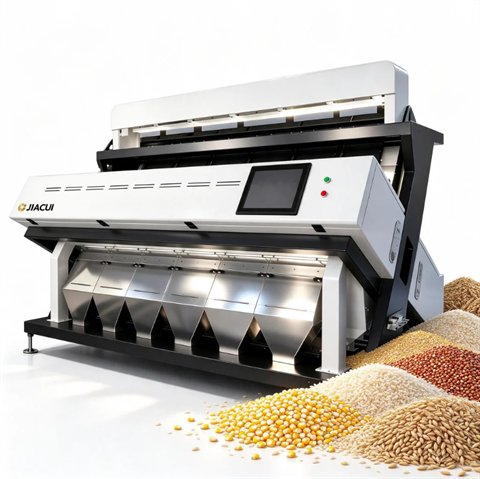


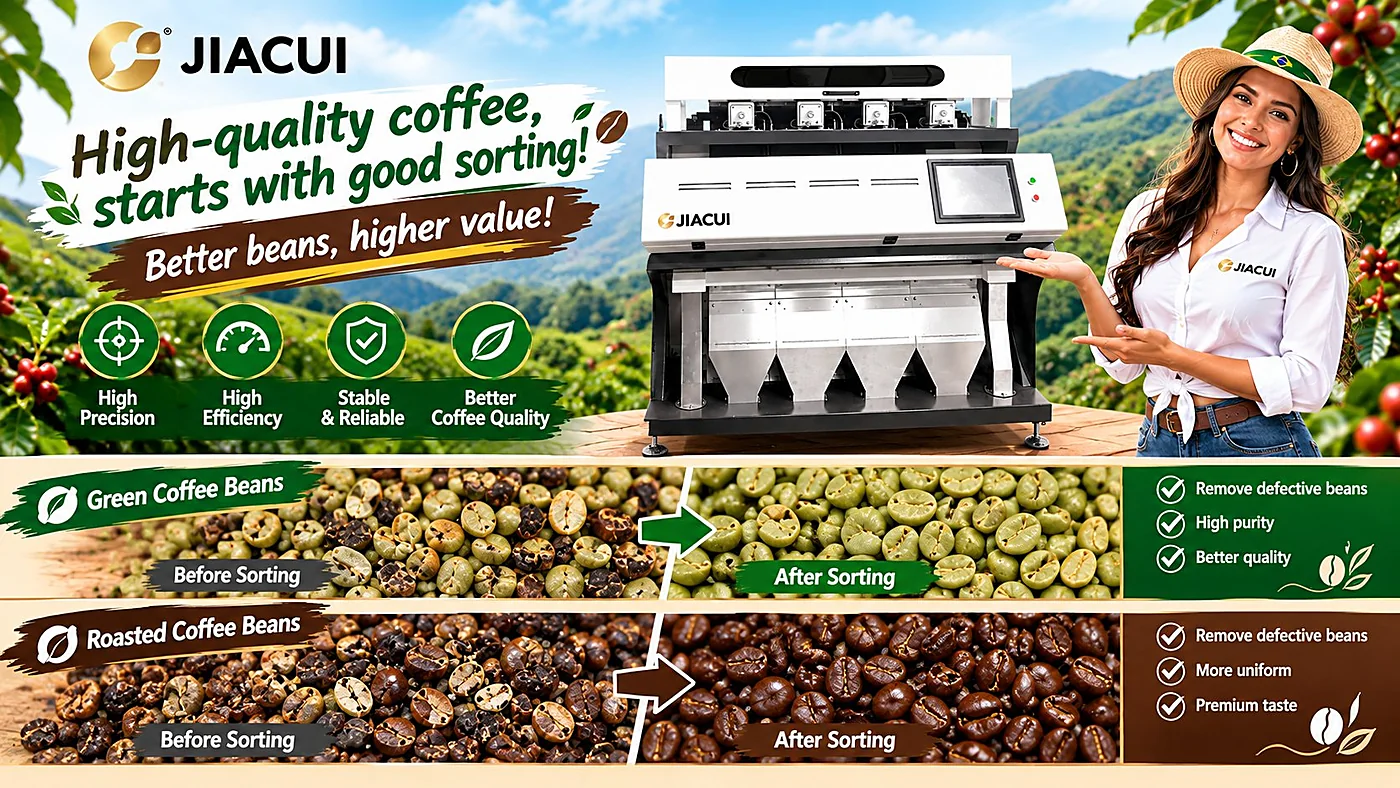
Coffee color sorting covers two very different materials: green beans that must clear export defect standards before shipment, and roasted beans that must look uniform without breaking in the chute. The machine logic is the same, the settings are not. This hub gathers the documented Colombia export case, the 1-8 t/h line configurations JIACUI quotes for both materials, and the sample test that fixes the specification.
The short answer
Coffee color sorting removes black beans, sour beans, insect-damaged beans, broken beans, stones and foreign matter at 1-8 t/h per machine, with accuracy up to 99.99% and carryover above 20:1. Green coffee export lines typically run 3-4 t/h per sorter; specialty lots start at 1-2 t/h, and high-volume mills move to 6-8 t/h. Roasted beans are sized lower to limit breakage.
Documented results
The reference case is Finca La Esperanza, a family-owned exporter in Huila, Colombia, shipping specialty-grade Arabica to Europe and North America. Roughly 8% of each shipment was rejected at port, and manual sorting could not hold specialty consistency at export volumes.
In early 2024 the company installed a 6-channel CCD color sorter configured for green coffee. It was calibrated to reject black beans, sour beans, broken beans, stones and foreign material while keeping good-bean carryover low, with a recipe set per lot so a change of harvest or supplier did not send operators back to manual re-sorting. The full account is in the Colombia coffee case study.
Reported results: defect removal above 99%, meeting Specialty Coffee Association standards; port rejections down from 8% to under 1.5% within three months; throughput of 4 t/h; manual sorting labour cost reduced by approximately 60%. Those figures are as reported by the customer and were not independently audited by JIACUI. Results depend on origin, moisture, screen size and line layout.
The transferable lesson is not the 99% figure but the recipe discipline. Partial black beans and insect-damaged beans sit close to good beans in colour, so they are separated on shape and texture as much as on colour, and every lot change needs its own recipe. Roasted lines add a second constraint: the surface is fragile, so belt conveying and lower chute speeds protect the product.
Typical line configurations
Chute count sets capacity on green coffee; on roasted coffee the conveyor type matters at least as much. The rows below are the configurations quoted most often, and final sizing follows the sample test.
| Capacity | Recommended platform | Typical defect targets |
|---|---|---|
| 1-2 t/h | CS-1C80 chute sorter, or CS-LA300 belt at 1.2-3 t/h | Black beans, sour beans, stones, light foreign matter |
| 3-4 t/h | CS-6A-384 or CS-6C-384 chute sorter, or CS-LA600 belt | Partial black beans, insect damage, broken beans, stones |
| 6-8 t/h | CS-10C-640 or CS-12C-768 chute sorter | Full export defect set, plus glass and heavy foreign matter |
For roasted beans, the CS-LA300 (1.2-3 t/h), CS-LA600 (2.5-6 t/h) and CS-LA1200 (5-12 t/h) belt platforms carry the product instead of dropping it, and the CS-LA1200D dual unit covers high-capacity roasted lines. Belt width and speed, not chute count, then decide the achievable rate.
Where the sorter sits in the flow changes the requirement too. Green lines usually stand after hulling and density grading and before bagging, while roasted lines stand after cooling and before packing, where a second pass is common in specialty roasting. State the position in the flow when you request a quote, because it sets both the required rate and the number of passes.
Two numbers decide a coffee quote: defect removal per class, and good-bean carryover from the same run. A 99% headline with heavy carryover is expensive on a 4 t/h line, and low carryover with weak black-bean removal fails at the buyer's door. Ask for both, measured on your sample. Machine options are described on the coffee bean color sorter page.
What to send for a sample test
Five items make a sample test conclusive. Without them the report can only return a generic curve.
- 2-5 kg of representative material, green or roasted, drawn from the lots you actually buy and packed to keep moisture stable.
- The defect list you want removed, plus the maximum acceptable level for each defect in the finished lot.
- Required throughput in t/h and the hours the line runs per day, so capacity is sized on the shift rather than the peak.
- Power supply details: voltage, phase and frequency at the site, and whether compressed air is already available.
- Packing standard: bag size, bag material and marking, because the target grade is set by what the buyer will accept.
Related guides
- Coffee bean color sorters: platforms and detection modes
- Coffee color sorting in Vietnam: a roaster's line
- Colombia coffee case: 8% port rejections to under 1.5%
Book a free sample test for your coffee line →
More case studies
- Corn processing in Nigeria: IR sorting for aflatoxin control
- Plastic recycling in Germany: NIR sorting lifts PET purity
To discuss a configuration for your own material, see the contact page.