


Rice milling is a volume business with thin margins, and a color sorter sits right at the point where margin is either protected or lost. Buy too little capacity and you starve the line; buy too much and you tie up capital in a machine that idles. Buy the wrong detection technology and you spend every shift re-sorting rejects that should never have left the first pass.
This guide is written for mill owners and procurement managers who are comparing machines now. It walks through the six decisions that actually determine whether a rice color sorter pays for itself: specification, capacity, detection, carry-over, platform, and running cost — then shows how to turn those numbers into a payback calculation you can defend to a bank or a board.
Step 1: Write the specification before you look at machines
Most buying mistakes are made before the first quotation. A supplier will happily sell you "99% accuracy", but that number describes nothing until you define what you are sorting and what the buyer will accept.
Start from the delivery contract, not the catalogue. Pull the actual defect tolerances your customer applies and translate them into machine tasks:
| What the buyer specifies | What the machine must detect | Difficulty |
|---|---|---|
| Broken content below 5% (2% for premium) | Length and shape, not just colour | Medium — needs shape discrimination and gentle handling |
| Low chalky / immature kernel count | White-on-white opacity differences | High — the hardest rice task |
| Minimal yellow and damaged grains | Discolouration, often subtle on pale rice | Medium |
| Paddy near zero in milled rice | Husk colour and surface texture | Low — strong contrast |
| No stones, glass or metal | Density as well as colour | High — usually needs upstream destoning or NIR |
Notice that the easiest defects are the ones with strong contrast, and the expensive ones are the low-contrast classes. That single observation explains most of the price difference between machine tiers. If your contract is tight on chalky kernels, you are buying optical quality, not tonnage.
Step 2: Size for real throughput, not the nameplate figure
Every brochure quotes a maximum capacity measured under ideal conditions: uniform feed, single layer, clean material, one product. Your mill does not run under ideal conditions.
A practical rule used across grain processing is to specify at 60–75% of the rated maximum. Running a sorter at its ceiling produces exactly the conditions that degrade accuracy — kernels overlap, the camera sees an averaged surface, and the ejectors start firing on neighbours.
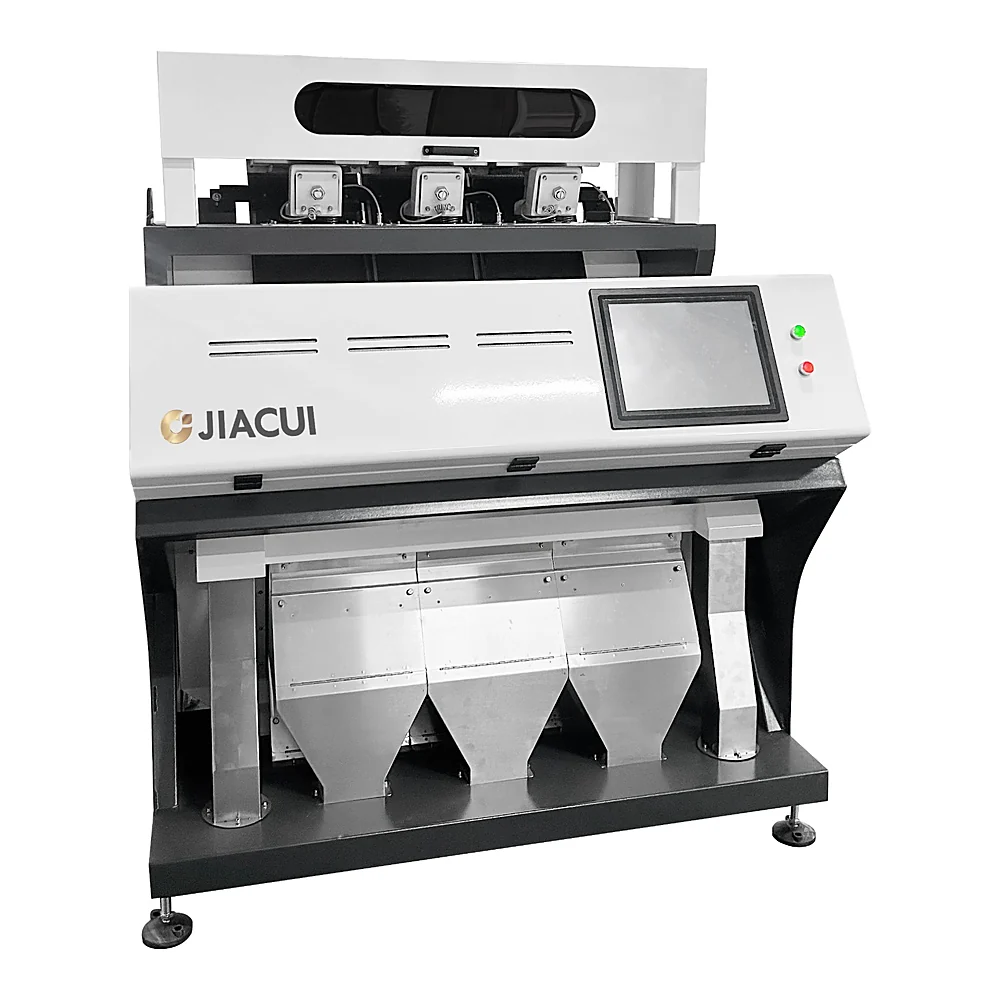
Chute count is the most visible capacity lever. As a rough orientation for rice:
| Chute count | Typical role | Practical note |
|---|---|---|
| 1–2 chutes | Small mills, specialty lots, re-sort recovery | Low capital cost; ideal as a second-pass unit |
| 3–4 chutes | Mid-size mills, single-line production | The most common entry point for a 2–4 t/h line |
| 5–7 chutes | Larger mills running continuous shifts | Better cost per tonne once utilisation is high |
| 8–10 chutes and above | High-tonnage export plants | Requires disciplined feeding and air supply |
These bands are orientation only — the actual tonnes per hour depend on grain size, bulk density, target purity and how hard you push sensitivity. Always ask a supplier what capacity corresponds to your rice at your target rejection rate, and ask for the test conditions.
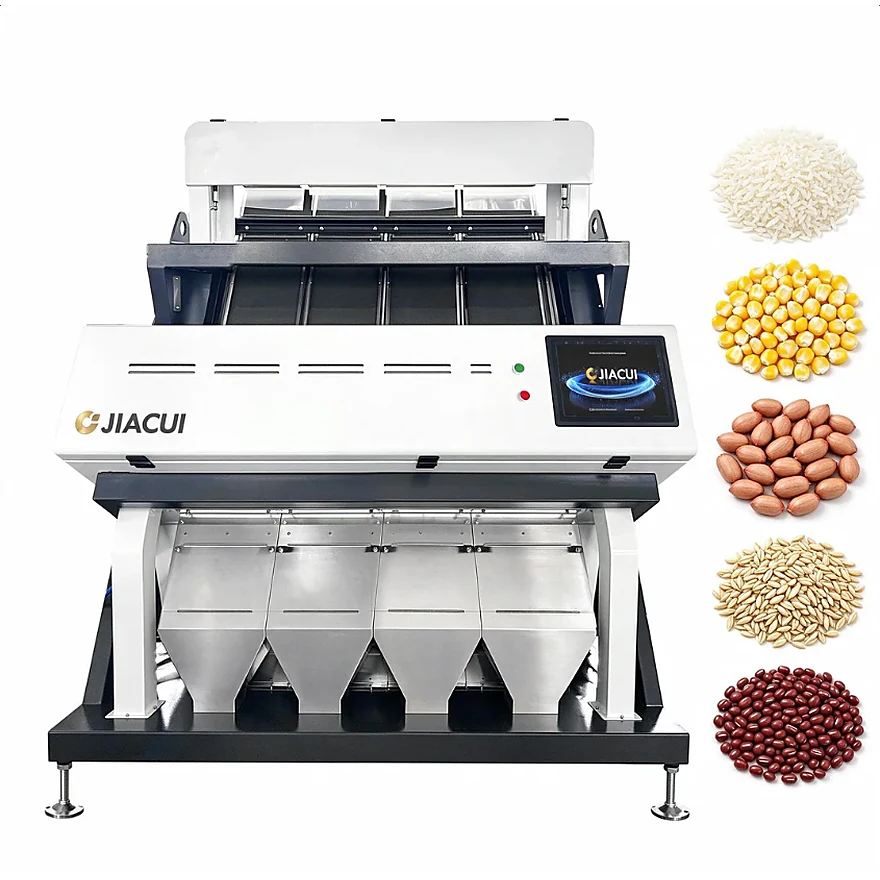
For mills that are still small or running several short batches rather than one continuous line, a compact unit is often the better first purchase than a large machine running at 30% load. The small rice color sorter options cover that scenario in more detail.
Step 3: Match detection technology to the defect classes you actually have
Rice sorting separates into two very different problems, and they need different technology.
High-contrast defects — paddy, stones, dark damaged grains — are handled well by conventional full-colour CCD cameras with threshold logic. This is mature technology and you should not pay a premium for it.
Low-contrast defects — chalky kernels, faint yellowing, slight bran residue — are where threshold systems fail. On white rice against white rice, there is almost no colour difference to threshold. Improvements come from three directions:
- Illumination geometry. Angled and structured lighting reveals opacity and internal structure that flat frontal light hides.
- Trained models rather than fixed thresholds. AI recognition learns the texture signature of a chalky kernel from labelled examples instead of relying on one cut-off value.
- Feed discipline. Chalky detection degrades quickly when kernels overlap; conservative feed rate improves both detection and yield.
If foreign material is your dominant risk rather than colour defects, optical sorting alone may not be enough for glass or embedded stones. That is a density problem, and it belongs in a separate discussion covered in our comparison of X-ray versus optical sorting.
Step 4: Understand carry-over — the number that actually costs money
Accuracy is quoted everywhere; carry-over is quoted almost nowhere, yet it is the figure that shows up in your monthly accounts.
Carry-over ratio = good product ejected into the reject stream, expressed as a percentage of the accept stream. A machine can hit 99% defect removal while throwing away 3% of perfectly good rice.
On a thin-margin commodity, that 3% is not a rounding error. Two machines with identical accuracy claims can differ by a factor of two on carry-over, and the cheaper machine can easily be the more expensive one over five years. This is why we separate the two concepts clearly in what color sorter accuracy really means.
The practical implication for a rice mill: always budget for a re-sort pass. Either route the reject stream back through the main machine on a second recipe, or dedicate a small unit to recovery. On rice, the recovery loop is essentially standard equipment, not an optional extra.
Step 5: Choose the platform for your rice type
Polished white rice is hard, dense and free-flowing. Chute-type machines generally deliver more tonnes per dollar on this material and are the default choice for high-volume white rice lines.
Belt platforms earn their place when the material is more fragile or the lot value is high: brown rice with an intact bran layer, parboiled rice with a brittle surface, and specialty or organic lots where a broken kernel is expensive. The trade-off is throughput and capital cost for gentler handling.
For mills that process both white rice and more delicate specialty lots, the honest answer is that one platform will be a compromise. Recipe storage makes switching practical; physically separate lines are better if volume justifies it.
Step 6: Count the running cost, not just the purchase price
Compressed air dominates the operating cost of a rice sorter, followed by power and consumables. Three checks separate a well-engineered machine from a cheap one:
- Air consumption per ejector. A machine with more channels but poorer valve design can consume more air per tonne sorted.
- Valve response and leak rate. Slow or leaking valves produce both missed defects and unnecessary reject — cost on both ends.
- Compressor headroom. Undersized air supply is the most common cause of "the machine works in the morning and fails in the afternoon".
Our detailed breakdown of air, power and consumables is in energy consumption in color sorting. Budget it before you sign, because retrofitting air capacity later is far more expensive than specifying it correctly.
Turning it into an ROI calculation
The payback model for a rice sorter has two revenue levers and one cost lever. State your assumptions openly; a conservative model that survives scrutiny is worth more than an optimistic one that does not.
| Line item | How to calculate it |
|---|---|
| Annual throughput | Hourly capacity × operating hours × working days |
| Grade uplift | Tonnes upgraded × price difference between your current grade and the target grade |
| Good-rice recovery | Annual throughput × reduction in carry-over × product value |
| Operating cost | Compressed air + power + spares + operator time |
| Net annual benefit | Uplift + recovery − operating cost |
| Simple payback | Installed cost ÷ net annual benefit |
A worked example makes the logic concrete. Take a mill running 8 t/h for 16 hours a day, 300 days a year — 38,400 tonnes annually. Suppose improved sorting moves 40% of output up one grade at a USD 12/t differential, and better carry-over control recovers 0.5% of output at USD 400/t:
- Grade uplift: 38,400 × 40% × 12 = USD 184,320
- Recovery: 38,400 × 0.5% × 400 = USD 76,800
- Operating cost: roughly USD 20,000–30,000 in air, power and spares
- Net benefit: approximately USD 230,000 per year
These are illustrative assumptions, not a quotation — your price differentials and defect profile will differ, sometimes dramatically. The point is that even conservative inputs produce a payback measured in months, which is why the decision should be driven by the specification rather than by the lowest quote. A fuller treatment of the model, including how to handle multi-shift utilisation, is in color sorter ROI and capacity planning.
The five selection mistakes we see most often
- Buying on accuracy alone. Accuracy without a stated test condition and carry-over figure is marketing, not engineering.
- Sizing at nameplate capacity. The machine then runs permanently in the condition that produces the worst sorting.
- Ignoring upstream cleaning. A sorter asked to remove stones and husk will mis-reject rice. Destoning and aspiration belong before the optical stage.
- No re-sort plan. Rejects with recoverable rice are a permanent, invisible loss.
- Underestimating air. The cheapest machine on the quotation is often the most expensive on the compressor.
Verify with your own rice before you commit
Specifications and case studies are useful, but rice varies enormously between origins, harvests and milling degrees. The decisive step is a sample test on your own material, assessed against your buyer's actual specification — not a demonstration lot chosen by the supplier.
Send 10–20 kg of your rice, state the defect classes you need removed and the purity you must reach, and ask for the accept and reject streams back so you can weigh both. If a supplier cannot or will not do this, treat that as information about how they will behave after the invoice is paid.
FAQ
How many tonnes per hour can a rice color sorter handle?
JIACUI's rice and grain range spans roughly 0.5 to 12 t/h across 15 models, but the usable figure depends on grain type, target purity and how many defect classes you are removing. Always specify well below the maximum — 60–75% of rated capacity is the practical working range for stable accuracy.
Is a bigger machine always better value?
No. Cost per tonne falls with utilisation, not with size. A large machine running at low load sorts worse than a correctly sized smaller one, because feed presentation becomes unstable. Buy capacity you will actually use on most shifts.
Do I need a second machine for re-sorting?
You need a re-sort strategy. That can be a second pass through the main machine with a different recipe, or a dedicated small unit. On rice, leaving recoverable grain in the reject stream is one of the largest avoidable losses in the mill.
Can one machine sort rice and other grains?
Usually yes, with recipe storage, but sensitivity and feed settings differ substantially between rice, wheat, maize and pulses. Expect a yield compromise when switching compared with a dedicated line.
Where to go next
Start with the specification, size below the nameplate, confirm carry-over on a sample, and count the air bill. Those four decisions determine the outcome more than the badge on the machine.
Browse the rice and grain color sorter range to see the model classes and their capacity bands, read the defect-specific techniques in how to solve chalky, yellow and broken rice defects, and then send us a rice sample so the recommendation is based on your grain rather than a brochure.