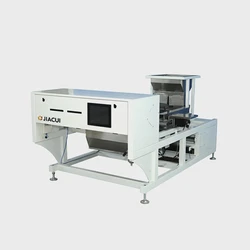


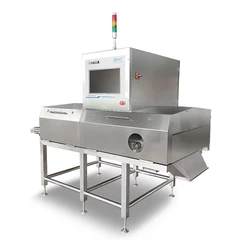


Ask any rice miller which defect causes the most arguments with buyers and the answer is rarely stones. It is the quiet, low-contrast group: chalky kernels, faint yellow grains and brokens. These are the defects that survive mechanical cleaning, look almost normal in a scoop, and still cost a container.
This guide covers why those three classes are hard, which techniques actually work on them, and how the problem changes when you move from commodity white rice to parboiled rice and basmati, where conventional sorting logic breaks down.
Why chalky kernels are the hardest problem in rice sorting
A chalky kernel is not a different colour. It is the same colour with different opacity and internal structure. Under flat frontal lighting, white rice and chalky rice return almost the same signal to a camera, which is why threshold-based sorters either miss them or over-eject in an attempt to catch them.
The physical cause is partial starch filling: the kernel did not complete grain filling, so light scatters differently through the endosperm. That difference is real and detectable — but only if your optical setup is designed to see it.
Three levers, in order of impact:
- Illumination geometry. Angled or structured light produces shadow and transmission differences that flat light hides. Two machines with identical cameras can perform completely differently on chalky rice purely because of how the light is arranged.
- Learned models instead of thresholds. A trained recognition model learns the texture signature of chalky kernels from labelled samples. It can hold a decision boundary that no single brightness threshold can express.
- Feed discipline. Overlapping kernels average their surfaces together in the camera's view. Slowing the feed slightly often improves chalky detection more than raising sensitivity does — and it protects yield at the same time.
This is also why chalky removal is the clearest way to tell a serious optical design from a repackaged commodity machine. The background is in AI deep learning for color sorting.
Yellow and damaged kernels: a contrast problem you can usually solve
Yellowing is more forgiving than chalkiness because there is a genuine hue shift, but it becomes difficult in two situations: lightly discoloured grains on pale rice, and parboiled rice where the whole batch is amber.
For standard white rice, full-colour CCD with well-controlled lighting handles yellow grains reliably. The failures usually come from operations rather than optics — dirty windows, drifting calibration, or sensitivity raised to compensate until the machine starts ejecting sound grain. Our field checklist in seven common rice sorter problems covers those causes in detail.
Parboiled rice is a separate case and deserves its own section below.
Broken rice: this is a shape problem, not a colour problem
Brokens are visually identical to whole kernels in colour. No amount of colour tuning will separate them. What separates them is length and aspect ratio — which means the machine needs shape discrimination running alongside colour discrimination.
Two distinct objectives exist, and mills often confuse them:
| Objective | What it requires | Commercial logic |
|---|---|---|
| Remove brokens from the premium stream | Shape recognition, accurate length measurement, gentle handling | Protects the head-rice grade and the buyer contract |
| Separate brokens into their own saleable grade | Size-based classification with stable thresholds | Brokens have their own market; discarding them destroys value |
The second objective is often the more profitable one, and it changes the specification: you are not buying a stricter reject threshold, you are buying a reliable measurement. Confirm both capabilities on your own grain before purchase, because "shape sorting" is used loosely in the market.
Parboiled rice: where normal sorting logic fails
Parboiled rice is steamed before milling, which drives colour into the kernel and turns the whole batch amber to deep yellow. This creates a specific trap: a threshold trained on white rice will classify perfectly good parboiled kernels as "yellow defects" and eject a large share of the product.
The correct approach is different in three ways:
- Recalibrate on the parboiled colour space. The reference for "acceptable" must be this batch's amber, not white rice. Recipes per product type are mandatory, not convenient.
- Use texture and uniformity rather than absolute hue. In parboiled rice, true defects tend to be non-uniform: streaked, blackened, or partially translucent where the starch did not gelatinise evenly. Uniform amber is normal; mottled amber is suspect.
- Expect a more fragile surface. Parboiled kernels are denser but more brittle, so belt platforms and gentle transfer points are often preferred even at lower throughput. Breakage created upstream cannot be sorted back.
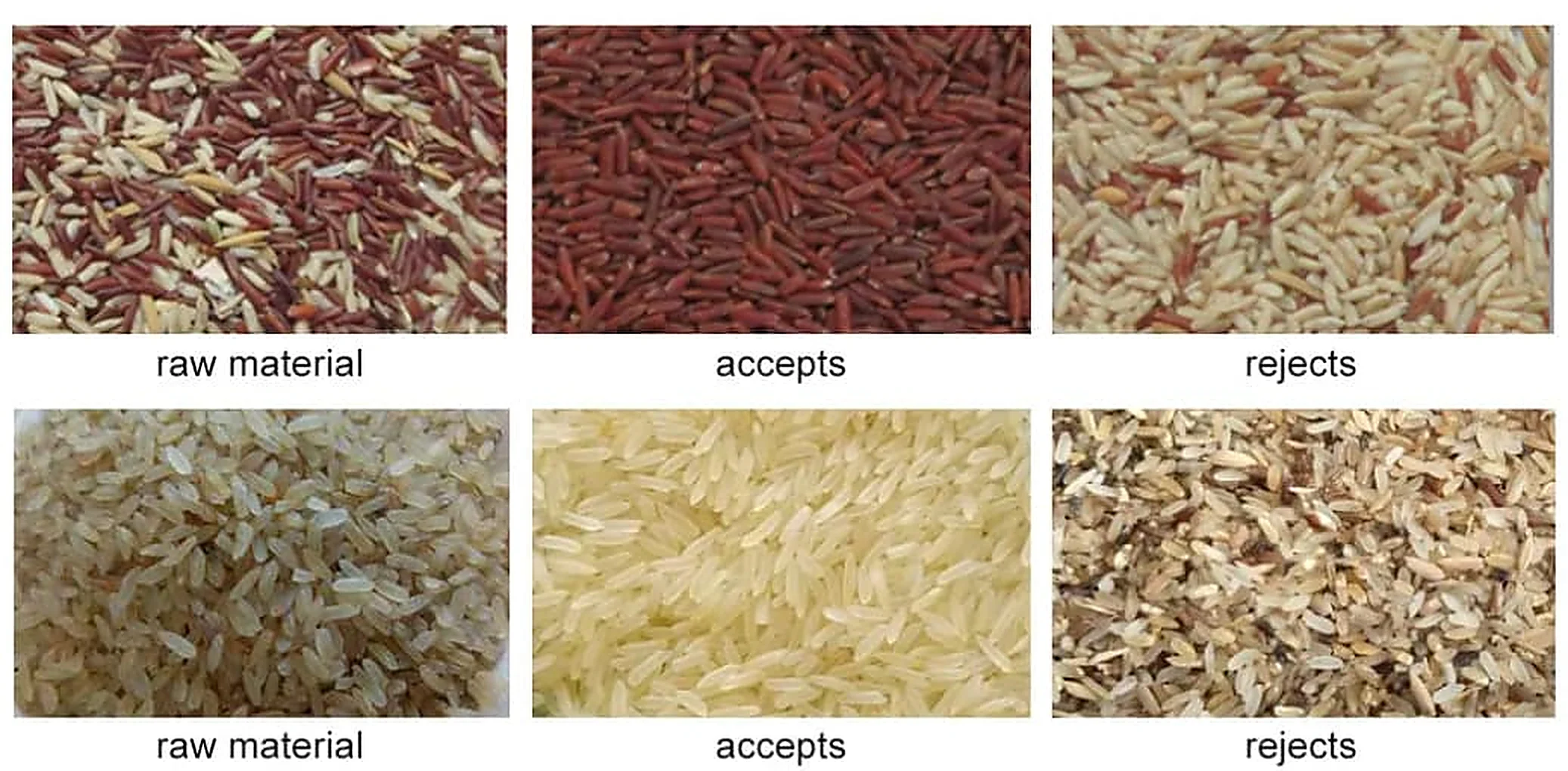
The reference images below show the difference clearly: the parboiled accept stream is uniformly amber, while the reject stream concentrates the dark, streaked and broken material.
Basmati: long grain, low breakage tolerance
Basmati is the most demanding premium rice to sort, for a structural reason: the grain is long and slender, so its mechanical strength is low relative to its length. Every transfer point, chute curve and ejector impulse is a chance to snap a kernel that was worth several times commodity rice.
Design implications:
- Platform matters more than on white rice. Belt-type feeding reduces impact and free-fall. Where a chute machine is used, chute material and curvature become a quality variable, not a detail.
- Ejector timing must be precise. A valve that fires slightly long blasts neighbouring kernels; on long-grain rice that shows up immediately as broken tips downstream.
- Shape sorting must be calibrated for elongation. A length threshold tuned for short grain will reject legitimate long kernels. Aspect-ratio based classification is the correct model.
- Lower throughput is often correct. On high-value basmati, running at 60% of rated capacity to protect whole-grain yield is usually the profitable choice, not a compromise.
Mills that treat basmati as "white rice with a different colour setting" consistently report higher breakage and lower head-rice recovery. The economics of that error are covered in our guide to export-grade rice sorting.
The defect groups you can see in a single test
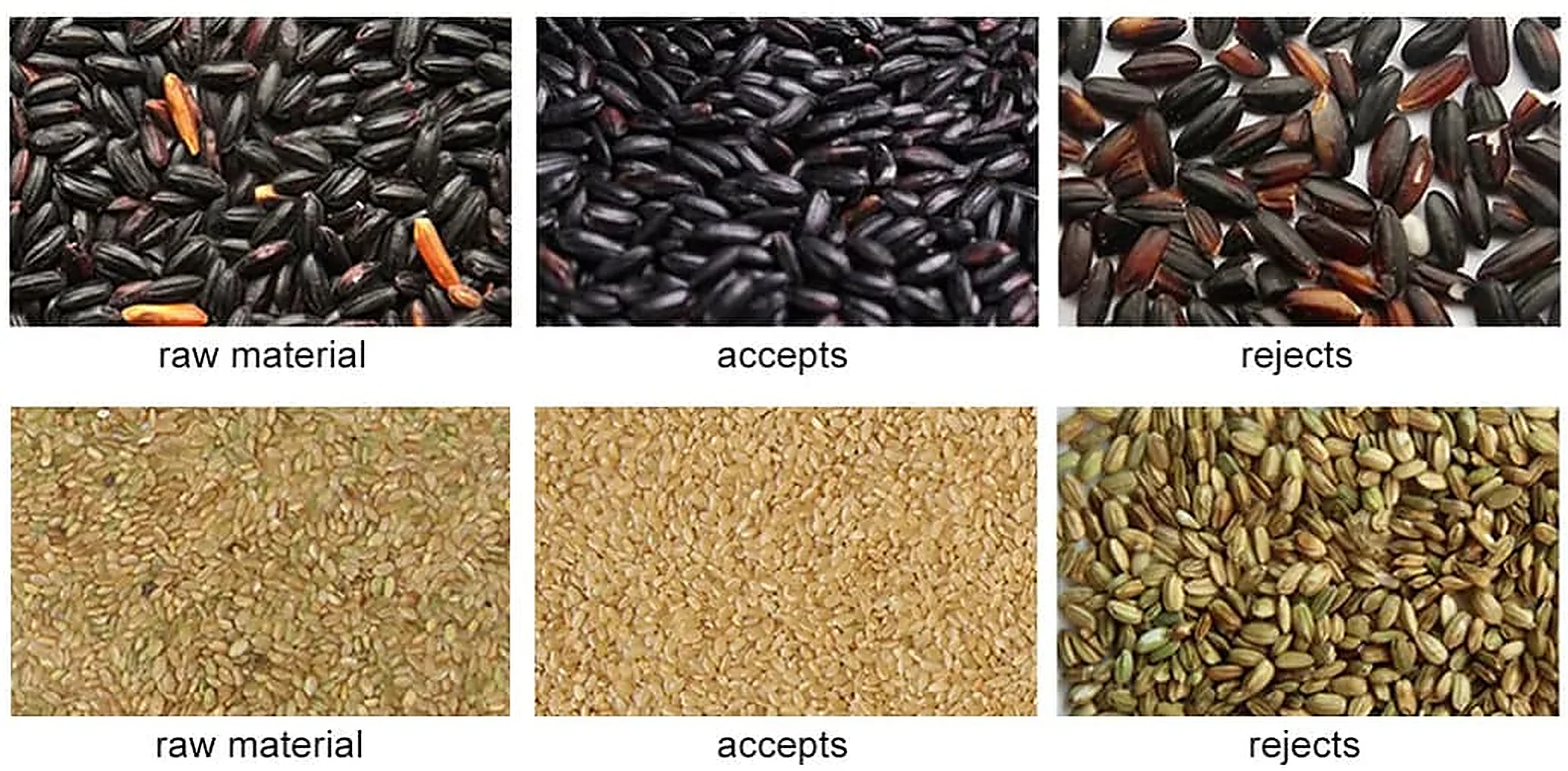
When you evaluate a machine, run each rice type separately and photograph the three streams: raw material, accepts and rejects. Well-designed sorting should show a reject stream that is concentrated — mostly defects — rather than a reject stream diluted with good grain.
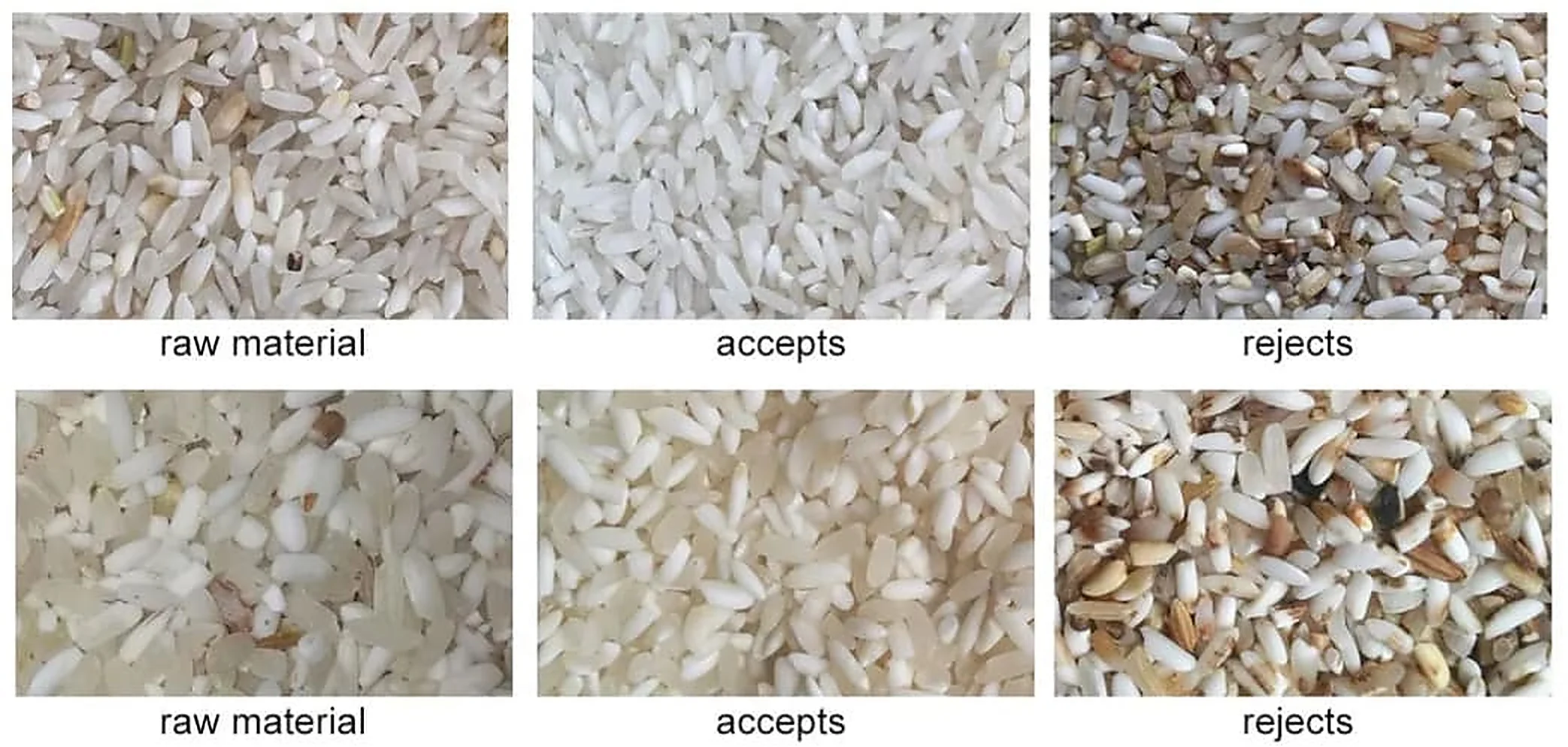
For coloured and specialty rice the same logic applies with different reference colours — black rice and paddy rough rice are shown below, where the task shifts towards removing light-coloured foreign material and immature grain from a dark background.
Infrared and multispectral detection: when colour is not enough
Some contaminants simply do not have a colour signature: clear glass, certain plastics, light-coloured stones embedded in the grain mass, and deeply chalky kernels with no surface colour shift at all. For those, Near-Infrared (NIR / InGaAs) sensing adds a second discrimination axis based on how the material absorbs and reflects specific wavelengths.
Practical guidance:
- NIR is not a replacement for RGB. It handles a narrow set of problems well and costs significantly more. Specify it for a defined contamination risk, not as a general upgrade.
- For hard foreign material, destoning upstream is cheaper. Gravity separation removes most stones at a fraction of the cost of optical detection.
- For near-zero tolerance lines — infant food, baby rice, premium export contracts — a combined approach is justified. Our comparison of X-ray and optical sorting covers when density detection beats colour.
What actually improves results, in priority order
- Clean the input upstream. Destoning and aspiration before the optical stage make everything downstream easier and cheaper.
- Feed a single, even layer. This alone fixes a large share of "the machine misses chalky kernels" complaints.
- Recalibrate per product. White, parboiled, basmati and coloured rice need separate recipes with separate reference standards.
- Add shape discrimination if brokens affect your grade, and decide whether you are removing or separating them.
- Consider NIR or X-ray only for a specific, identified contamination risk.
FAQ
Why does my sorter eject good parboiled rice?
Almost always because the recipe was built on white rice. Parboiled kernels are uniformly amber, and a white-rice reference treats that amber as discolouration. Build a separate recipe from parboiled accepts and set the reference against that batch.
Can a color sorter remove broken rice?
Only with shape discrimination. Brokens have the same colour as whole kernels, so colour alone cannot separate them. Confirm that the machine measures length or aspect ratio, and test the result on your own variety.
Is AI sorting necessary for chalky kernels?
Not strictly, but it is where AI shows the clearest benefit. Improved illumination geometry can achieve a lot on its own; trained models extend that further by recognising texture rather than relying on a brightness threshold.
Will sorting basmati on a chute machine break the grain?
It can, if transfer points and ejector timing are not designed for long, slender kernels. Belt feeding is generally gentler. If you use a chute machine, verify breakage on a sample run rather than relying on the specification sheet.
Next step: test on your own grain
Defect profiles differ by origin, harvest and milling degree, so a demonstration on someone else's rice proves very little. Send a sample of each grade you actually produce — white, parboiled, basmati or coloured — and compare the three streams yourself.
See the model classes in the rice and grain color sorter range, and if your bottleneck is operational rather than optical, start with the seven common rice sorter problems. When you are ready to test, send us your rice samples and we will return the accept and reject streams with the settings used.