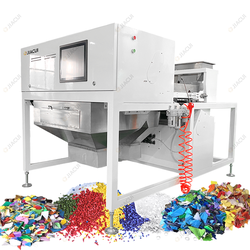


Egyptian sesame exporters should sort on a chute, because natural and hulled seed flows freely and a high-channel chute gives the lowest cost per tonne at 1-3 t/h. The job is to remove dark, damaged and shrivelled seed, stones and plant debris before shipment, then prove the result with a sample test against the contract specification.
Egyptian sesame: crop, season and export grades
Most Egyptian sesame comes from Upper Egypt, around Luxor, Sohag, Minya and Assiut, with harvest from late August into October. The crop is sold as natural sesame in its seed coat or as hulled sesame for tahini, halva and bakery use, and the two streams have different buyers, defect lists and risk profiles.
Export destinations include Japan, Korea, the Gulf and the European Union, and each market tests differently. Purity of 99.9% with a tightly controlled admixture is a common contractual target, but the number means nothing without the method: sample size, divider, sieve set and the laboratory that signs the report all change the result.
Hulled sesame adds a food safety expectation. Removing the hull improves appearance but exposes the seed, so buyers ask about cleaning records, pest control and microbiological testing. A colour sorter is a physical cleaning step, not a sterilisation step, and no supplier should imply otherwise.
The defect list for natural and hulled sesame
Natural sesame carries dark and black seeds, damaged and shrivelled seeds, immature seed, stones and sand, plant debris, and foreign seeds such as castor or cottonseed. Hulled sesame adds hull fragments, broken seeds and the dust that comes with the hulling line, and it shows damage more clearly because the seed is pale.
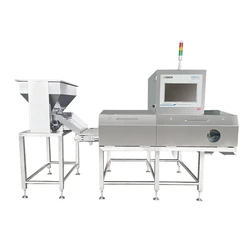
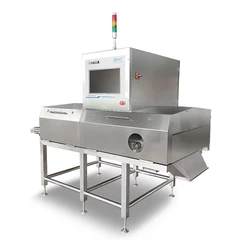
The hardest defects are the ones that look like the product. A dark sesame seed is a clear target for a colour camera, but a grey stone of similar size and tone is not. For stone and glass risk, a colour sorter handles the contrasting fraction and a density step or an X-ray unit such as the CS-XCA60 handles the rest, at a dose below 1 uSv/h. Promising that one optical machine removes every stone is a promise that fails at the port.
Foreign seed is the quiet commercial risk. Castor seed is larger and differently shaped, and one find in a container can trigger a rejection that costs far more than the machine. Make foreign seed removal part of the test report.
Why sesame runs on a chute
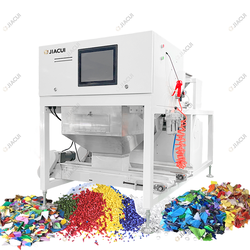
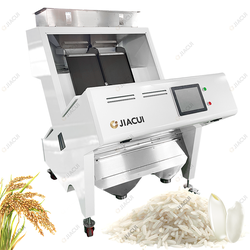
Sesame is small, round and free-flowing, the ideal condition for a chute. Seed falls past fixed cameras in thin, even curtains, the ejector sees a stable target and channel count translates almost directly into throughput. A belt would add width, floor space and cost without improving presentation, and fine seed would be harder to keep in a single layer.
Channel count is the sizing lever. More channels mean more parallel streams under the same camera and valve set, so a plant can match capacity to intake without changing platform.
| Model | Channels | Typical role | Why choose it |
|---|---|---|---|
| CS-1C96 | 96 | Small plant or first pass ahead of a second sorter | Compact footprint and modest air demand |
| CS-2C160 | 160 | Single-pass export line at small to mid volume | Good balance of capacity, accuracy and floor space |
| CS-6C-384 | 384 | High volume plant or two-pass sorting in one frame | Highest throughput per machine, but needs more air and power |
There is no honest way to convert channel count into tonnes per hour without the product in hand. Density, seed size, moisture and reject percentage all move the real rate, which is why a sample test is part of sizing.
Sizing 1-3 t/h and planning the sample test
Plan with the standard formula: shift output = rated t/h x hours x 0.85. A plant taking 1.5 t/h over eight hours plans on 1.5 x 8 x 0.85 = 10.2 t per shift, or about 3,000 t over 300 working days. If a second pass is needed to reach contract purity, it consumes hours from the same budget, so add a machine or plan a longer shift.
The sample test is where the specification becomes a number. Send 5-10 kg per lot, drawn with a proper divider rather than a hand scoop, and include the defects you actually see. State the contract purity, the destination market and whether the seed is natural or hulled. A test on clean, hand-picked seed flatters every machine and tells you nothing about the lot that will be loaded.
Ask for three numbers in the report: accuracy on your defect list, reject rate as a share of feed, and carryover as a ratio. Carryover is the one buyers forget. On 100 t of feed with a 3% reject stream, a 10:1 machine puts about 0.27 t of good seed into the reject bin, while a 30:1 machine puts about 0.10 t. On an export lot that difference pays for a better machine within a season or two.
Moisture, dust and static on fine seed
Sesame is normally stored and shipped at low moisture, often around 6-8%. Seed above that range sticks in the hopper, bridges on the chute and smears the window, producing false rejects and inconsistent results. Dry to specification before sorting; a sorter cannot fix a wet lot.
Fine dust is the second enemy. It settles on the optical window within hours and softens the image without any alarm, so the only reliable defence is a fixed cleaning interval and a positive-pressure cabinet. In Delta and coastal plants, humidity swings cause condensation on cold metal in the early morning, so let the cabinet heater run before production starts.
Static is less obvious but real on hulled sesame. It makes light hull fragments cling to the chute and the window and disturbs the feed. A grounded chute, controlled humidity and a clean earth solve most of it. Compressed air must be dry and oil-free at 6-8 bar, with a dew point low enough that no water reaches the valves.
Power, operators and spares
Egyptian supply is typically 220 V single phase and 380 V three phase at 50 Hz, with voltage dips in rural areas and during peak demand. Confirm the voltage at the order stage, fit a stabiliser where the supply is unstable, and give the sorter a dedicated circuit with a clean earth. Air demand, not motor load, is usually the real constraint, so size the compressor for the peak number of nozzles firing at once.
Operators need about two days of training. The skill that matters is recipe management across lots: the crop changes from Sohag to Minya, the hulling line changes the dust load, and the contract changes the acceptable reject. A written recipe log keeps results consistent between shifts.
Keep a season of consumables: ejector nozzles, air filters, window glass and sensors. JIACUI has built sorting machines since 2005 in Hefei, Anhui, holds 21 patents and serves customers in more than 50 countries. Machines are CE marked under CE M.2025.206.C125724 and built to ISO 9001 under NOA2105037, which supports the supplier file that EU and Japanese buyers now request as standard.
Payback is usually straightforward. If sorting lifts a lot from a discount grade to a contract grade at a premium of 60-100 USD per tonne, a plant handling 2,000 t with 70% of output upgraded recovers a mid-size machine within one to two seasons. Use your own reject rate and premium.
Frequently asked questions
How pure can a color sorter make Egyptian sesame?
It depends on the incoming lot and the defect. Export lines commonly reach 99.9% purity on the tested sample, but the number must be read with the reject rate and carryover that produced it. A machine can reach any purity by rejecting aggressively and throwing away good seed. Agree purity, reject rate and carryover together before you sign.
Does hulled sesame need different settings from natural sesame?
Yes. Hulled seed is pale, so damage, dark specks and hull fragments stand out more, and the dust load from the hulling line is higher. Recipes should be saved separately for natural and hulled lots, with different sensitivity and cleaning intervals. One recipe for both is the most common cause of inconsistent results between shipments.
Can a color sorter remove stones from sesame?
It removes stones that differ in colour from the seed, which is most of them. Stones of similar size and tone can pass a colour camera, so export lines usually combine colour sorting with a density step or an X-ray unit for glass and stone. If your contract names stone content, plan for a second technology rather than expecting one camera to cover it.
What sample should I send before shipment?
Send 5-10 kg drawn with a divider from the actual lot, not hand-picked seed, and state the contract specification, destination and whether the lot is natural or hulled. Ask for a written report with accuracy, reject rate and carryover. Keep it with the shipping documents so the purity claim can be traced if a buyer tests the container on arrival.
Related guides: see the sesame color sorter range, check the certifications page for documents you can put into a tender pack, and review measured case studies for lines running similar seed crops.
Request a free sample test and quotation for your sesame line →