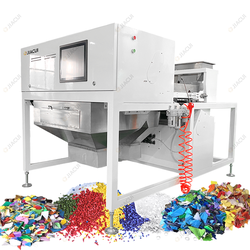


"Which Chinese color sorter brand is best?" is the wrong question to search, and a very reasonable one to ask. Buyers ask it because the shortlist looks flat on paper: dozens of suppliers on marketplaces and exhibition lists, similar model codes, similar 99.99% claims, and a price range wide enough to be meaningless. The brand name does not sort your product; a platform, a valve set and a service route do.
This guide answers the question in a way you can act on. It sets out what "best" should mean for a sorter buyer, the four kinds of Chinese supplier you will actually meet, a 30-minute verification routine, and a map from product to platform. It ends with the traps that make brand comparisons worthless — so you can shortlist on evidence instead of on logo recognition.
Nothing here asks you to trust a brand name, ours included. Every claim below is written so you can check it against a certificate number, a patent record, a test report or a reference call.
Five criteria that decide whether a Chinese brand is worth shortlisting
A color sorter is a ten-year capital item with consumables, software and support attached. Judge every candidate on the same five axes, and score each one with evidence rather than adjectives.
- Platform range. A factory that builds chute, belt and X-ray platforms can recommend the right architecture instead of selling you the only machine it makes. A single-platform supplier will always find a reason why its platform fits your product.
- Measured performance, not brochure performance. Accuracy and carryover should be quoted as a pair and demonstrated on your own sample. A supplier that hides carryover is selling the easy half of the number.
- Documented engineering. Patent numbers, software copyrights, certificate numbers you can look up, and an electrical build matched to your destination voltage and frequency.
- Spares and service structure. A named service route, a published wear-parts list with lead times, and remote diagnostics that can read the machine log. Ask what happens on a Sunday in harvest week.
- References you can reach. Installed plants in your segment and region, with owners willing to take a call. A brand with no reachable reference is a brand with no installed base you can verify.
The four kinds of Chinese supplier behind the brand names
Most disappointing purchases are not caused by bad machines. They are caused by buying from the wrong type of company for the way you will use the machine. These four types look similar on a marketplace listing.
| Supplier type | What you are really buying | Strength | Risk to manage |
|---|---|---|---|
| Trading company / reseller | A machine sourced from a third-party factory, with margin added | Fast quotes, export paperwork, small orders | No control over build quality; slow or unclear after-sales route; specifications copied from a catalogue |
| OEM factory with its own brand | Design, assembly, software and spares under one roof | Direct engineering contact, model breadth, custom builds, spare-part continuity | Needs verification that the brand and the factory are the same entity |
| Component assembler | Purchased cameras, valves and software integrated into a frame | Low entry price | No software ownership; recipe and firmware updates depend on a third party that may disappear |
| Focused regional manufacturer | Deep experience in one material family, narrow range | Strong on that one product | Poor fit when your product mix changes across the season |
The practical test is simple: ask for the factory business licence, the factory address, and a live video walk-through of the assembly line with your model in it. A reseller will send a catalogue. A factory will send a video and invite an audit.
How to verify any Chinese supplier in one afternoon
None of these steps needs a local agent or a consultant. Each produces a document or a number you can file with the purchase order.
- Check the legal entity. Business licence scope should include colour sorter manufacturing, not only "machinery trade". Match the company name on the licence to the name on the quotation and the bank account.
- Verify certificate numbers. CE certificates carry a number and a validity date; look them up with the issuing body. ISO 9001 certificates name the scope and the site. A certificate that cannot be checked is a picture, not a certificate.
- Ask for patent and copyright numbers. Patents show what the company actually developed. Ask which patent covers the ejection timing, the optical enclosure or the recipe system, and read the title.
- Run a sample test on the intended platform. Send 5–10 kg of representative product including the defects you actually see. Ask for measured reject rate, contamination remaining in the accepts, and good-product loss in the reject stream.
- Request the wear-parts list with prices. Nozzles, filters, window glass, LED modules and belts. A factory publishes this list. A reseller changes the subject.
- Call a reference in your segment. One conversation with an owner running the same product tells you more than ten specifications. Ask about accuracy drift, downtime and spares lead time.
- Confirm the electrical build. Destination voltage, frequency and phase in writing, with the panel drawing. This is where low-cost offers quietly cut corners.
Where JIACUI sits on those criteria
JIACUI was founded in Zhengzhou in 2005, when grain export mills were still sorting by hand, and added a second production base in Hefei in 2010. The company is a manufacturer, not a reseller: design, assembly, software and spares sit under the same roof, and the model range covers 16 to 768 channels on chute platforms, 300 to 1,200 mm belts and dual-energy X-ray.
What can be checked rather than claimed:
- Certificates. CE marking under Machinery 2006/42/EC, EMC and Low Voltage Directives — certificate M.2025.206.C125724, valid to 2 September 2030. ISO 9001 quality management system certified 2021–2024 under NOA2105037, with the renewal audit in progress. High-tech enterprise registration GR202301004540.
- Engineering record. 21 patents and 3 software copyrights covering optical sorting hardware and control software. The full list sits on the quality and certifications page.
- Range. Chute, belt and X-ray platforms under one brand, so the recommendation follows the material rather than the inventory. The model overview lists every CS- model with capacity, power, weight and dimensions.
- Evidence of operation. Measured before-and-after results in the case studies and machine demonstrations in the video library, including factory walk-through footage.
- Partnership route. A distributor programme with territory and spare-parts terms on the dealer page, for buyers who want a local service partner rather than a direct import.
That is the standard the comparison should be held to, and the same standard applies to any competitor you shortlist. Our company history is set out year by year on the about page.
Which platform for which product
Brand choice matters far less than platform choice. This map is the fastest way to narrow a shortlist before comparing suppliers.
| Product | Platform | Typical models | Why |
|---|---|---|---|
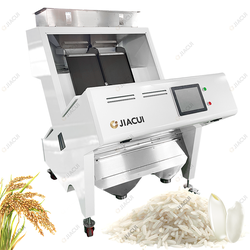
| Rice, sesame, small seeds | Chute | CS-1C64 to CS-12C | Free-flowing product, highest tonnage per yuan |
| Coffee, pulses, beans | Chute, anti-breakage | CS-2A128, CS-HA32 | Colour and shape defects, whole-bean value |
| Nuts and kernels | Chute and belt | CS-4A to CS-LA600 | Chute for kernels, belt for in-shell and large nuts |
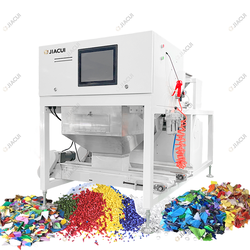
| Plastic flake and regrind | Belt | CS-LA600, CS-LA1200 | Flake will not behave in a chute; belt keeps it flat |
| Ore, quartz, industrial minerals | Belt | CS-LA300 to CS-LA1200D | Coarse, abrasive feed needs a stable single layer |
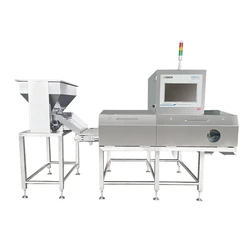
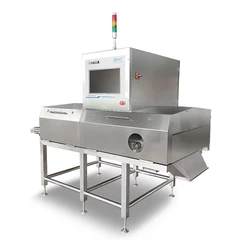
| Glass, stone, bone, dense plastic | X-ray | CS-XCA60, CS-XCB30 | Defect has no colour signature for a camera to read |
The full comparison of platforms and competing brands is on the brands comparison page. Use it to build the shortlist, then verify each candidate with the routine above.
Five traps that make brand comparisons worthless
- Comparing brochure tonnage across platforms. Five tonnes per hour on a chute and on a belt are different jobs at different accuracy. Fix the platform first, then compare tonnage.
- Reading accuracy without carryover. A machine can reach 99.99% by ejecting aggressively and lose the crop's value in the reject bin. Always ask for both numbers.
- Treating a reseller as a factory. The logo on the machine and the company that built it are not always the same. Licence, address and video settle it.
- Buying on price per channel. Channel count is not performance. Valve grade, camera stability, air efficiency and spares determine cost per sorted tonne.
- Skipping the sample test. A clean, hand-picked sample flatters every brand equally and predicts nothing about your real lot.
Frequently asked questions
Are Chinese color sorters as good as Japanese or European brands?
On mainstream optical sorting of rice, coffee, pulses, nuts and plastic, the camera and valve technology has converged, and a verified Chinese factory can match measured performance at a lower capital cost. The differences that remain are in service depth, software maturity in niche applications and documentation for regulated markets. Judge the individual supplier on measured samples and checkable documents, not on the country of origin.
Which Chinese brand has the widest model range?
Range is easy to claim and easy to check. Count how many platforms a supplier actually builds — chute, belt and X-ray — and whether the belt widths and channel counts cover both your smallest and largest product. A brand that covers only one platform will steer every enquiry toward it.
How much does a Chinese color sorter cost?
Price is set by platform, channel count or belt width, valve grade, options and destination. A lab-scale chute and an industrial 640-channel line are different categories. Ask for an itemised quotation covering the machine, freight, commissioning, training and a spares kit, so offers can be compared on the same scope.
Can I visit the factory before buying?
Yes, and you should. A factory audit lets you see the assembly line, the optical bench, the test bay and the spares store. If a visit is impractical, ask for a live video walk-through with your model in production and the serial number in frame.
Do Chinese color sorters meet CE requirements?
Reputable exporters build to the Machinery Directive, EMC and Low Voltage Directives and hold a CE certificate with a number and validity date. Ask for the certificate, verify it with the issuing body, and confirm the electrical build matches your destination voltage and frequency.
How do I check a supplier's patents?
Ask for patent and software copyright numbers, then check the titles and owners in the public register. A supplier that developed its own ejection timing, optical enclosure and recipe system can show the filings. A reseller typically cannot.
Conclusion: shortlist on evidence, then test on your own product
The best Chinese color sorter brand for your plant is the one whose platform matches your material, whose measured carryover protects your product value, whose certificates and patents you can verify, and whose spares and service you can reach in harvest week. That is a shortlist you can defend to a board, a bank or an auditor — and it has nothing to do with which logo is most familiar.
Send 5–10 kg of your product and we will return a measured report and a platform recommendation, whether or not it is one of ours. Compare the platforms on the model overview, read the measured results in the case studies, and check the documents on the certifications page.