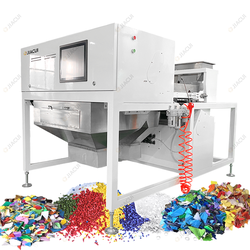


A Nigerian rice mill sorting 2-4 t/h of milled rice should plan a chute sorter of roughly 160 to 384 channels, power it from a 380-415 V three-phase supply behind a stabiliser or AVR, and expect payback within one to two milling seasons. Chute count follows peak intake, not the annual average, and the decision should be confirmed by a sample test on your own paddy.
What Nigerian mills actually feed the machine
Nigerian rice lines rarely see the clean, uniform sample that appears in a catalogue. Most mills buy paddy from hundreds of smallholders across Kebbi, Niger, Benue, Ebonyi and Cross River, and lots arrive with different moisture, different varieties and different amounts of sand and stone. Parboiled rice, which dominates the domestic market, adds its own signature: darker grains, partially gelatinised kernels and a surface that holds dust.
The wet season makes this harder. Paddy dried quickly on a road or a concrete slab can arrive at 16-20% moisture when the mill expects 13-14%, and under-dried parboiled rice tends to bridge in the hopper and smear the chute glass. A sorter cannot fix a feed problem, so put a de-stoner and a magnet upstream and use a variable-speed vibratory feeder instead of a fixed gate.
Volume also peaks. In harvest weeks a mill that averages 1.8 t/h can see 4 t/h at the intake for several days. The sorter is sized for that week, because that is the week when paddy waits in trucks and the mill either keeps up or loses the crop.
The defects that decide your grade
Write the defect list before you look at any model, because the list sets both the settings and the platform.
- Chalky and white-belly grains. The largest grade drag in Nigerian milled rice. Chalk is a colour and texture problem, so a camera with shape processing handles it well.
- Yellow and heat-damaged kernels. Usually from uneven parboiling or poor storage. Small numbers cost a whole bag its premium.
- Red-streaked, damaged and broken grains. Broken grains are a shape decision; red streaks are a colour decision. Buy a machine that can use both signals on one pass.
- Paddy, husk and foreign seed. A colour sorter removes most of it, but a paddy grain that is the same colour as milled rice needs shape sorting.
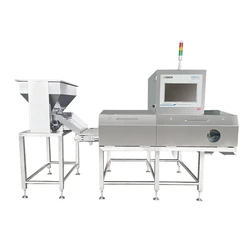
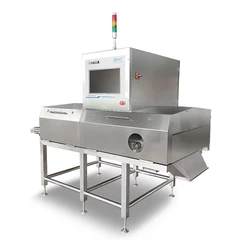
- Stone, glass and grit. A camera cannot see a white stone in white rice. That is a de-stoner job, or an X-ray machine such as the CS-XCA60 if an export buyer demands documented stone control.
Sizing in tonnes per hour and picking the platform
Size from the peak hour on the intake scale, then convert to a rated capacity: rated t/h = peak t/h / utilisation, with utilisation between 0.80 and 0.90 to cover grade changes, cleaning and short stops. A mill with a 3.2 t/h peak needs about 3.8 t/h of rated capacity.
| Configuration | Channels | Planning throughput, milled rice | Typical Nigerian line | Why choose it |
|---|---|---|---|---|
| CS-1C80 | 80 | 1.2-1.8 t/h | Community mill, one shift, one grade | Lowest capital cost, easy to run on a small generator |
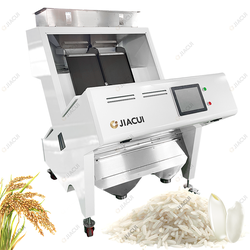
| CS-2C160 | 160 | 2.5-3.5 t/h | County mill, 2-4 t/h peak intake | Best balance of cost and speed for the common Nigerian line |
| CS-6C-384 | 384 | 6-8 t/h | Integrated mill or export packing plant | Headroom for a second pass on rejects without a second machine |
Those throughputs are planning figures for milled rice on a single pass; confirm them on your own sample, because chalk content and broken-grain load change the effective rate. Larger frames such as the CS-8C-512 and CS-12C-768 exist for lines above 10 t/h, but most Nigerian mills sit in the 160-384 channel band.
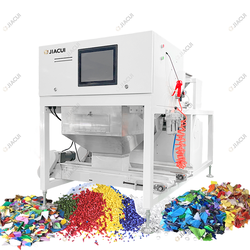
Milled rice free-flows, so a chute is the right platform for almost every Nigerian line. It gives the lowest cost per tonne, the smallest footprint and the easiest clean-down. A belt sorter makes sense only when the product is sticky, when the line is above 6-8 t/h and you want a wider single layer, or when you also sort sesame, cashew or other products. X-ray is not a platform for colour defects; it is a stone and density insurance policy, and most mills should buy the de-stoner first.
Power, voltage and generator reality
The sorter is usually the most voltage-sensitive machine on a Nigerian mill floor. Cameras, LED drivers and ejector controllers expect a steady 380-415 V at 50 Hz, and a generator that sags when a hammer mill starts will produce nuisance valve faults and shorten LED life, even though the sorter itself draws little compared with the mill motors.
- Specify the build for 380-415 V, three phase, 50 Hz, and ask for the nameplate kW in writing.
- Put the sorter and its feeder on a dedicated circuit with an automatic voltage stabiliser, not on the same bus as welding sets and grinders.
- Size the generator at roughly 1.5 times the sorter and feeder load, with a working AVR, and never switch the machine on and off at the breaker during a shift.
- Supply dry, filtered compressed air. Humidity condenses inside an ejector block and turns a clean nozzle into a sticky one.
If you later move to a belt platform for higher tonnage, the numbers are simple: the CS-LA600 draws 2.5 kW, the CS-LA1200 draws 6 kW and the dual-layer CS-LA1200D draws 9 kW.
Operator skill, spares and the local service route
A chute sorter is not difficult to run, but it is easy to run badly. One trained operator can cover two machines if each grade is stored as a named recipe instead of being re-taught every lot. Budget one to two days for commissioning and training, and insist that the training happens on your own product, not on a clean demo sample.
Stock the consumables that stop a line: ejector nozzles, air filter elements, chute glass or windows, LED modules and feeder springs. Ask for prices and lead times in the quotation, and ask who holds stock in Nigeria. Remote diagnostics that can read the machine log turn a Sunday breakdown in harvest week into a phone call rather than a flight. Documents for a tender pack matter too: CE M.2025.206.C125724 and ISO 9001 NOA2105037 are the certificates buyers ask for most often.
Payback: a worked estimate
Take a mill moving 6,000 tonnes of milled rice a year. Suppose chalky and yellow removal lifts the premium-grade share from 55% to 68%, and the price gap between premium and standard is USD 35 per tonne. The incremental revenue is about 6,000 x 0.13 x 35, or USD 27,300 a year. Add the yield saved by a tighter carryover ratio, often 0.5-1% of feed on a poorly set machine, and the annual benefit passes USD 30,000 before energy and spares are counted.
Against the delivered cost of a 160-384 channel chute line, that usually means payback in one to two seasons, and faster if you already sell branded bagged rice. Run the same arithmetic with your own price gap and grade mix rather than ours; a mill selling only to a bulk trader has a thinner premium and needs a longer horizon.
Frequently asked questions
How many chutes do I need for a 3 t/h rice line?
For a peak intake near 3 t/h, a 160-channel chute such as the CS-2C160 is the usual starting point, because it plans at roughly 2.5-3.5 t/h of milled rice. If your harvest peak reaches 4-5 t/h, step up to the 384-channel CS-6C-384 rather than running the smaller machine flat out. Confirm both figures with a sample test on your own paddy.
Can a color sorter run on a generator?
Yes, provided the supply is stable. Use a generator with a working AVR, size it at about 1.5 times the sorter and feeder load, and put an automatic voltage stabiliser on the sorter circuit. Avoid sharing that circuit with welders, hammer mills or other heavy starting loads, because voltage dips cause false ejections and nuisance alarms.
Will a color sorter remove stones from rice?
Not reliably. A camera sorts by colour and shape, and a white stone in white rice looks like rice. Use a de-stoner before the sorter for everyday protection. If an export contract demands documented stone control, add the CS-XCA60 dual-energy X-ray sorter after the optical pass rather than paying for X-ray on every tonne.
What spare parts should I stock for the first season?
Ejector nozzles, air filter elements, chute glass, one LED module and a set of feeder springs cover most first-season stops. Add one valve driver board if the mill runs three shifts. Ask for the spares list with prices and lead times in the quotation, and confirm whether your local agent holds stock or ships from Hefei.
Related guides: for a step-by-step selection process see how to choose a rice color sorter; for platform specifications and models see the rice and grain color sorter range; for measured results in similar mills see our case studies.
Request a free sample test and quotation for your rice line →
How the free sample test works
Send 2-5 kg of your material and we return a written report with before and after photos, measured defect removal and a recommended model. No cost, no obligation.
- Send your sample - 2-5 kg of production material, sealed in a bag or tin.
- Tell us the target - the defects you must remove and the purity or grade you sell against.
- State the line - tonnes per hour, power supply and available floor space.
- We run the test - typically 3-5 working days on a machine matched to your material.
- You get the report - removal rate, carryover, reject ratio, photos and a model recommendation.
- Decide with data - quotation, lead time and spare-parts list follow only if the numbers work for you.