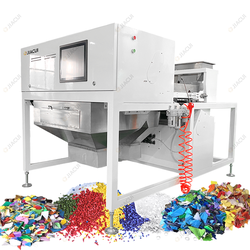


For rice, coffee, pulses, seeds and most nuts, buy a chute color sorter: it gives the lowest cost per tonne and up to 99.99% accuracy on free-flowing product. Choose a belt sorter when the material is fragile, coarse or sticky — ore, plastic flake, large kernels — and an X-ray sorter only when the defect has no colour or shape signature, such as glass, stone, bone or stainless steel.
That sentence settles most buying questions, but only if you know which condition you are in. A chute and a belt can carry the same headline tonnage and still produce very different breakage, carryover and air consumption. This comparison puts the three platforms side by side on presentation, damage, capacity, defect coverage and cost, then gives you an order of decisions to follow before you ask for a quotation.
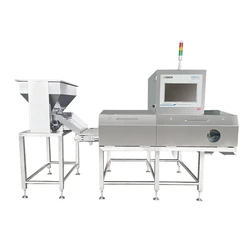
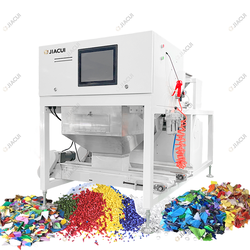
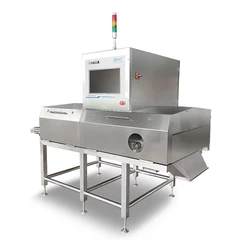
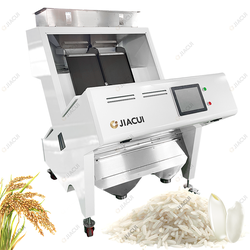
Every sorter is limited by how the product meets the light. On a chute machine the grain falls in a curtain past fixed cameras at roughly 4–6 m/s after a drop of about 1–2 m. On a belt machine it rides a flat belt under top-mounted cameras at 0.5–1.5 m/s, so each particle is seen from above with a stable orientation and little motion blur. An X-ray unit images a shallow layer on a 620 mm POM belt through a 600 mm inspection width and measures density instead of colour.
Presentation decides how fast the machine can run, how hard the ejectors work and how much product is damaged on the way through.
Product damage: where the chute penalty bites
Free fall is gentle for a rice kernel and brutal for a roasted coffee bean. Impact at 5 m/s is enough to chip cashew kernels, crack large peanuts and shatter brittle plastics, and the damage doubles if rejects are re-run. On fragile products, an extra 0.5–2% breakage per chute pass is common, which on 2,000 tonnes a year is 10–40 tonnes of lost grade.
A belt removes that penalty. The product sits still relative to the belt, transfer points are short and the drop into the outfeed can be kept under 300 mm, which is why belt platforms are standard for minerals, plastic flake and large fragile kernels.
Capacity, footprint and power
Chute capacity is set by channel count: the same optical box serves 64 streams on a CS-1A64 and 768 on a CS-12C768. Belt capacity is set by width and speed, from the CS-LA300 at 1.2–3 t/h and 1.75 kW to the CS-LA1200 at 5–12 t/h and 6 kW, or 9 kW on the dual-layer CS-LA1200D. X-ray throughput is capped by the belt and inspection width, so a CS-XCA60 runs at 1–6 t/h.
| Platform | Best material fit | Typical throughput | Indicative price (FOB China) |
|---|---|---|---|
| Chute | Rice, coffee, pulses, seeds, nuts | 0.8–5 t/h in small and mid models; up to 20 t/h at 768 channels | US$5,000–37,000 |
| Belt | Ore, minerals, plastic flake, fragile or coarse kernels | 1.2–3 t/h (CS-LA300) to 5–12 t/h (CS-LA1200) | US$9,000–38,000 |
| X-ray | Glass, stone, bone, dense plastic, metal inside product | 1–6 t/h through a 600 mm inspection width | US$25,000–38,000 |
Weight is the column buyers forget. A CS-LA600 is 750 kg and a CS-LA1200 is 1,150 kg, against a few hundred kilograms for a mid-size chute, which changes crane access, floor loading and how fast the line can be rearranged.
What each platform can actually remove
Chute and belt machines share the same optical core, so they see the same defects: discoloured kernels, chalky rice, mould, and foreign matter that differs in colour or shape. The difference is coverage quality. A belt holds product flat, which makes shape and texture sorting more reliable on coarse material, and it accepts NIR sensors more easily because the layer is thin and stable.
X-ray is a different measurement. It sees density, so it finds glass, stone, bone, dense plastic and stainless steel spheres down to 0.3 mm that no camera can separate from good product. It cannot tell a white kernel from a yellow one. When the reject list holds both colour faults and dense contaminants, no single sensor covers it: you need an optical pass and an X-ray pass, in that order.
Running cost: air, power and lost yield
Purchase price is only the first number. Compressed air is usually the second-largest running cost on a chute line, because every ejector fires a short high-pressure burst and air demand rises with reject rate. Ask for air consumption at your measured reject rate, not at a clean sample.
Power is easier to calculate. A CS-LA1200 drawing 6 kW for one eight-hour shift, 300 days a year, uses 14,400 kWh; at US$0.10/kWh that is about US$1,440 a year, and the 9 kW dual-layer version adds roughly US$720 on the same basis. On a chute, power scales with channels, from about 2.5 kW at 64 channels to around 10 kW at 768. Yield loss usually outweighs both: hold carryover above 20:1 and good product in the reject stream stays under about 5%.
Matching the platform to your product
- Rice and grains. Chute, unless the mill also handles fragile coarse material. Start with the grain color sorter range.
- Coffee. Chute for green and roasted beans; a belt only where a flat, stable view is needed to hold breakage down.
- Nuts. Chute for almonds, peanuts and cashews at normal grades; belt where kernels are large, fragile or premium. See the nut sorting platforms.
- Plastics. Belt, almost without exception, because flake is light, static-prone and needs a thin even layer. Compare the plastic color sorter options.
- Minerals. Belt, often a wide CS-LA1200, because ore is heavy, coarse and abrasive. The mineral sorting range covers this duty.
- Dense contaminants. X-ray. The X-ray sorting machine page explains what a 0.3 mm stainless sphere test proves.
The decision order that avoids a wrong purchase
- Write the defect list, then mark each defect as colour, shape or density.
- If any defect is density-only, budget for an X-ray stage and size the optical stage in front of it.
- If the product is fragile, coarse or sticky, choose belt and accept the higher price per tonne.
- If the product free-flows and is not fragile, choose chute and spend the saving on more channels, not a wider belt.
- Size from the peak hour, then confirm on a sample test of the exact platform.
JIACUI has built sorters in Hefei since 2005, holds 21 patents and runs machines in more than 50 countries, which matters mainly because the range covers every step above: chute from 64 to 768 channels, belt from 300 to 1,200 mm, and X-ray. The 2026 buying guide takes the next step on sizing, carryover and total cost once the platform is fixed.
Frequently asked questions
Can a belt sorter handle rice as well as a chute?
It can sort rice, but it is the wrong tool for it. A belt spreads grain into a thin layer and runs slower, so a 600 mm belt tops out near 6 t/h, where a 384-channel chute passes 5–9 t/h for less money per tonne. Choose a belt for rice only when the same machine must also run coarse or fragile products.
Why is a chute sorter cheaper per tonne than a belt?
Product falls past fixed cameras at 4–6 m/s, so one optical box serves many parallel streams with no conveyor, no belt tracking and almost no wear parts. A belt needs a frame, a driven belt and a wider inspection zone to reach the same tonnage, which is why belt platforms start near US$9,000.
Is X-ray sorting safe for food?
Yes, when the machine is built and operated to food-inspection standards. Product passes through a shielded tunnel, leaves no radiation behind and is not made radioactive, and interlocks stop the generator when the enclosure is open. Operators still follow local registration rules, so ask for the compliance documents for your market.
Do I need a chute and an X-ray machine on the same line?
Only when the defect list mixes colour faults with dense contaminants. Many export lines run a chute sorter first to remove discoloured and broken product, then a CS-XCA60 to catch glass, stone, bone, dense plastic or stainless steel spheres from 0.3 mm. If cameras already find every defect, the second machine adds cost without yield.
Budgeting for one? See the 2026 color sorter machine price ranges by type and capacity.