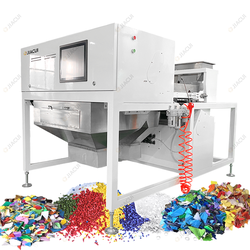


Most color sorter buyers in 2026 are not choosing between good machines and bad machines. They are choosing between platforms that look alike on a quotation and behave very differently on a factory floor. Two offers can carry the same headline tonnage and the same 99.99% accuracy line, yet one will pay for itself in a season and the other will quietly lose product every shift.
This guide is written for the person who has to sign the purchase order: a mill owner, a plant manager, a procurement engineer or an exporter preparing a line for a new contract. It walks through the seven decisions that actually determine whether a sorter earns its cost — platform, capacity, carryover, technology, total cost of ownership, sample testing and the RFQ — and finishes with the model map, common mistakes and the questions buyers ask most often.
Why 2026 is a different buying year
Four pressures have changed what a good sorter purchase looks like compared with five years ago. First, energy and compressed air are no longer trivial line items. A machine that is 1 kW heavier and 20% thirstier for air now shows up in the annual budget, especially where electricity has been deregulated. Second, labour is tighter: a sorter that needs a skilled operator to re-teach every lot is a hidden cost, while recipe-driven machines let one operator cover several lines.
Third, buyers audit more. Export contracts and retail supply agreements increasingly ask for measured reject data, traceable recipes and documented sample tests, not just a certificate on the wall. Fourth, material variety has grown. The same plant may run rice, pulses, coffee, nuts and seeds across a season, so a platform that only sorts one product well is a poor investment in 2026.
None of this makes the old rules wrong. It makes them stricter. Accuracy still matters, tonnage still matters, but carryover, recipe discipline and documented performance now decide the payback.
Six questions to answer before you shortlist a machine
- What exactly is the defect? Discoloration, shape, foreign material, glass, stone, bone, dense plastic or mould? A camera sees colour and shape; X-ray sees density. Write the defect list before you look at any model.
- What is your peak hour, not your average? The sorter must hold the busiest intake hour of the season. Average tonnage hides the bottleneck that stops the line when it matters most.
- What is the value of the accepts? A premium product justifies a higher carryover ratio; a low-value commodity justifies a lower-cost platform. The machine must be priced against the value of what it protects.
- What form and moisture does the product arrive in? Wet, sticky, dusty or fragile product changes the platform decision before the model decision.
- Who will run it, and for how many shifts? A single-shift small mill and a three-shift industrial line need different service plans, spares stock and training.
- What is the real installation envelope? Door width, aisle width, ceiling height, floor level, air drop and power location. These constraints eliminate more models than specifications do.
Step 1: choose the platform, then the tonnage
The platform is the first filter, and it is the one decision that cannot be fixed later by buying more channels. Chute, belt and X-ray each change how the product meets the sensor, and each suits a different kind of material.
| Platform | How the product is presented | Best for | Avoid when |
|---|---|---|---|
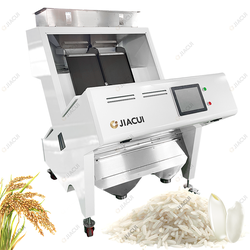
| Chute | Free-fall past fixed cameras at high speed | Rice, coffee, pulses, sesame, nuts, grains, seeds | Product is fragile, sticky or very coarse |
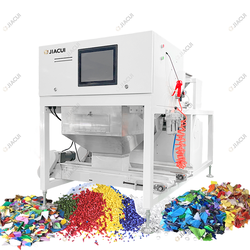
| Belt | Rides a conveyor under top-mounted cameras | Ore, quartz, plastic flake, large kernels, dried vegetables | Space or budget is tight and the product free-flows well |
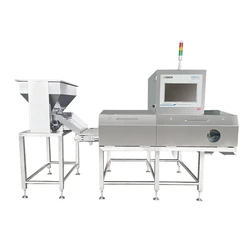
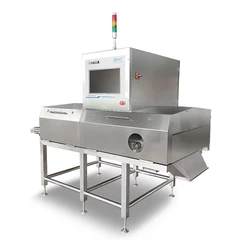
| X-ray | Density inspection through a shallow layer | Glass, stone, bone, dense plastic, stainless inside product | Defect already differs in colour and a camera is cheaper |
Within a platform, tonnage is set by channel count on a chute and belt width on a belt. A 64-channel chute and a 384-channel chute use similar cameras and valves; the difference is how many streams of product run under them in parallel. A 600 mm belt and a 1,200 mm belt use the same inspection approach; the difference is how wide a layer can be spread at a given speed.
This is why the question "what is your best price for 5 tonnes per hour?" has no useful answer. Five tonnes is reachable on several platforms, at different accuracy, different carryover, different footprint and different power. Give the platform and the material first, and the tonnage becomes a sizing calculation instead of a shopping comparison.
Step 2: size capacity from your peak hour
The nominal figure on a specification sheet is measured on clean, uniform, freely flowing material. Your plant will not run under those conditions every shift, so plan on a utilisation factor rather than the headline number.
A practical formula is: shift output = rated t/h × hours × utilisation, where utilisation accounts for changeovers, grade switches, cleaning and short stops. Most plants sit between 80% and 90%; use 85% unless you have measured your own line.
Worked example. A mill buys a machine rated 3.2 t/h and runs one eight-hour shift. Nominal shift output is 25.6 tonnes; at 85% utilisation the planning figure is 21.8 tonnes per shift. Over 300 working days that is about 6,500 tonnes a year. If the mill's peak intake is 4 t/h, the machine is undersized no matter how good its accuracy is, because the line will stop at the busiest hour of the harvest.
- Size for peak, budget for average. A machine sized for average intake will be idle most of the year and still fail in the peak week.
- Leave room for a re-run. If you plan to re-sort rejects in a second pass, that pass competes with the main flow for the same hours.
- Check the feed, not just the sorter. A conveyor, hopper or vibratory feeder that cannot deliver a steady single layer will cap the machine below its rating.
Step 3: read accuracy and carryover together
Accuracy describes how much contamination is removed. Carryover describes how much good product leaves with it. The two numbers must be read as a pair, because a machine can reach very high accuracy by ejecting aggressively and still destroy the value of the crop.
Carryover is normally written as a ratio, such as 10:1 or 20:1, meaning that for every ten or twenty rejected particles about one good particle is lost with them. The good-product share of the reject stream is therefore roughly 1 / (ratio + 1). At 10:1 that is about 9.1%; at 20:1 about 4.8%; at 120:1 about 0.8%.
Worked example. On 100 tonnes of feed with a 2% reject rate, the reject stream is 2 tonnes. At 10:1 carryover, about 0.182 tonnes of good product goes into the reject bin — 9.1% of the reject stream. At 20:1 the same 2 tonnes of reject carries about 0.095 tonnes of good product. The difference is roughly 87 kg per 100 tonnes of feed, or 5.7 tonnes a year on a 6,500-tonne line. On a premium product that difference is the payback.
| Carryover | Good product lost as share of reject stream | Good product lost per 100 t feed at 2% reject | Where this ratio is common |
|---|---|---|---|
| 10:1 | ~9.1% | ~182 kg | General-purpose rice and grain lines |
| 20:1 | ~4.8% | ~95 kg | Belt sorters on ore, plastic and premium product |
| 30:1 | ~3.2% | ~63 kg | Mid-range chute platforms on high-value beans |
| 120:1 | ~0.8% | ~17 kg | High-yield rice and coffee platforms |
Ask every supplier for both numbers on your own material. A quotation that lists accuracy but hides carryover is telling you only the half of the story that is easy to make look good.
Step 4: audit the 2026 technology checklist
Camera and valve technology has converged across reputable manufacturers, so the differences now sit in integration, stability and support. Use this checklist to compare offers on equal terms.
- Camera and lighting. Colour cameras with stable LED lighting, and near-infrared where defects differ in composition rather than colour. Ask how the lighting is thermally managed, because LED drift is a slow accuracy loss.
- Shape and texture processing. Modern software should sort on shape, length, width and texture as well as colour, which is what makes broken, chipped and irregular product sortable.
- Recipe management. Each product, grade and supplier lot should be a stored recipe with a name, not a set of settings re-taught from scratch. Recipe discipline is the difference between one operator and three.
- Ejector hardware. Fast, individually replaceable valves with a documented nozzle test on the touchscreen. A valve that can only be replaced as a block turns a minor fault into a line stop.
- Air efficiency. Documented air consumption at a stated reject rate. Air is often the second-largest running cost after labour, and "low consumption" without a number is marketing.
- Dust and moisture protection. A stated IP rating on the optical box and a real air-purge design. On spice, grain and mineral lines this is what sustains accuracy through a season.
- Connectivity and support. Remote diagnostics that can read the machine log, plus a named service route and a spares list with lead times. Ask what happens on a Sunday in harvest week.
- Safety and compliance. Documented electrical build to your destination voltage and frequency, guarding interlocks, and certificate copies you can put into a tender pack.
Step 5: build a total cost of ownership model
Purchase price is the smallest part of the decision on a machine that runs for a decade. Build a five-year model with the same line items for every offer, and force each supplier to fill the gaps.
| Cost line | What drives it | What to ask the supplier |
|---|---|---|
| Purchase and freight | Platform, channels or belt width, options, destination | Itemised quote, packing, insurance, unloading |
| Civil and installation | Frame weight, footprint, floor level, lifting access | Foundation drawing, lifting points, services schedule |
| Energy | Installed kW, utilisation, tariff | kW at rated configuration, annual kWh estimate |
| Compressed air | Nozzle count, reject rate, air pressure | Air consumption at a stated reject rate |
| Wear parts | Nozzles, filters, window, LED module, belt | Spares list with prices and lead times |
| Labour | Operator skill, recipe changes, cleaning routine | Training plan, recipe count, cleaning time |
| Yield loss | Carryover ratio and product value | Carryover measured on your sample |
| Downtime | Service response, spares stock, remote support | Response commitment and local stock |
Two lines dominate the model in most plants: yield loss and labour. A machine with a better carryover ratio can cost more up front and still be the cheaper purchase within one or two seasons, while a machine that needs a skilled operator to re-teach every lot can erase its price advantage in a single harvest.
Step 6: run a sample test before you negotiate
No serious supplier should ask you to buy from a brochure. A sample test is the only way to convert a specification into a number that applies to your material, and it should be run on the same platform you intend to buy.
Send 5–10 kg of representative product, not a hand-picked clean sample. Include the defect types you actually see, at the frequency you actually see them, and state the moisture and temperature at which the line runs. If your product changes across the season, send the worst lot, not the best.
A useful test report contains: the platform and model tested, feed rate and settings, measured reject rate, contamination remaining in the accepts, good-product loss in the reject stream, and a recommended configuration. Photographs of before and after are helpful, but the numbers are what belong in the purchase file. Ask for the report in writing so it can be attached to the PO and referenced if performance is disputed later.
If a supplier cannot run your sample, that is a signal about the after-sales relationship as much as about the machine.
Step 7: the RFQ checklist
A clean request for quotation gets comparable answers and shortens negotiation. Include every item below in the enquiry, and ask each supplier to answer point by point rather than sending a catalogue.
- Product name, form and grade, with photographs.
- Feed size range and moisture at the line.
- Peak tonnage per hour and shifts per day.
- Defect list, with the reject percentage you need to reach.
- Maximum contamination allowed in the accepts.
- Carryover expectation, stated as a ratio.
- Destination voltage, frequency and phase.
- Available compressed air pressure and capacity.
- Floor space, ceiling height and door width.
- Dust, wash-down and ambient temperature conditions.
- Required certificate copies for tender or audit.
- Spares kit and recommended stock on site.
- Commissioning scope and operator training.
- Warranty terms and service response commitment.
- Sample test offer, with the report format.
The 2026 JIACUI model map
Our range covers 16 to 768 channels on chute platforms, 300 to 1,200 mm belts, and dual-energy X-ray. The table below is a starting point, not a substitute for a sample test.
| Model | Platform | Capacity (t/h) | Typical duty | Page |
|---|---|---|---|---|
| CS-QB16 | 16-channel mini chute | 0.03 | Sample and lab trials | CS-QB16 |
| CS-1C64 | 64-channel chute | 0.5–1.0 | Small rice mill | CS-1C64 |
| CS-2A128 | 128-channel chute | 1.2–2.5 | Coffee and high-value beans | CS-2A128 |
| CS-3A | 192-channel chute | 2.5–4.0 | Mid-size rice mill | CS-3A |
| CS-6A | 384-channel chute | 5–9 | High-tonnage rice | CS-6A |
| CS-10C | 640-channel chute | 7–10 | Industrial rice line | CS-10C |
| CS-LA600 | 600 mm belt | 2.5–6 | Ore and plastic flake | CS-LA600 |
| CS-LA1200 | 1,200 mm belt | 5–12 | Plastic recycling | CS-LA1200 |
| CS-XCA60 | 620 mm X-ray belt | 1–6 | Glass, stone and dense plastic | CS-XCA60 |
Compare all platforms on the model overview page, and see measured results in the case studies and machine videos.
Five buying mistakes that cost the most
- Buying tonnage without a platform. Comparing 5 t/h offers across chute, belt and X-ray is comparing three different jobs. Fix the platform first.
- Sizing for the average week. The machine fails in the peak, which is the only week that sets the year's revenue.
- Ignoring carryover. A cheap machine with a low ratio can cost more in lost product than the price difference, every season.
- Testing on the wrong sample. A clean, dry, hand-picked sample flatters every machine and predicts nothing about your real lot.
- Buying without a services plan. Nozzles, filters and a window are consumables. A machine with no local spares and no remote support turns a minor fault into a week of downtime.
Frequently asked questions
How much does a color sorter cost in 2026?
There is no single answer because the price is set by platform, channel count or belt width, options and destination. A mini lab chute and an industrial 640-channel line are different categories of machine. Ask for an itemised quotation and compare the same scope across suppliers; a single lump-sum figure usually hides a different service and spares package.
How long is delivery and installation?
Standard models generally ship faster than custom belt widths, frame heights and destination-voltage builds, and the exact date is confirmed on the order. Installation and commissioning of a single machine is normally one to two days once the floor, power and air are ready; a full line with conveyors takes longer because the feed and outfeed must be balanced first.
Can I test my own material before buying?
Yes. Send 5–10 kg of representative product, including the defects you actually see, and we run it on the intended platform and return measured accuracy, reject rate and carryover. This is the step that turns a specification into a decision.
Is a chute sorter or a belt sorter better?
Neither is better in general. A chute suits free-flowing grain, coffee, beans and seeds and gives the lowest cost per tonne. A belt suits ore, plastic flake, fragile and coarse product, where a stable trajectory and gentle handling matter more than speed. Choose by material, not by price.
Do I need X-ray as well as an optical sorter?
Only if your defect has no colour or shape signature — glass, stone, bone, dense plastic or stainless steel. Many food lines run an optical sorter first and an X-ray machine last. If a camera can see the defect, an X-ray machine is an unnecessary cost.
What should be in the warranty and service agreement?
Coverage period and what is excluded, response time, whether remote diagnostics is included, and the spares list with lead times. Ask specifically what happens during harvest week and who pays for travel. A warranty that reads well but has no local route is a warranty on paper only.
Conclusion: buy the platform, prove the numbers, then negotiate
The 2026 buying process is not complicated, but it is unforgiving of shortcuts. Choose the platform from the defect and the material. Size the capacity from the peak hour. Read accuracy and carryover as one number pair. Build a five-year cost model instead of comparing sticker prices. Prove the machine on your own sample. Then negotiate, with a written test report on the table.
If you want a starting point, send 5–10 kg of your product and we will return a measured report and a recommended platform, whether or not it is one of ours. See the certifications and compliance page for the documents we can put into a tender pack, and the short selection guide for a one-page version of this process.