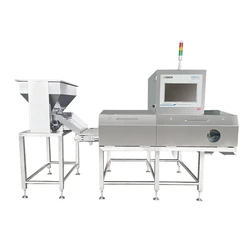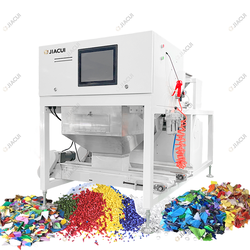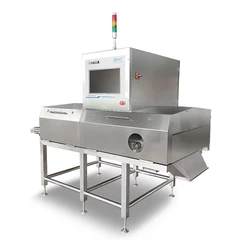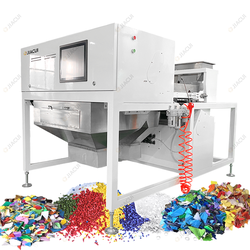


A color sorter machine costs US$5,000 to US$38,000 FOB China in 2026. The number is set by platform, channel count or belt width, camera and ejector specification, and the tonnage you need to hold. A six-channel entry chute for a small mill starts near US$5,000, while a dual-layer belt or an X-ray unit reaches US$38,000. Price per tonne of throughput explains more than the sticker price. Not sure which materials a sorter handles? See color sorter machine uses.
Price by machine type and capacity
The table below gives indicative 2026 price ranges, FOB China, for chute, belt and X-ray platforms. Capacity assumes free-flowing product at nominal settings. Sticky, wet or fragile material lowers throughput, and a difficult defect specification pushes any quotation toward the top of its band.
| Machine type | Models | Capacity | Indicative price (FOB China) |
|---|---|---|---|
| 64-96 channels | CS-1A64 / CS-1C80 / CS-1C96 | 0.8-2 t/h | US$5,000-7,500 |
| 160-192 channels | CS-2C160 / CS-3A-192 | 2-4 t/h | US$7,000-12,000 |
| 256-320 channels | CS-4C / CS-5C | 4-6 t/h | US$12,000-16,500 |
| 384-448 channels | CS-6A-384 / CS-6C-384 / CS-7C-448 | 6-9 t/h | US$17,000-24,000 |
| 512-768 channels | CS-8C-512 / CS-10C-640 / CS-12C-768 | 9-20 t/h | US$23,000-37,000 |
| Belt 300-600 mm | CS-LA300 / CS-LA600 | 1.2-6 t/h | US$9,000-20,000 |
| Belt 1200-1800 mm | CS-LA1200 / CS-LA1200D | 5-12 t/h | US$26,000-38,000 |
| X-ray | CS-XCA40 / CS-XCA60 / CS-XCB20 / CS-XCB30 | Inspection | US$25,000-38,000 |
Chute models use gravity instead of a conveyor, so they cost less at the entry tonnage. Belt models add a frame, tracking and drive, while X-ray units add a radiation source and shielding.
Price per tonne of throughput
Sticker price hides the real comparison. Divide the quotation by the tonnes per hour the machine will actually hold, then check what that capacity costs over its service life.
Worked example. A CS-LA600 belt sorter quoted at US$18,000 with a nominal 4 t/h works out at US$4,500 per tonne of hourly capacity. On one eight-hour shift at 85% utilisation it moves about 27 tonnes a day, or roughly 8,160 tonnes a year over 300 days. Spread over five years, the capital cost is about US$0.44 per tonne sorted.
Compare like with like: same product, same defect target, same utilisation and same annual hours. A cheap machine that runs at 70% of its rated tonnage is more expensive per tonne than a dearer machine that holds its rating.
Why two quotes for the same tonnage can differ three times
Two suppliers can both offer 5 tonnes per hour and still be three times apart. The gap is rarely one item; it is a stack of specification decisions that are easy to leave out of a headline price.
- Channels and streams. More channels mean more parallel streams and therefore more cameras, nozzles and processing; a 96-channel and a 384-channel machine are different products.
- Camera count and resolution. Two cameras per side see less of the stream than four or six, and lower resolution limits the smallest detectable defect.
- Ejector valves and nozzle count. High-speed, individually replaceable valves with a documented nozzle test cost more than a block swapped as a unit; valve count scales with channels and belt width.
- Air consumption. A machine that uses 20-30% less air at the same reject rate reduces compressor size and running cost, and that efficiency is priced in.
- Build quality. Frame stiffness, food-grade contact parts, IP-rated optical boxes and LED thermal management decide how long accuracy holds in a dusty plant.
- Brand components and support. Cameras, valves, PLC, touchscreen and service route all carry a price; local spares stock and remote diagnostics are part of the quotation even when they are not a line item.
When a quote is much cheaper, ask which of these six was reduced. The answer usually shows in the valve count, camera count or service commitment.
What is not in the price
Every range on this page is FOB China, so the machine is priced at the port. Budget separately for:
- Freight and insurance. Sea freight, inland haulage, port charges and insurance vary by route, container size and season.
- Import duty and clearance. Duty rates, VAT or GST, broker fees and certificate costs depend on your destination and tariff code.
- Installation and commissioning. Lifting, foundation work, electrical connection, commissioning and operator training are usually quoted separately.
- Air compressor and dryer. A sorter needs clean, dry, pressurised air; a suitable compressor and dryer can add US$3,000-8,000 when they are not bundled; our standard chute and belt quotations include a matched compressor, dryer and air tank.
- Spare parts and consumables. Nozzles, filters, window glass, LED modules and belts are wear items. A first-year spares kit is a line item, not a gift.
- Voltage adaptation and civil works. Transformers, cabling, flooring and access openings are site costs that no FOB quotation covers.
Add these before you compare quotations. A machine that looks 20% cheaper can lose that advantage once landed cost and installation are included.
How to compare two quotations
Put both offers on one sheet and make each supplier answer the same six points; treat a blank as a risk, not a saving.
- Scope and model. Exact model, platform, channel count or belt width, and every option included or excluded.
- Measured performance. Accuracy, reject rate and carryover on a named product, ideally your sample, at a stated feed rate.
- Utilities. Installed kW, air consumption at a stated reject rate, and required air pressure and quality.
- Landed cost. FOB price plus packing, freight, insurance, duty, installation and training, shown as separate lines.
- Spares and service. Spares list with prices and lead times, warranty terms, response time and remote diagnostic access.
- Delivery and payment. Confirmed lead time, shipment date, deposit percentage, balance trigger and accepted payment method.
| Check item | What to compare | Red flag |
|---|---|---|
| Scope and model | Exact model, platform, channels or belt width, options | Equivalent model with no model number |
| Measured performance | Accuracy, reject rate and carryover on your sample | Brochure accuracy with no carryover figure |
| Utilities | Installed kW, air consumption, pressure and quality | Low air use with no number |
| Landed cost | FOB plus freight, insurance, duty, installation, training | A single lump sum with no breakdown |
| Spares and service | Spares prices, lead times, warranty, response time | No local route or spares stock |
| Delivery and payment | Lead time, shipment date, deposit and balance terms | Vague date or full payment before shipment |
Payment, lead time and warranty norms
Standard terms in the category are a 30% deposit with the balance before shipment, or a letter of credit for larger orders. Custom belt widths, special voltages and dual-layer builds usually carry a higher deposit. Treat any request for full payment before production as a warning sign unless you have a long relationship or a secure payment instrument.
Lead time is commonly 15-30 days for standard chute models and 30-60 days for belts, X-ray units and custom builds, followed by 20-45 days of sea freight. Add clearance and inland delivery at your end. Ask for the lead time in writing with the order.
Warranty is normally 12-24 months on the machine, with wear parts excluded. A useful warranty names the response time, says whether remote diagnostics is included, lists the spares covered and states who pays travel and labour.
How to get a real number
Published ranges are a budget tool, not a quotation. To convert a range into a price for your plant, send 5-10 kg of representative material including the defects you actually see, and state your peak tonnage, destination voltage, air pressure and floor space.
A proper sample test returns measured accuracy, reject rate, carryover and a recommended configuration on the platform you intend to buy. That report makes two quotations comparable and belongs in the purchase order. Buyers in India, Pakistan and Sri Lanka can use the same process; only freight, duty and voltage change.
Start with the model overview to fix the platform, read the 2026 buying guide for specification detail, and review measured results in the case studies. Then request an itemised quotation, not a single figure.
Disclaimer: all prices on this page are indicative China-level, EXW China including delivery to the port (excluding tax, sea freight, duty and installation) ranges for 2026, excluding freight, duty and installation. An actual quotation depends on material, capacity, voltage and configuration.
Frequently asked questions
Why do two suppliers quote very different prices for the same capacity?
Headline tonnage hides specification. One quote may use fewer cameras, a lower valve count, a lighter frame or a shorter warranty, and it may leave out installation, spares or air preparation. The three-times gap usually comes from several small omissions stacked together. Compare the model, measured carryover, installed kW, air consumption and service scope before you compare the number. A supplier who cannot explain the difference in writing is not offering the same machine.
What are the risks of buying the cheapest machine?
The cheapest offer usually saves on the parts that decide long-term cost: cameras, valves, air efficiency and build quality. It may also arrive without local spares or remote support, so a blocked nozzle becomes a stopped line. Lower accuracy or poor carryover then loses product every shift, and that loss often exceeds the price saving within one season. The cheapest machine is only cheap if it holds its rating on your material for years.
Are shipping and import duty included in these prices?
No. Every range here is FOB China, so it covers the machine at the port but not the journey. Freight, insurance, import duty, VAT or GST, clearance fees, inland haulage, installation and commissioning are extra. They vary widely by destination, container size and tariff code. Ask each supplier for a landed-cost sheet with these lines separated, then compare the total. Otherwise a lower FOB price can still be the more expensive purchase.
Is price per tonne a better way to compare machines?
Yes, when the inputs are equal. Divide the quotation by the tonnes per hour the machine holds on your product at your utilisation, not the brochure figure. Then annualise over the hours you actually run. This exposes machines that are cheap per unit but expensive per tonne because they cannot sustain their rating. Use the same product, defect target and shift pattern for every offer, and add air and power cost before you decide.
Should I buy a used color sorter instead of a new one?
A used machine can cut capital cost, but it brings unknown valve and camera life, an older control platform and limited spares. Inspect the optical box, run a sample test, check the valve count and confirm that nozzles, filters and LED modules are still available. If the machine cannot be tested on your material, treat the discount as compensation for risk. For a line that runs every day, a new mid-range unit with warranty and support is often the cheaper five-year decision.