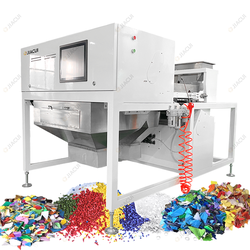


A color sorter machine separates granular material by colour, shape and material difference. Cameras inspect each particle as it falls down a chute or travels on a belt, and high-speed air jets knock out the pieces that fail your standard. The same principle covers grains, pulses, nuts, seeds, tea, spices, coffee, plastics, minerals and seafood, so one machine family serves many industries. What changes is how the product is fed, which optics are used and which defect you are removing.
Buyers usually arrive with one question: can this machine sort my material? The sections below answer that material by material, then explain how to match a platform to your product. Indicative budgets sit in the color sorter price guide, and the full range is on the product overview.
Grains and pulses
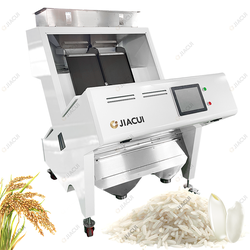
Rice is the largest application. A chute sorter removes yellow kernels, chalky grains, red rice, stones and glass from milled or brown rice at 3-12 t/h depending on width. Wheat and corn lines use the same platform to take out ergot, fusarium-damaged kernels, cob pieces and foreign seeds before milling. Pulses such as lentils, chickpeas, mung beans and soybeans are sorted for discoloured seed, split halves, mud balls and stone.
The defect list matters more than the headline tonnage. A line that only removes stones needs a different sensitivity setting from one that must reach an export colour standard, and the second case usually needs a second pass. Our grain sorting page covers rice, wheat, corn and pulse configurations in more detail.
Nuts, kernels and seeds
Peanuts, cashews, walnuts, sunflower kernels, pumpkin seeds and sesame are sorted for shell fragments, skins, mould, discoloured kernels and foreign material. Whole-kernel retention is the number that decides whether the investment pays: a belt sorter with a wide, gentle feed protects the product better than a chute, because kernels do not tumble against each other on the way to the camera.
For cashew and walnut lines, belt platforms also handle the larger particle size and give the operator a clear view of the stream. See the nut and kernel page for belt widths and typical throughput by product.
Tea, spices and dried products
Tea sorting removes stems, fibre, yellow leaves and foreign matter from green, black and oolong grades; the same machines handle dried chili, pepper, Sichuan pepper, star anise, cumin and dried herbs. These products are light, dusty and irregular, so a belt feed with a low-drop transfer reduces breakage and keeps dust away from the optical box.
Colour alone is not always enough, because stems and leaf can be close in tone; shape and texture grading earn their place here. Our tea sorting page shows the settings used for leaf grade and for dried spice blends.
Coffee and cocoa
Green coffee is sorted for black, sour, insect-damaged and faded beans, plus sticks, stones and husk. Cocoa beans and nibs are sorted for mould, slaty beans and shell. A defect that looks identical in colour but differs in density or internal structure will not be caught by a camera, which is where an X-ray unit becomes relevant.
Specialty buyers often ask for a two-pass flow: colour first, then a second pass on the reject stream to protect the good-bean yield. The coffee bean page covers belt and chute options for green and roasted product.
Plastics and recycling
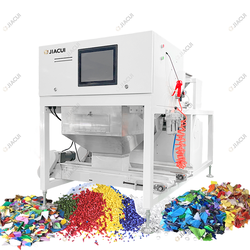
PET bottle flake, HDPE, PP, PS and mixed rigid scrap are sorted by colour and polymer. Typical targets are black specks, off-colour flake, labels, caps and foreign plastic; near-infrared sensors added to the same frame separate polymer type. Flake flows fast and carries static, so feed consistency and clean air decide accuracy more than camera resolution.
Capacity is usually quoted in tonnes of flake per hour, and a wash line upstream changes the economics completely. Our plastic sorting page sets out flake and regrind configurations.
Minerals and industrial materials
Quartz, feldspar, limestone, barite, salt, garnet and some ores are sorted for colour difference: dark inclusions, iron staining, clay lumps and contrasting waste rock. Coarse material above roughly 10 mm runs well on a belt; finer grades need a chute with a controlled feed and careful dust management.
Colour sorting cannot separate two minerals of the same appearance. When the difference is density or atomic structure rather than colour, an X-ray sorter is the correct tool, because it reads transmission through each particle and rejects by density contrast. The mineral sorting page covers both approaches for salt, quartz and ore.
Seafood and processed food
Shrimp, dried fish, frozen vegetables and fried snacks are checked for shell, foreign matter, burnt pieces and discoloured product. Belts are standard here because the product is fragile and often wet; washdown construction and food-grade contact parts matter more than raw tonnage.
Uses at a glance
The table summarises the platform that fits each material family. Capacities are indicative for free-flowing product at nominal settings; wet, sticky or fragile material reduces throughput.
| Material | Typical defects removed | Recommended platform | Typical capacity |
|---|---|---|---|
| Rice, wheat, corn, pulses | Yellow grains, chalky kernels, stones, glass, foreign seed | Chute | 3-12 t/h |
| Peanuts, cashews, seeds | Shell, skin, mould, discoloured kernels | Belt | 0.5-4 t/h |
| Tea, chili, spices | Stems, fibre, yellow leaf, foreign matter | Belt | 0.3-2 t/h |
| Coffee, cocoa | Black, sour and insect-damaged beans, sticks, stones | Chute or belt | 0.5-5 t/h |
| PET, PP, PE flake | Off-colour flake, black specks, labels, caps | Belt or wide chute | 1-6 t/h |
| Quartz, feldspar, salt | Dark inclusions, iron staining, clay lumps | Belt, X-ray for density | 2-20 t/h |
| Shrimp, dried seafood | Shell, burnt pieces, foreign matter | Belt | 0.5-3 t/h |
How to choose the right platform for your material
Three platforms cover almost every case, and the choice follows from the product rather than from the price list. As a budget guide, an entry chute machine starts near US$5,000 FOB China, while a large dual-layer belt or an X-ray unit reaches about US$38,000, excluding tax, sea freight, duty and installation.
- Chute. Gravity feed for free-flowing, uniform particles from about 0.5 mm to 10 mm: rice, seeds, pulses, small plastic flake and fine minerals. Lowest cost per tonne and the highest throughput per metre of width, but the product tumbles and can break.
- Belt. A flat conveyor holds large, irregular, fragile or sticky pieces: nuts, tea, coffee, seafood and coarse mineral. Seen from above, the product presents a stable face to the camera and breakage drops, at a higher price and lower tonnage per metre.
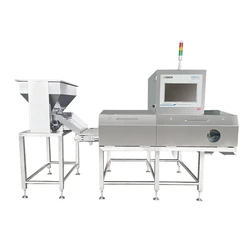
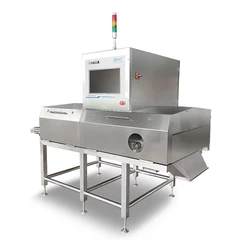
- X-ray. Needed when the defect is invisible to a camera: stones inside nuts, plastic mixed into food, density differences in ore. It complements colour sorting rather than replacing it.
If you are still unsure, the comparison of chute, belt and X-ray platforms walks through feed behaviour, defect type and cost per tonne side by side.
What a color sorter cannot do
A colour sorter sees the surface. It cannot remove a foreign body that is the same colour, shape and texture as the good product, such as a clear plastic fragment in white rice or a stone that matches the mineral around it. Internal defects, from mould inside a nut to an insect larva in a bean, stay invisible without X-ray or another inspection method.
Very fine powder, below roughly 40-60 mesh, is also a poor fit: particles are too small to be resolved individually and dust fouls the optics. Wet or sticky product that bridges in the feed is another limit, and it must be dried or mechanically dewatered first. Finally, a sorter cannot fix a feed that arrives in surges; steady, metered flow is part of the machine's performance, not an accessory to it.
Customs classification and import documentation are a separate question from sorting performance, and the HSN code guide explains how these machines are classified.
Test your material before you decide
Every material behaves differently, and no brochure can predict your yield. Send 5-10 kg of representative product, including the defects you actually see, and state your target tonnage, voltage and available air pressure. A sample test returns measured accuracy, reject rate and carryover, plus a recommended platform and an itemised quotation, which is the only basis on which two offers can be compared.