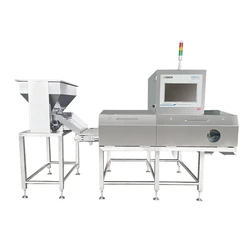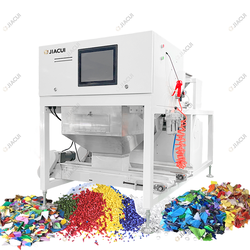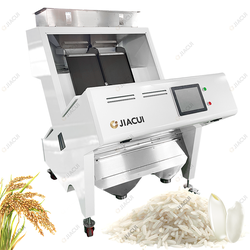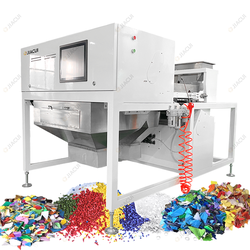


A mini rice color sorter is the smallest machine that still does a real production job: usually 64 to 96 channels, 0.8 to 1.5 tonnes per hour, and a footprint that fits a single bay in a small mill. Buyers search for the price first, so here is the honest 2026 range, what moves it up or down, and the capacity checks that stop a mini machine from becoming a bottleneck.
What "mini" means in rice sorting
In the Chinese manufacturing market, mini covers the 64-channel, 80-channel and 96-channel chute machines. They use one or two cameras, 64 to 96 ejector valves per chute bank, and a 2.2 to 4 kW total load. Throughput depends on the material and the number of passes:
| Model class | Channels | Paddy / brown rice | Parboiled or glutinous | Typical use |
|---|---|---|---|---|
| Mini entry | 64 | 0.6-0.9 t/h | 0.5-0.8 t/h | Farm mill, sample room |
| Mini standard | 80 | 0.8-1.1 t/h | 0.7-1.0 t/h | Small commercial mill |
| Mini top | 96 | 1.0-1.5 t/h | 0.9-1.2 t/h | Second pass, specialty rice |
These figures assume a single pass and normal moisture. If you need a clean second pass after a larger sorter, or you are sorting basmati to export purity, derate by 20-30 percent.
Mini rice color sorter price in 2026
For a standard configuration, EXW China, the range is US$5,000 to US$7,500 for 64 to 96 channels. That band covers a complete machine with cameras, ejectors, air preparation, touch screen and a basic spare-parts kit. It does not include sea freight, import duty, installation or a local service visit.
Three things move the number inside that band:
- Channel count and valve quality. A 96-channel machine with high-speed valves costs more than a 64-channel machine with standard valves, and the difference shows up in carryover and air consumption.
- Camera set. A single visible-light camera is the entry configuration. Adding a second camera or a near-infrared channel for subtle defects adds cost but changes what the machine can remove.
- Build and options. Stainless contact parts, a belt feed, a dust extraction hood, a voltage variant or a custom frame height all add to the quote.
A mini machine at US$5,000 and one at US$7,500 are not the same product. Ask for the valve count, camera count, measured carryover on your sample and the spare-parts list before you compare the two numbers. The color sorter price page shows how the same logic scales to 160-768 channels.
Where a mini sorter actually fits
Mini machines are not scaled-down versions of a 10 t/h line. They win in five situations:
- Single-pass cleanup in a farm or village mill processing under 20 tonnes a day, where a 192-channel machine would run empty most of the shift.
- Second-pass polishing after a larger sorter, where the feed is already clean and only a small volume needs re-sorting.
- Specialty and premium rice such as organic, aromatic or gift-pack lots, where batches are small but the defect standard is strict.
- Seed rice, where the volume is low and the value per tonne is high.
- Sample rooms and demonstrations, where the machine must show a result on 20-50 kg without a full production line.
If your daily volume is above 40 tonnes, a mini machine becomes the bottleneck and the payback arithmetic changes. The small rice mill selection guide covers the 2-5 t/h step, and the rice mill layout page covers 6-20 t/h lines.
Mini vs 160-192 channels: the real price step
The next size up, 160 to 192 channels, runs US$7,000 to US$12,000 and roughly doubles throughput. That is a small price step for double the capacity, which is why mills often skip mini entirely. Mini makes sense when one of these is true:
| Question | Choose mini if... | Choose 160-192 if... |
|---|---|---|
| Daily paddy volume | Under 20 t | 20-60 t |
| Sorting role | Second pass or specialty lots | Main production sorter |
| Power available | Single-phase or limited 3-phase | Stable 3-phase supply |
| Floor space | One bay, tight layout | Room for a full chute bank |
| Growth plan | Stable small volume | Expect volume to grow |
Power, air and floor space
A 64-96 channel rice sorter needs 2.2-4 kW of power, 0.6-1.0 m³/min of clean dry air at 0.6-0.8 MPa, and a footprint of roughly 1.6 x 1.2 m including the feed hopper. Air quality matters more than most buyers expect: water and oil in the line will block valves and cause false rejects within weeks. Budget for a refrigerated dryer and a three-stage filter if the mill does not already have one.
Single-phase power is available on some mini models, which is often the deciding factor for farm mills without a three-phase connection. Confirm the voltage and phase before ordering, and ask for the model's nameplate photo rather than a generic datasheet.
What to check before you pay
- Test report on your rice. Send 2-5 kg of your paddy or brown rice. A supplier who will not run a sample and report carryover is selling a box, not a result.
- Valve count and brand. Ask how many ejectors per chute and whether they are serviceable individually.
- Camera resolution and lighting. 5,400 or 7,000 pixels per scan line is the current norm for mini machines.
- Spare parts. Nozzles, filters, camera glass and a valve driver board should be available for at least five years.
- Warranty scope. Clarify whether it covers valves, cameras and boards, and who pays the courier.
- Support channel. Remote diagnostics over video call is realistic for a mini machine; a local engineer visit usually is not.
Model pages for the mini range: CS-1C64, CS-1C80 and CS-1C96. All three share the same frame and differ in chute count, so the price difference between them is straightforward.
Frequently asked questions
How much is a mini rice color sorter in 2026?
US$5,000 to US$7,500 EXW China for 64-96 channels, depending on camera set, valve quality and options. Sea freight, duty and installation are extra.
How many tonnes per hour can a mini sorter clean?
0.6-1.5 t/h of paddy or brown rice in a single pass, depending on channel count and material. Derate 20-30 percent for parboiled rice, glutinous rice or export-grade second passes.
Can a mini sorter run on single-phase power?
Some 64-channel models can. Confirm the exact model and voltage with the factory, because the same frame may be offered in 220 V single-phase and 380 V three-phase versions.
Is a mini sorter enough for a 2 t/h rice mill?
Only as a second pass. A 2 t/h continuous line needs roughly 160-192 channels to keep up; a mini machine would force the line to wait.
What sample size should I send for a test?
2-5 kg is enough for a mini machine test. Include a note on the defect you care about most, such as chalky grains, yellow tips, paddy or stones.
Send 2-5 kg of your rice with the defect you want removed. We will return the sorted sample, the measured carryover and a quotation for the model that matches your volume. Start from the rice and grain color sorter page or the price page.