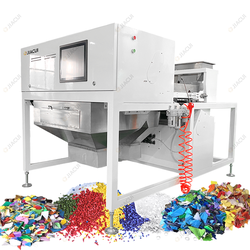


A rice mill should choose a color sorter by tonnes per hour first, then by the defect load in its incoming rice and the grade it must ship, and only then by channel count and model. Hourly tonnage and target grade decide everything else. This page covers where the sorter belongs in the mill flow, how to size it, what it removes, the layout and utilities it needs, a conservative payback example, and what to expect at installation.
Where the sorter sits in a rice mill
A rice mill runs a fixed sequence: pre-cleaning and destoning, husking, milling, polishing, color sorting and packing. The sorter sits after polishing and before the packing line, so it sees milled rice at its final appearance. Bran, husk and broken kernels are removed upstream by aspirators, destoners and graders, which is why the sorter should not be asked to do their job.
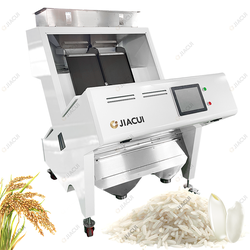
Most mills run the sorter in one or two passes. The head pass handles the full product stream and ejects discolored and foreign grain at line capacity. A re-sort pass runs only on the rejects, which is a much smaller stream, and returns good kernels to the product. A single pass suits clean domestic rice; a head-and-re-sort arrangement suits export grades, parboiled rice and lots with a heavy defect load. The same logic applies across the rice and grain color sorter range.
Sizing by throughput
Size from the hour, not the season. Take daily finished output, divide by the hours the sorter actually runs, and add headroom for the peak hour. A mill producing 100 tonnes of milled rice a day over two 10-hour shifts averages 5 t/h, but the sorter must carry that stream plus re-sorted rejects, and trucks arriving together push peaks higher. In practice a 100 t/day mill is normally fitted with 8–12 t/h of sorting capacity.
Confirm that figure on your own lot before ordering. Published capacity assumes milled rice at a normal reject rate; a dirty lot with 5% rejects needs a bigger machine than a clean lot at 1%.
| Mill scale | Sorting capacity | Typical model |
|---|---|---|
| Small, single shift (about 40–60 t/day) | 2–4 t/h | CS-3A-192, 2.5–4.0 t/h, 192 channels |
| Medium (about 100–160 t/day) | 6–10 t/h | CS-10C-640, 7–10 t/h, 640 channels |
| Large (about 200–320 t/day) | 12–20 t/h | Two CS-12C-768 frames at 8–12 t/h each, or one plus a CS-6A-384 on re-sort |
Prices for these frames sit inside the general color sorter machine price range of US$5,000–38,000 FOB China. A 256–448 channel rice machine commonly falls between US$12,000 and US$24,000, excluding tax, sea freight, duty and installation.
What it removes from rice
The sorter handles what graders cannot: yellow and discolored grains, chalky kernels, kernels with disease spots, dark or burnt grains in parboiled rice, stones and glass of similar size, other-color grains and foreign seed. Current cameras read shape and texture as well as color, so a badly broken or insect-damaged kernel can be rejected on more than its hue alone.
Two numbers decide whether the machine earns its place. Head rice yield, the share of whole kernels in the finished lot, is the mill's main value driver because broken rice sells at a lower grade. Carryover ratio is the mass of good grain ejected with each unit of defect: a higher ratio means fewer good kernels are lost removing the same contamination. Rice-focused frames are specified above 10:1 and often above 120:1, which is why a second pass pays on premium grades.
Layout and utilities
Floor space follows the frame, not the tonnage. A 192-channel unit such as CS-3A occupies roughly 1.6 × 1.5 m and needs 2–3 m² with access doors open; a 384–768 channel frame runs 2.6–4.7 m long and needs 4–6 m². Leave 1–1.5 m of clear service space, 1 m above the hopper, and a door at least 1.2 m wide on the route in.
Air, dust and power cause most of the delays. The sorter needs dry, oil-free compressed air at 0.6–0.8 MPa; consumption rises with reject rate, so add a dryer and receiver tank instead of sharing a wet line with the mill. Extract dust at the feed and bagging points and keep the sorter intake away from them. The standard build is 380 V three-phase 50 Hz, with other voltages to order, drawing roughly 2.6 kW on CS-3A up to 7.5 kW on CS-12C before the compressor. Mount the frame on a level concrete floor and isolate it if milling equipment nearby transmits vibration.
Payback math
Payback is a subtraction, not a promise. Worked example with illustrative figures only: a mill sorting 18,000 t of milled rice a year, a US$120/t gap between head rice and broken, a 7–10 t/h machine installed at about US$22,000, and two hand-picking staff at US$150 a month.
- Half a point of head rice recovered: 90 t × US$120 = US$10,800 a year.
- Hand-picking labour released: 2 × US$150 × 12 = US$3,600 a year.
- Combined benefit near US$14,400 a year, before any premium for cleaner export lots.
That is a simple payback of roughly 18 months on this example. Substitute your own tonnage, grade gap and local wages. A mill running a clean lot or selling one domestic grade will recover more slowly; a mill losing export orders to defect levels will recover faster.
Installation and operator training
Delivery, unloading and rigging are arranged with your site team, and the frame is positioned and levelled to the layout drawing. Our engineers then connect power, air and dust extraction, commission the machine on your rice, teach recipes for each variety and grade, and train operators on cleaning, nozzle checks and routine fault-finding. Timing depends on site readiness, model and travel, so the schedule is confirmed per project rather than quoted as a fixed number of days. Remote support covers recipe adjustments and most diagnostics after handover.
Choosing between chute and belt for rice
Rice is small, free-flowing and uniform, which is exactly what a chute machine is designed for: high capacity per square metre of floor and a simple gravity feed. Belt platforms are built for large or fragile items that must not fall, and X-ray frames for internal defects cameras cannot see. For milled rice the default is a chute sorter; for the full comparison read chute vs belt vs X-ray color sorters.
For a compact mill, the small rice mill sorter guide covers the 2–4 t/h case in detail, the applications overview shows where rice sits against other materials, and buyers comparing suppliers can start from color sorter manufacturers in India and the full model range.
Frequently asked questions
How many tonnes per hour can one rice color sorter handle?
Nominal capacity runs from about 2.5–4 t/h on a 192-channel frame such as CS-3A-192, through 7–10 t/h on CS-10C-640, to 8–12 t/h on CS-12C-768. These are milled-rice figures at a normal reject rate; confirm them with a sample test at your own defect load.
Do I need one sorting pass or two?
One head pass is enough for clean domestic rice. A second pass on the rejects is worth it for export grades, parboiled rice and lots with heavy discoloration, because it recovers good kernels and lowers carryover. The re-sort stream is small, so a smaller frame can handle it.
What air and power supply does a rice sorter need?
Dry, oil-free compressed air at 0.6–0.8 MPa, sized for your reject rate, plus a dryer and receiver tank. Power is normally 380 V three-phase 50 Hz, built to order for other supplies, drawing 2.6–7.5 kW depending on frame, before the compressor.
What does a color sorter for a rice mill cost?
US$5,000–38,000 FOB China across the range, with 256–448 channel rice machines commonly at US$12,000–24,000. That excludes tax, sea freight, duty and installation.
Send 2–5 kg of your rice with the defects you actually see, and we will run it on the model we propose and report the measured results before you commit. Request a sample test and a written model recommendation →