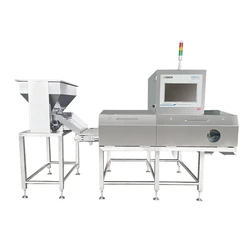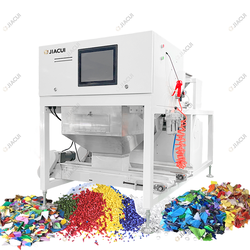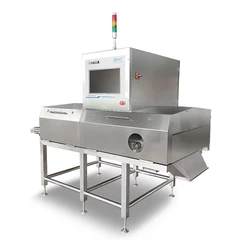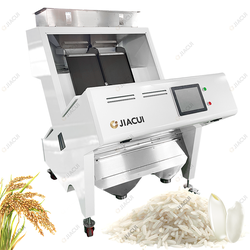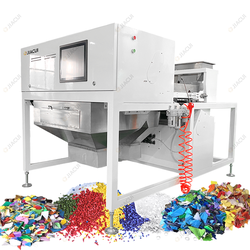


India has local assemblers and traders, but the machine itself is usually built in China. Trading houses in Coimbatore, Delhi and Mumbai resell imported units, and small workshops assemble imported optical modules into local frames. The camera, ejector bank, feed system and sorting software that decide sorting quality come from a limited number of Chinese factories, many of them in Henan around Zhengzhou. The first question about a quotation is therefore not the price but what the seller is: factory, trading company or rebadger. The three quote differently and carry different risk.
Who actually builds the machine
A factory designs the frame, writes the software and calibrates optics and ejectors in house. A trading company buys from one or more factories and resells, sometimes with local stock and paperwork support; useful, but it adds no engineering. A rebadger buys a finished machine, fits its own nameplate and calls it local manufacture, so the buyer never sees the real factory, spare parts list or warranty terms.
Four checks separate them without a factory visit.
- Factory video. Ask for a live walk-through rather than a marketing clip: the assembly hall, the calibration bench where cameras and ejectors are set, and packing. If no bench exists in the building, the machine is not made there.
- Workshop photos. A factory can photograph your frame at each stage with a dated marker; a trader sends stock images that appear in other catalogues.
- Model naming. A real range follows one scheme; our CS- series reads as platform, chute or belt, channel count and layer. A catalogue that mixes unrelated naming was assembled from several suppliers.
- Spare parts list. Ask for nozzles, filters, ejector valves, LED modules and optical windows with part numbers, prices and lead times. A seller who cannot price a nozzle does not hold the parts list.
What Indian buyers usually compare
An Indian quotation and a factory quotation rarely share a scope. Four items decide the comparison.
- Price. Insist on a fixed FOB price for a named model and configuration, not a range for a product family, so that two offers line up channel for channel.
- Spare parts. A local dealer may hand over a nozzle the same week; a factory ships by air. What matters is whether both can name the part, price it and state a lead time.
- Service response. Clarify who answers a breakdown call, in which language and hours, and whether the answer is a diagnosis or a visit.
- Clearance. Someone must own the IEC, the broker and the document set; a machine stuck at port costs more than a slightly higher price.
Sorting performance is the fifth item and the one a price list cannot show: send the same sample to both sellers and compare measured results on the material you actually run.
Shipping and clearance to India
Most machines for Indian mills ship through Nhava Sheva (JNPT), Chennai or Mundra. Ocean transit is similar across the three; the port changes inland freight and your broker more than the sea leg.
The standard set is a commercial invoice, packing list, bill of lading and certificate of origin, plus the technical description and HS code your broker asks for. Documents must name the importer exactly as registered against the IEC, or clearance stalls. Color sorters are usually discussed under HS heading 8437.10 as grain cleaning and sorting machinery, but classification is your broker's call and depends on the machine and the declared end use; the HSN code guide explains the reasoning.
No website can quote the duty that applies on the day your container lands, and any percentage printed here would be out of date before the shipment sails. Ask your broker for the current rate and compare on landed cost, not FOB alone.
Service model without a local office
JIACUI is a Chinese factory. We have no office, warehouse or resident engineer in India, and nothing on this site should be read as claiming one. What we do have is a documented commissioning routine and a parts list with prices.
Mechanical installation follows a drawing and is normally done by your fitters or a local rigging contractor. Commissioning, recipe teaching for a new lot and most fault-finding happen remotely: machine logs and camera images are read over a video call, and settings are changed with your operator at the panel. Consumables and fast-moving spares ship by air from Zhengzhou, so keep the recommended kit on the shelf. Engineers travel for larger projects, installation support and training, arranged per project; we do not promise a response time in hours, because flights and visas are outside our control. The remote support article describes the practice.
Price ranges for Indian rice mills
Machines sold to Indian rice, pulse and spice mills run from about US$5,000 to US$38,000 FOB China. A rice mill buying its first sorter usually lands between US$12,000 and US$24,000 for a 256 to 448 channel chute machine at 3–8 t/h; entry units near US$5,000 are small single-chute machines for seeds. All figures exclude tax, sea freight, duty, insurance and installation, and the final number moves with camera count, ejector configuration, voltage build and options.
The full band is on the price page for India, the method is on the price hub, and rice lines are covered on the rice mill color sorter page.
Checklist before you pay a deposit
- Sample tested on the exact quoted model, with measured reject rate and good-product loss.
- Dated video or photos of your frame under assembly.
- Model, channel count, camera and ejector specification written into the contract.
- Voltage and phase confirmed against your plant supply.
- Spare parts list with part numbers, prices and lead times.
- Ship date, export port, Incoterm and packing method stated on the order.
- Warranty terms: coverage, duration, and who pays freight on a claim.
- Document set agreed with your customs broker before production ends.
- Installation and commissioning priced separately from the machine.
Frequently asked questions
Are color sorters manufactured in India?
Some are assembled in India, and many are imported and resold there. Assembly can be genuine, with local frames and imported optics, or a nameplate on a finished import. Ask for the factory video, the calibration bench and the parts list, and check the port of loading on the bill of lading before accepting a made-in-India claim.
Is buying direct from a Chinese factory cheaper?
Usually on equipment price, sometimes by 15–30% for comparable capacity. The gap narrows once freight, duty, inland transport and commissioning are added, and a local invoice with stock and service can look competitive on small units. Compare landed cost and measured results, not headline prices.
How long does delivery to an Indian port take?
A standard chute machine is usually built in two to four weeks after the drawing is confirmed. Sea freight to Nhava Sheva, Chennai or Mundra is typically three to five weeks, then clearance and inland transport. Custom voltage, wide belts and X-ray units take longer.
Can a Chinese supplier support a machine without a local office?
Within limits. Installation is local labour against a drawing; commissioning and fault-finding can be remote with video and machine logs; spares travel by air. What you cannot expect is a same-day site visit. Budget for one trained operator and a stocked consumables kit.
Next step
Send 5–10 kg of your lot with the defects you see, and ask for a measured test plus an itemised FOB quotation. The comparison of the Coimbatore cluster and direct import may help you choose the route first.