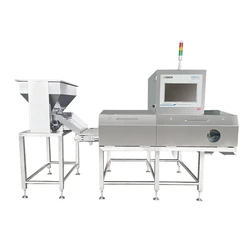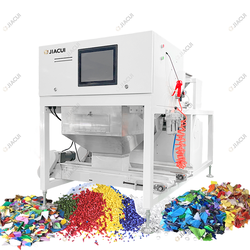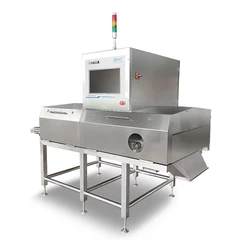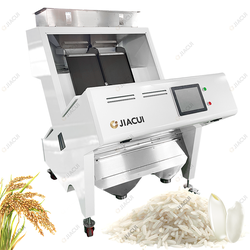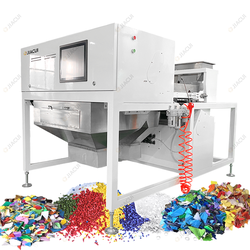


For a rice mill under 5 t/h, the best buy is a single- or double-chute sorter in the CS-1C80 to CS-2C160 range: US$6,000–12,000, roughly 5–8 kW, and enough capacity to hold a 2–4 t/h peak without a second pass. A 64-channel CS-1A64 only makes sense below about 1 t/h, and a belt machine is not a rice machine.
Small mills get sold the wrong machine more often than large ones, because the failure stays invisible. The sorter runs, the rice looks clean, and the mill still loses money on broken kernels, re-runs and air bills. This guide fixes the sizing question first, then covers power, installation, payback and the details worth writing into the order.
Channels are not tonnes
A channel is one stream of product with its own ejector, not a unit of throughput. Two machines with 128 channels can differ by 40% in capacity depending on chute width, camera resolution, valve speed and how aggressively the machine is tuned. On milled rice, a rough working figure is 15–20 kg per channel per hour at a normal reject rate, so 96 channels lands near 1.5–2 t/h and 160 channels near 2.5–3.2 t/h.
The number that matters is your peak intake hour, not your annual average. A mill that finishes 40 tonnes a day in two shifts is running 2.5 t/h on average but may take 3.5 t/h for two hours when trucks arrive together. Size for that peak, or the line stops exactly when the paddy is wet and waiting.
Single chute or double chute?
A single chute sends product down one set of chutes under one optical box. A double chute splits the flow into two independent chutes, usually with one set of cameras and two ejector banks. For a small mill the practical difference is floor space and flexibility: a double-chute unit gives 2–4 t/h in a footprint that still fits a 6 m bay, and it can run one chute during low season without wasting air.
Double chute is not automatically better. It costs more, needs more compressed air when both sides run, and needs a feed distributor that splits the product evenly, or one chute starves while the other floods. Below 1.5 t/h, a single chute with fewer channels is cheaper to buy, cheaper to run and easier to clean.
Models that actually fit under 5 t/h
| Model | Channels | Typical rice capacity | Price band (FOB China) |
|---|---|---|---|
| CS-1A64 | 64 | 0.8–1.2 t/h | Small chute band, from US$5,000 |
| CS-1C80 / CS-1C96 | 80 / 96 | 1.2–2.0 t/h | Small chute band, US$5,000–7,500 |
| CS-2A128 | 128 | 2.0–2.5 t/h | Mid chute band, from US$7,000 |
| CS-2C160 | 160 | 2.5–3.5 t/h | Mid chute band, US$7,000–12,000 |
Above 3.5 t/h sustained, move to a 192-channel CS-3A-192 rather than pushing a small machine past its tuning range. Overspeed is how mills end up with good colour accuracy and 8% broken kernels. Mills above that size should start from the rice mill sorter capacity, layout and payback guide.
Power, air and the installation nobody budgets for
Small chute sorters generally run on three-phase 380 V at 50 Hz, drawing about 2.5–4 kW for a 64–96 channel unit and 5–8 kW for a 128–160 channel unit. Add lighting, compressor and conveyors and the mill's supply needs headroom; a 15 kVA feed is a realistic minimum for a single-chute installation with its own compressor.
Compressed air is the hidden cost. Expect 0.6–0.8 MPa at the machine and a consumption that rises with reject rate, so a dryer and a receiver tank are not optional in humid climates. Plan 6–9 m² of floor for a single chute including access doors, 1 m clear above the machine for hopper and maintenance, and a door wide enough to move it in. Installation itself is one to two days once power and air are ready.
The payback, calculated on broken rice
Take a mill running 2.5 t/h for eight hours, 300 days, at 85% utilisation: about 5,100 tonnes of milled rice a year. If head rice sells at US$420/t and broken rice at US$300/t, every percentage point of head rice recovered is worth about US$6,100 a year on that volume, because 51 tonnes move from the broken bin to the head rice bin.
A sorter that recovers 1.5 points pays back a US$7,000–12,000 machine in roughly two to three years, before counting the value of removed stones, husk and discoloured grain, or the labour saved by not hand-picking. A 64-channel unit on the same duty rarely reaches that recovery, which is why buying the smallest machine is often the most expensive decision in the mill.
What to write into the order
- Peak tonnage per hour and the number of shifts, not the annual total.
- Paddy or milled rice, variety, and the defect list with target reject percentage.
- Chute count and whether one or both chutes must run independently.
- Destination voltage, frequency and phase, plus available air pressure and capacity.
- Floor plan with door width, ceiling height and lifting access.
- Spares kit: nozzles, filters, ejector valves and one optical window.
- Commissioning, operator training and the response time for service.
JIACUI has manufactured in Hefei since 2005, holds 21 patents and supports machines in more than 50 countries, which matters to a small mill mainly through spares availability and remote diagnostics rather than through the model list. Compare the full sorter range and the grain color sorter line before you fix the channel count, and read the rice sorter selection guide for the defect-by-defect view and the 2026 buying guide for the TCO model.
Frequently asked questions
How many channels do I need for 2 t/h of rice?
Around 96 to 128 channels on milled rice, provided the chute design and valve speed are current. A 96-channel single chute holds 1.5–2 t/h comfortably; a 128-channel machine gives headroom for a 2.5 t/h peak. Confirm with a sample test at your reject rate, because a dirty lot with 5% rejects needs more capacity than a clean one at 1%.
Can a small mill run a sorter on single-phase power?
Not normally. Color sorters use three-phase motors, compressors and ejector drivers, and the standard build is 380 V three-phase at 50 Hz, with other voltages available on order. If the mill only has single-phase supply, budget for a phase converter or a supply upgrade before the machine arrives, not after.
Is a used sorter a better deal for a small mill?
Sometimes, but price the risk. A used machine often needs new ejector valves, nozzles and an optical window, and its software may not hold recipes for your varieties. Ask for the valve count replaced, hours run, and whether spare parts are still produced. Without those answers, a cheap used unit can cost more than a new entry-level chute within two seasons.
How long is the payback on a small rice mill sorter?
Typically two to four years on a 2–3 t/h mill, driven by head rice recovery rather than by colour accuracy alone. At 5,000 tonnes a year, each percentage point of head rice moved out of the broken bin is worth roughly US$6,000 at a US$120/t grade gap. Mills with a high broken fraction pay back faster.
Budgeting for one? See the 2026 color sorter machine price ranges by type and capacity.