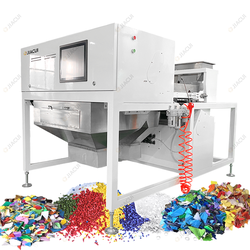


Plastic sorting is a different business from rice sorting. The material is lighter, the defects are often chemical rather than visual, and a machine that cannot see in the near-infrared will miss the most valuable separation in the plant: PVC out of PET. That is why the manufacturer list for plastics looks different from the grain list, and why buying on price alone is more dangerous here.
This is our 2026 list of the ten manufacturers that matter for plastic recycling sorters, ranked on plastic-specific product depth, published specifications, installed base in recycling plants, and service and spare-parts support. It is an editorial list, not a paid placement, and it is not a ranking of company revenue.
How this list was built
We looked for manufacturers that build sensor-based sorting as a core product, offer configurations for flakes, regrind or whole bottles, and publish enough technical detail to compare: sensor types, working width, throughput per metre, air consumption and ejector layout. Companies that only sell colour sorters rebadged for plastic, with no NIR option and no answer for black plastics, were not included.
One warning before the list: in plastics, the sensor set matters more than the brand. A visible-light-only machine can remove coloured flakes but cannot separate clear PET from clear PVC. If your goal is bottle-grade PET, NIR is not an upgrade, it is the requirement.
1. TOMRA (Norway)
TOMRA is the largest dedicated sensor-based sorting company in recycling and the default reference for plastic plants. Its sorting platforms combine visible and near-infrared sensors, and the company has deep application knowledge across PET bottle sorting, flake purification and mixed plastics.
The strength is the application library: TOMRA has seen more plastic streams than almost anyone, and its service network is global. The trade-off is price and the cost of proprietary parts and service contracts. For a plant that needs guaranteed recovery rates on bottle-grade PET, that premium is often justified; for a small flake line, it may be over-specified.
2. Steinert (Germany)
Steinert builds magnetic and sensor-based sorting for recycling and is strong where plastic sorting is part of a wider material recovery facility. Its optical platforms handle mixed plastics, films and flakes, and the company is known for robust mechanical design in dusty, high-throughput plants.
For a plant that also sorts metals and needs one supplier for the whole line, Steinert is a natural candidate. For a standalone flake sorter, a specialist may offer a simpler and cheaper configuration.
3. Pellenc ST (France)
Pellenc ST focuses on optical sorting for recycling, with visible and near-infrared platforms used in plastic packaging and flake sorting. The machines are common in European MRFs and in plants that need to meet tight output specifications for PET and HDPE.
The strength is sensor and software tuning for difficult streams, including thin films and similar-colour polymers. The trade-off is the same as with other European brands: capital cost and spare-parts logistics outside Europe.
4. Sesotec (Germany)
Sesotec builds sorting and separation systems for plastics processing, including flake purification units that remove metal and colour defects after washing. Its background is in plastics production rather than municipal recycling, which shows in the way the machines are specified for continuous extrusion feed.
For a recycling line that feeds a pellet mill or an injection plant, Sesotec's focus on downstream contamination is relevant. For mixed municipal plastics, a wider recycling platform may fit better.
5. MSS (United States)
MSS builds optical sorters for recycling in North America, with a range covering fibre, plastics and mixed containers. The company is known for rugged frames and for service responsiveness in the US market.
For a North American plant, local service and spare parts are a real advantage. Outside the region, the logistics of support become part of the evaluation.
6. Redwave (Austria)
Redwave, part of the BT-Wolfgang Binder group, builds sensor sorting systems for recycling, including plastic packaging and flakes. The company is strong in central Europe and in plants that need custom conveyor integration.
The engineering is solid and the systems are often delivered as part of a complete sorting line. Buyers outside Europe should confirm spare-parts lead time before committing.
7. Meyer Optoelectronic (China)
Meyer is the largest Chinese sorter manufacturer and offers plastic sorting machines alongside its grain range. Its advantage is scale: a wide model ladder, mature manufacturing and a large spare-parts operation.
In plastic, the key question is the sensor set. A Meyer machine specified with NIR and a proper belt feed can handle flake and regrind sorting well; a visible-light-only unit cannot replace PVC in a PET stream. Specify the sensor, not just the brand.
8. Anhui Zhongke Optic-Electronic (AMD, China)
AMD builds plastic sorters with visible and near-infrared options and competes directly with Meyer on specification and price. For a plant in Asia, Africa or Latin America, AMD is a common shortlist entry because the price-to-specification ratio is strong and the machines are built for export.
The caution is documentation: ask for the sensor configuration, working width, measured throughput on your flake size and the air consumption per hour. Compare those numbers, not the headline price.
9. Anhui Jiexun Optoelectronic (ANYSORT, China)
Anysort includes plastic among its core applications and offers chute and belt configurations for flakes and regrind. The company is known for a wide model range and for camera and AI claims aimed at difficult colour separations.
For plastic, the practical test is a sample run on your washed flake, with the target contamination specified. Ask for the carryover of good flake as well as the removal rate of the contaminant.
10. JIACUI Machinery (China)
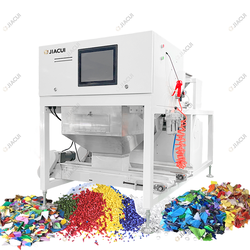
JIACUI builds chute and belt optical sorters, including belt platforms sized for plastic flakes and regrind. We are placing ourselves last on purpose: we do not have TOMRA's application library or Steinert's mechanical scale, and we are not the right supplier for every plant.
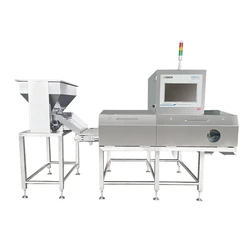
What we do offer is a belt platform with a working width from 300 mm to 1,800 mm, a transparent specification, and a sample test before payment. The plastic color sorter range lists the configurations, and the platform comparison explains when a belt machine beats a chute machine for flakes.
What is different about sorting plastic
NIR is the core sensor. Clear PET and clear PVC look identical to a colour camera. Near-infrared spectroscopy separates them by polymer type. If your output is bottle-grade flake, a visible-only sorter is a finishing tool, not the main separation step.
Black plastics are hard. Carbon black absorbs both visible and NIR light, so standard sensors cannot classify it. Newer black-plastic detection uses different wavelengths and is still priced at a premium. Confirm the claim with a sample test, not a datasheet.
Flake size changes everything. A machine tuned for 12 mm flake will behave differently on 6 mm regrind. Throughput per metre drops as particle size falls, and small flakes are harder to eject cleanly without losing good material.
Belt feed is often better. Flakes and films do not flow like rice. A belt spreads the material in a single layer, which improves camera exposure and ejection accuracy, at the cost of throughput per metre compared with a chute.
Dust and humidity. Washing lines leave moisture and fines. Air preparation and camera window cleaning are maintenance items that decide uptime more than the sensor resolution does.
Specification checklist before you compare prices
- Sensor set: visible only, visible + NIR, or multi-spectral; which polymers can it actually separate?
- Working width and throughput: tonnes per hour at your flake size, not the brochure maximum.
- Ejector count and valve type: how many valves per metre, and are they individually serviceable?
- Air consumption: m³/min at working pressure, and the compressor capacity it implies.
- Feed system: chute, belt or vibrating feeder; belt width and speed range.
- Outputs: how many ejector banks, and can the machine make two or three products in one pass?
- Spares: nozzle, filter, camera window and valve driver pricing and lead time.
- Test evidence: a report on your own flake, with recovery and purity numbers.
Price bands in 2026
Plastic sorters are usually priced by working width and sensor set. For planning, belt machines currently run about US$9,000-20,000 for 300-600 mm width and US$26,000-38,000 for 1,200-1,800 mm, while chute machines for flakes fall in the US$5,000-37,000 range depending on channels and sensors. NIR capability and black-plastic detection push a quote toward the top of its band. All figures are EXW China, excluding tax, freight, duty and installation. The price guide explains the variables.
What changed in 2026
Three changes matter for buyers. NIR sensors have become affordable on mid-range Chinese machines, which narrows the gap with European platforms for standard PET and HDPE jobs. AI classification is being used to handle dirty and overlapping flakes that used to be sent to landfill. And modular belt platforms have made it practical to start with one width and add capacity later, instead of buying an oversized line on day one.
At a glance: the ten plastic sorter manufacturers
| Manufacturer | Country | Main plastic application | Sensor focus | Price level |
|---|---|---|---|---|
| TOMRA | Norway | Bottle sorting, flake purification | VIS + NIR | Premium |
| Steinert | Germany | MRF mixed plastics | VIS + NIR | Premium |
| Pellenc ST | France | Packaging and flake | VIS + NIR | Premium |
| Sesotec | Germany | Flake purification for extrusion | VIS + metal | Upper mid |
| MSS | USA | Mixed containers and plastics | VIS + NIR | Upper mid |
| Redwave | Austria | Packaging and flakes in custom lines | VIS + NIR | Upper mid |
| Meyer | China | Flake and regrind | VIS, NIR optional | Value to mid |
| AMD | China | Flake and regrind | VIS, NIR optional | Value |
| Anysort | China | Flake and pellets | VIS, NIR optional | Value |
| JIACUI | China | Flake, regrind, belt platforms | VIS, NIR optional | Value |
Shortlist by sensor, not by logo. If you need PVC removal from PET, only the rows with NIR belong on your list. If you are removing coloured flakes from a single-polymer stream, a visible-only machine can do the job for less.
How to run a flake trial that means something
A plastic trial fails when the sample does not represent production. Five kilos of clean flake proves very little. Prepare a sample that matches what the machine will actually see.
- Use production flake, not hand-picked samples. Include fines, dust and the contamination you normally fight.
- Spike the sample. Add a known weight of the target contaminant, such as PVC or coloured flake, so recovery can be calculated rather than guessed.
- Ask for three numbers: contaminant removal rate, good-flake loss, and output purity. A supplier who reports only removal rate is hiding the cost.
- Run at production throughput. A trial at half the rated feed rate always looks better than the real line.
- Repeat with a second flake size if your line handles both bottle flake and regrind.
Ask for the raw weights, not just percentages. Percentages without a basis weight cannot be checked, and a serious supplier will keep the sample bags and the scale tickets.
Common buying mistakes in plastic sorting
Buying colour-only for a bottle-grade job. Clear PVC in clear PET is invisible to a colour camera. The machine will look fine in a demo with coloured flakes and fail on the one separation that matters.
Ignoring belt speed and singulation. Flakes must pass the camera in a single layer. A narrow belt run too fast is the most common reason a machine underperforms its datasheet.
Under-sizing air. Plastic lines run long shifts, and valves fire constantly. A compressor sized for average demand will starve the machine at peak contamination.
Forgetting the washing line. Residual moisture and fines on the flake change camera exposure and block valves. Dryer and filter capacity belong in the same budget as the sorter.
No plan for the reject stream. The reject from a plastic sorter is often valuable and can be re-sorted. Decide whether you need a second pass before you choose the machine, because it changes the specification.
Frequently asked questions
Can a colour sorter separate PET from PVC?
Not on colour alone. Clear PET and clear PVC look the same to a visible-light camera; you need NIR. Some machines combine visible and NIR sensors, which is the usual configuration for bottle-grade flake.
What throughput can I expect from a 600 mm belt sorter?
Roughly 0.8-1.5 t/h on washed PET flake, depending on flake size and contamination level. Smaller flake and heavier contamination reduce the figure; confirm with a test on your material.
Is a chute or belt machine better for plastic?
Belt is usually better for flakes, films and irregular shapes because the material is spread in a single layer. Chute machines are cheaper per tonne and work for free-flowing pellets and some regrind.
Can these machines sort black plastic?
Standard visible and NIR sensors cannot see carbon black. Black-plastic detection uses alternative wavelengths and costs more; ask for a sample test before you rely on the claim.
How much air does a plastic sorter need?
Typically 1.5-3 m³/min at 0.6-0.8 MPa for a mid-size belt machine, depending on valve count. Budget for a refrigerated dryer and filters; wet air will block valves.
Send 2-5 kg of your washed flake or regrind with the contamination you need to remove. We will return the sorted sample with recovery and purity figures, and a quotation for the belt or chute configuration that matches your line. Start from the plastic sorter range or the price guide.