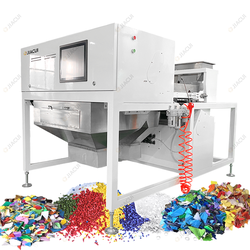


Rice is the most crowded corner of the color sorter market. Every major manufacturer builds a rice machine, most of them look alike in a brochure, and the price spread between two quotes for "a 10 t/h sorter" can still be three times. This list ranks the ten manufacturers that matter most for rice mills in 2026, based on four things a buyer can actually check: the depth of their rice-specific product range, whether they publish verifiable specifications, their installed base in rice-growing regions, and how they handle spare parts and service after the container leaves.
It is not a paid list and it is not a ranking of revenue. A Swiss or Japanese brand that dominates premium parboiled lines and a Hefei factory that ships 64-channel machines to village mills are answering different questions. Read the entry that matches your tonnage and your defect standard, then compare quotations line by line.
How this list was built
Three filters were applied. First, the company must manufacture optical sorters as a core product, not as one item in a catalogue of farm equipment. Second, it must have a rice configuration that is actually sold and supported, including chute options for paddy, brown rice, white rice and parboiled rice. Third, there must be enough public information to verify the claims in this article: model ranges, channel counts, capacity tables, certifications or published service networks.
Companies that only rebrand machines, or that publish no specifications at all, were left out. Price is discussed separately because it varies with configuration, not with the logo on the frame.
1. Satake Corporation (Japan)
Satake is the reference point for rice milling machinery, and its optical sorters are sold as part of a complete milling system rather than as a standalone box. For a mill that is buying a full line, from cleaning and de-stoning through hulling, whitening and polishing, Satake can supply the sorter with the rest of the process and take responsibility for the interface between machines.
The strength is process knowledge. Rice behaves differently at each stage, and a supplier that also builds the whitener and the polisher usually gets the sorter settings right faster. The trade-off is cost and commercial flexibility: a premium Japanese package is priced accordingly, and a small mill buying one machine may find the entry point high and the delivery schedule tied to the wider line.
Best fit: medium and large mills, parboiled and premium white rice lines, buyers who want one supplier for the whole process.
2. Bühler Group (Switzerland)
Bühler owns the SORTEX brand, which is the name many buyers still use for any optical sorter, the way some people call every photocopier a Xerox. SORTEX rice sorters are known for stable calibration, good documentation and a global service organisation, and they are common in export-oriented mills that need to defend a purity specification to a buyer.
The engineering is strong and the validation data is usually complete, which matters when a mill has to prove carryover to a customer. The trade-offs are price and the cost of proprietary spare parts. A Bühler machine is a long-term asset, not the cheapest way to add a second pass.
Best fit: export mills, large parboiled plants, buyers who value documentation and a global service footprint over the lowest capital cost.
3. Meyer Optoelectronic (China)
Meyer is the largest of the Hefei cluster and the Chinese brand most often compared directly with Japanese and Swiss machines. Its rice range covers small chute machines through high-capacity multi-chute units, and the company has invested heavily in camera and AI sorting claims in recent years.
For a rice mill, the appeal is a wide model ladder: you can buy a 64-channel machine for a farm mill and a 512-channel machine for an export line from the same supplier, with a shared spare-parts philosophy. The company also has a large domestic installed base, which means its service and calibration experience with parboiled rice is real.
The trade-off is that a big brand carries a brand premium, and the configuration behind a low headline price may be thinner than the brochure suggests. Ask for the valve count, camera count and measured carryover on your sample.
4. Anhui Zhongke Optic-Electronic (AMD, China)
AMD, often written as Anhui Zhongke, is a Hefei manufacturer with a broad sorter portfolio and a strong position in rice, seeds and grains. It competes with Meyer on specification and usually on price, and it is a common alternative in tenders where two or three Chinese quotes are compared.
Its rice machines cover the usual chute range, and the company supports multi-pass configurations for mills that want a first pass and a re-sort. Documentation is generally better than the average trading company, though not always as complete as Bühler or Satake. For a mill that needs a solid rice sorter without paying a European premium, AMD is a rational shortlist entry.
5. Anhui Jiexun Optoelectronic (ANYSORT, China)
Anysort is another Hefei-based original manufacturer, with rice as one of its core applications alongside tea, beans and plastics. The brand is known for a wide model range and for pushing camera resolution and AI defect classification in its marketing.
In rice, the practical question is not the camera headline but whether the machine holds its carryover on parboiled and glutinous rice, where defect contrast is low. Anysort machines are common in Chinese domestic mills and increasingly in Southeast Asian and African installations. Buyers should ask for a test on their own material and for the spare valve and nozzle list.
6. Hefei Taiho (TAIHO, China)
Taiho is one of the established Hefei sorter makers, with a rice range aimed at small and medium mills. Its positioning is practical: standard chute machines, straightforward controls, and a price that sits below the top Chinese brands.
For a mill that needs a dependable first sorter and does not need the newest AI feature set, Taiho is worth a quotation. The points to verify are the same as with any mid-market Chinese machine: valve brand and count, air consumption, warranty scope and whether spare boards are stocked for five years.
7. Wesort (China)
Wesort has built a visible online presence around rice, coffee, nuts and plastic sorting, and its machines are marketed heavily to export buyers. The range covers small chute units and larger multi-chute configurations, and the company publishes application pages per material.
The strength is accessibility for first-time importers: English documentation, online enquiries, and a product range that is easy to compare. The caution is the same one that applies to every export-focused brand: verify that you are dealing with the factory and not a trading layer, and confirm the exact configuration behind the quoted price.
8. Anhui Wenyao Intelligent Photoelectronic (China)
Wenyao is a Hefei manufacturer that has focused on export markets, with rice, grains, tea and plastic sorters in its range. The company is smaller than Meyer or AMD, which can mean more flexibility on configuration and a shorter path from enquiry to engineering answer.
For a mill buying one or two machines, that flexibility is useful: frame height, voltage, discharge layout and sample testing can usually be discussed directly. The trade-off is a smaller service footprint, so the spare-parts kit and remote support arrangements matter more than they would with a global brand.
9. Cimbria (Denmark)
Cimbria is a grain and seed processing group rather than a pure sorter brand, and its optical sorters are usually sold as part of seed cleaning and grain handling systems. For rice, that makes it most relevant to seed production and to mills that also handle other grains.
The engineering and documentation are solid, and the integration with conveyors, elevators and cleaners is a genuine advantage in a new plant. For a rice mill that only needs a sorter, a specialist manufacturer is usually simpler and cheaper.
10. JIACUI Machinery (China)
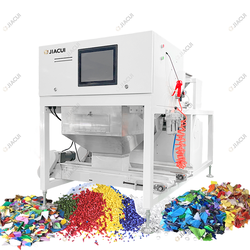
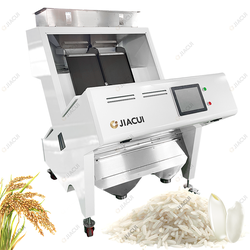
JIACUI is a Hefei manufacturer focused on chute and belt optical sorters for grains, nuts, tea, plastics and minerals. The rice range runs from 64-channel machines for farm mills to 512- and 768-channel units for export lines, with belt platforms for material that cannot free-fall.
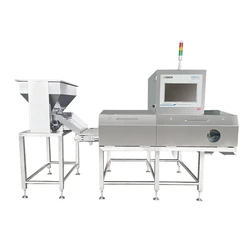
We are placing ourselves last on this list on purpose. We do not have the installed base of Satake or Bühler, and we are not the right answer for every tender. What we offer is a transparent specification, a sample test before you pay, and a price that reflects the configuration rather than the brand. The rice and grain sorter range lists the channel counts and capacities, and the price guide shows where each band sits.
Market structure: three tiers, three buying logics
Rice sorters sell in three tiers. The premium tier is Japanese and Swiss: Satake and Bühler, with strong process integration, global service and prices that reflect both. The second tier is the large Chinese brands: Meyer, AMD, Anysort and Taiho, which now cover most of the specification gap at a materially lower price. The third tier is the long tail of smaller Hefei factories and export traders, where the machine can be excellent value but the buyer has to do more verification.
The tiers are not fixed. A 256-channel Chinese machine with good valves and a proper air system will outperform a thinly specified European machine on a simple white rice job. What the premium tier still buys is certainty: documented performance, service response and resale credibility.
Rice-specific criteria that decide the result
Capacity matching. A rice mill should size the sorter at 1.1 to 1.2 times the upstream throughput, so the sorter is never the bottleneck. A 2 t/h mill needs roughly 160-192 channels; 5 t/h needs 256-320; 10 t/h needs 512 or two 256-channel machines.
Rice type. Parboiled and glutinous rice have lower defect contrast than white rice, so camera resolution, lighting and NIR options matter more. A machine tuned on white rice will not automatically perform on parboiled.
Carryover. The number that decides profitability is good-rice loss, not defect removal alone. Ask for measured carryover on your sample, not a brochure figure.
Air quality. Rice dust plus humid air is hard on valves. A refrigerated dryer and a three-stage filter are not optional in most mills, and a supplier who does not ask about your air supply has not thought about your uptime.
Spares. Valves, nozzles, filters and camera glass are consumables. Confirm the price and lead time before you sign, not after the first blockage.
Price ranges in 2026
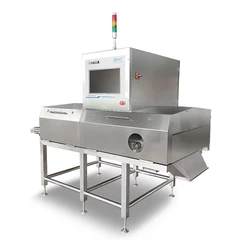
For planning, chute rice sorters currently fall in these EXW China bands: US$5,000-7,500 for 64-96 channels, US$7,000-12,000 for 160-192, US$12,000-16,500 for 256-320, US$17,000-24,000 for 384-448 and US$23,000-37,000 for 512-768. Belt platforms and X-ray units sit higher. These are machine prices, excluding tax, sea freight, duty and installation. The full price guide explains what moves a quote inside each band.
What changed in 2026
Three shifts are visible across the list. AI defect classification has moved from demo to production, mainly for chalky and lightly discoloured grains where colour thresholds alone are unreliable. NIR channels have become affordable on mid-range machines, which matters for parboiled rice and for plastic, not just for premium lines. And remote diagnostics over video call has become normal, which changes the service calculus for buyers far from any factory.
At a glance: the ten rice sorter manufacturers
| Manufacturer | Country | Type of rice work | Price level | Service reach |
|---|---|---|---|---|
| Satake | Japan | Full rice lines, parboiled and premium white | Premium | Global, mill-integrated |
| Bühler / SORTEX | Switzerland | Export-grade white and parboiled | Premium | Global |
| Meyer | China | Entry to 512-channel export lines | Mid to upper | Wide dealer network |
| AMD | China | Rice, seeds, multi-pass | Mid | Export service partners |
| Anysort | China | Rice, parboiled, glutinous | Mid | Growing export network |
| Taiho | China | Small and medium mills | Value | Factory-direct support |
| Wesort | China | Rice and multi-material | Value to mid | Export-focused |
| Wenyao | China | Rice, grains, small lines | Value | Factory-direct |
| Cimbria | Denmark | Seed and grain processing lines | Premium | Global, line-integrated |
| JIACUI | China | 64-768 channel rice and grain | Value to mid | Factory-direct, remote support |
Use the table to build a shortlist of three, then compare only those three on the same specification. A ten-supplier comparison always collapses into a choice between a premium, a mid-market and a value option.
Total cost of ownership, not purchase price
The purchase price is roughly half of what a sorter costs over five years. The rest is air and power, spares, downtime and the value of the rice lost in the reject stream.
Power and air. A 256-channel machine draws around 5-7 kW and needs 2-3 m³/min of clean air. If the mill has to add a compressor and dryer, that is a real cost and should be in the comparison. A machine that uses less air per tonne is worth more than its price difference suggests.
Spares. Ejector valves, nozzles, filters and camera glass are consumables. Ask for a five-year spares price list. A cheap machine with expensive proprietary valves can cost more than a mid-priced machine with standard parts.
Good-rice loss. Every percentage point of good rice sent to the reject stream is a recurring loss. At 5 t/h and 300 days, one percent of carryover is measured in tonnes per year. This is why a test report matters more than a brochure.
Downtime. A blocked valve or a failed board stops the line. Remote diagnostics and a stocked spare kit convert a two-day stop into a two-hour fix. For a mill running one shift, that is manageable; for a three-shift export plant, it is the difference between meeting a container date and missing it.
Frequently asked questions
Which rice color sorter brand is best?
There is no universal best. Satake and Bühler lead on process integration and documentation; Meyer, AMD, Anysort and Taiho cover most specifications at a lower price; smaller factories can be better value for one-off purchases. Match the machine to your tonnage and defect standard first.
How many channels do I need for my rice mill?
Roughly 160-192 channels for 2-5 t/h, 256-320 for 5-8 t/h, and 512 or two 256-channel machines for 10 t/h. Size at 1.1-1.2 times upstream throughput.
Is a Chinese rice sorter as good as a Japanese one?
On simple white rice jobs, a well-specified Chinese machine with good valves and air preparation can match the result at a lower price. The gap shows up in parboiled and premium export work, in documentation and in service response.
Should I buy one large sorter or two smaller ones?
Two machines give redundancy: if one stops, the mill keeps running at reduced capacity. One large machine is cheaper per tonne and simpler to install. Mills above 8 t/h usually prefer two units for uptime.
What sample should I send for a test?
2-5 kg of the rice you actually process, with a note on the defects you care about: chalky grains, yellow tips, paddy, stones or broken kernels. A supplier who will not test your sample is not a serious candidate.
Send 2-5 kg of your rice and we will return the sorted sample, the measured carryout and a quotation for the model that matches your tonnage. Start with the rice and grain sorter range, or read the mini rice sorter price guide if your volume is under 2 t/h.